



 Chat with AI
Exam 13: Investments and Long-Term Receivables

Exam 1: The Demand for and Supply of Financial Accounting Information89 Questions
Exam 2: Financial Reporting: Its Conceptual Framework87 Questions
Exam 3: Review of a Companys Accounting System146 Questions
Exam 4: The Balance Sheet and the Statement of Shareholders Equity112 Questions
Exam 5: The Income Statement and the Statement of Cash Flows151 Questions
Exam 6: Cash and Receivables149 Questions
Exam 7: Inventories: Cost Measurement and Flow Assumptions123 Questions
Exam 8: Inventories: Special Valuation Issues148 Questions
Exam 9: Current Liabilities and Contingencies128 Questions
Exam 10: Property, Plant, and Equipment: Acquisition and Subsequent Investments105 Questions
Exam 11: Depreciation, Depletion, Impairment, and Disposal143 Questions
Exam 12: Intangibles105 Questions
Exam 13: Investments and Long-Term Receivables140 Questions
Exam 14: Financing Liabilities: Bonds and Notes Payable171 Questions
Exam 15: Contributed Capital154 Questions
Exam 16: Retained Earnings and Earnings Per Share111 Questions
Exam 17: Advanced Issues in Revenue Recognition113 Questions
Exam 18: Accounting for Income Taxes108 Questions
Exam 19: Accounting for Postretirement Benefits98 Questions
Exam 20: Accounting for Leases149 Questions
Exam 21: The Statement of Cash Flows107 Questions
Exam 22: Accounting for Changes and Errors130 Questions
Exam 23: Time Value of Money Module121 Questions
Select questions type


Exhibit 13-03 On January 1, 2014, Train, Inc. accepts an $80,000, non-interest bearing 3 year note in exchange for equipment it sold to Steam Company. Train originally purchased the equipment for $125,000 and had a book value of $75,000 on the date of the sale. The note was non-interest-bearing. An assumed 11% interest rate is implicit in the agreement. Actual information for 11%, three periods, follows:  -Refer to Exhibit 13-03. What amount would Train record as interest income on December 31, 2014?
 (Multiple Choice)
4.9/5  (78)
(78) At December 31, 2014, Isotope Co. held the following investments in stock that are classified as available-for-sale securities. All investments were acquired in December 2014.  Changes in fair value were considered to be temporary. On March 1, 2015, half of the B Company stock was sold for $650. Isotope Co. acquired additional security C stock during 2015. At December 31, 2015, the following investments in stock were held by Isotope:
 Changes in fair value again were considered to be temporary.
Required:
Prepare journal entries for
a.December 31, 2014
b.March 1, 2015
c.December 31, 2015
Changes in fair value were considered to be temporary. On March 1, 2015, half of the B Company stock was sold for $650. Isotope Co. acquired additional security C stock during 2015. At December 31, 2015, the following investments in stock were held by Isotope:
Changes in fair value again were considered to be temporary.
Required:
Prepare journal entries for
a.December 31, 2014
b.March 1, 2015
c.December 31, 2015 (Essay)
4.9/5 (77)
(77) On January 6, 2014, Michael Company acquired 4,000 shares (or 10%) of George Corporation's common stock at $25 per share. The securities are classified as available-for-sale investments. On October 24, 2014, George declared and paid a cash dividend of $1 per share. On December 31, 2014, the market value of George's common stock was $35 per share. George also reported a net income of $250,000 for 2014. At what value should Michael report the investment in George's common stock on its December 31, 2014 balance sheet?
(Multiple Choice)
5.0/5 (84)
(84) On January 3, 2014, Nancy Corporation purchased the following equity securities as an investment:  These securities are classified as available-for-sale.
Required:
a.Prepare the journal entry to record the acquisition of the stock.
b.On June 30, 2014, C Company paid dividends of $3.00 per share. Prepare the journal entry that would be used by Nancy to record the dividend receipt.
c.On December 31, 2014, the market values per share were:
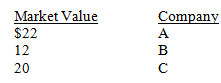 Prepare any journal entry or entries necessary to record these changes in market value.
On March 14, 2015, Nancy sold 800 shares of C Company for $18 per share. Prepare the journal entry to record the sale.
These securities are classified as available-for-sale.
Required:
a.Prepare the journal entry to record the acquisition of the stock.
b.On June 30, 2014, C Company paid dividends of $3.00 per share. Prepare the journal entry that would be used by Nancy to record the dividend receipt.
c.On December 31, 2014, the market values per share were:
Prepare any journal entry or entries necessary to record these changes in market value.
On March 14, 2015, Nancy sold 800 shares of C Company for $18 per share. Prepare the journal entry to record the sale.
(Essay)
4.7/5 (72)
(72) Investments in equity securities include all of the following except
(Multiple Choice)
4.8/5 (85)
(85) Each of the three categories of investments in debt and equity securities has similar accounting for all of the following transactions except
(Multiple Choice)
4.8/5 (87)
(87) On July 1, 2015, Jason Company purchased $60,000 of ten-year 6% bonds of Santo, Inc., for $51,850, to be held-to-maturity. Interest is payable semiannually on June 30 and December 31. The effective yield on the investment is 8%. What amount of interest income should Jason record for the six-month period ended December 31, 2015?
(Multiple Choice)
4.9/5 (76)
(76) In a perfectly matched hedge of fixed-rate debt using an interest rate swap, the effect of a change in fair value of the derivative on the income statement
(Multiple Choice)
4.7/5 (80)
(80) Exhibit 13-03 On January 1, 2014, Train, Inc. accepts an $80,000, non-interest bearing 3 year note in exchange for equipment it sold to Steam Company. Train originally purchased the equipment for $125,000 and had a book value of $75,000 on the date of the sale. The note was non-interest-bearing. An assumed 11% interest rate is implicit in the agreement. Actual information for 11%, three periods, follows:
-Refer to Exhibit 13-03. What amount should Train record for the discount on Notes Receivable?
-Refer to Exhibit 13-03. What amount should Train record for the discount on Notes Receivable? (Multiple Choice)
4.8/5 (72)
(72) Reagan Company purchased 10,000 shares of Clinton's Company at $45 per share plus $15,000 of Delta Company's 12% bonds, acquired at par, as an available-for-sale securities. The bond pays interest on June 30 and December 31 each year. What amount should be recorded to the Investment in Available-for-Sale Securities account?
(Multiple Choice)
4.8/5 (83)
(83) Texas Company has a $4,000,000, 8% bank loan from James Bank. On January 1, 2014, the bank loan has three years to maturity. Texas enters into a three-year interest rate swap with Black and White Investments with a $4 million notional. The agreement calls for Texas to receive a fixed interest rate of 8% and pay a variable rate based on LIBOR at the beginning of the year. Payments are to be made for the net amount at each year-end. At the beginning of 2014, the LIBOR rate is 7.5%. The three-year fixed rate at the end of 2014 is 9%.
Required:
Prepare the journal entries for Texas relating to the bank loan and derivative for 2014.
(Essay)
4.8/5 (78)
(78) On January 1, 2014, Lightner bought 20,000 shares (5% ownership) of Winter Corp. common stock for $360,000. On May 3, 2014, Winter declared and distributed a 50% stock dividend. On September 1, 2014, Lightner sold 2,000 shares of its investment in Winter stock for $21,400.
Required:
Compute the amount of gain (loss) on the sale of this stock.
(Essay)
4.7/5 (83)
(83) Ringer Company acquired 40% of the outstanding stock of the Leopard Company for $370,000 on January 1, 2014. The purchase price equaled 40% of the book value of Leopard Company. During 2014, the following information is available for Leopard:
 Required:
Prepare the journal entries necessary by Ringer to reflect the preceding information.
Required:
Prepare the journal entries necessary by Ringer to reflect the preceding information. (Essay)
4.8/5 (70)
(70) What are the four components necessary to account for investments in held-to-maturity debt securities?
(Essay)
4.8/5 (69)
(69) In order to classify an investment as held-to-maturity the company has to have the ability and the intent to hold the investment until it matures.
(True/False)
5.0/5 (82)
(82) An interest rate swap in which a company has a fixed rate of interest and pays a variable rate is called a
(Multiple Choice)
4.8/5 (66)
(66) Exhibit 13-2 On January 1, 2014, the Cluzt Company purchased 30% of the 1,000,000 shares of Nancy's common stock for $15,000,000 when 30% of Nancy's net assets totaled $12,000,000. The excess purchase price over the underlying assets was attributable to undervalued depreciable plant assets with a remaining useful life of ten years. Nancy reported net income of $8,000,000 and paid cash dividends of $2,000,000 during 2014.
-Refer to Exhibit 13-2. The investment in Nancy Company stock should be reported on Clutz's December 31, 2014, balance sheet at
(Multiple Choice)
4.8/5 (84)
(84) On January 1, 2015, Fargo Company purchased 30% of the common stock of Fairly Company for $80,000. The purchase was made at book value. Additional information for Fairly Company follows:  On Fargo's books, what would be the balance of Investment in Fairly Company at December 31, 2016?
 (Multiple Choice)
4.8/5 (69)
(69) Under U.S. GAAP investments are classified into three categories based upon management's intent, IFRS divides investments into three classifications as well but they based on the business model for managing financial assets and the characteristic of the cash flows of the financial asset.
(True/False)
4.9/5 (79)
(79) 
Filters
- Essay(0)
- Multiple Choice(0)
- Short Answer(0)
- True False(0)
- Matching(0)