



 Chat with AI
Exam 11: Sleep and Waking

Exam 1: Introducing Biological Psychology179 Questions
Exam 2: The Anatomy and Evolution of the Nervous System198 Questions
Exam 3: Cells of the Nervous System184 Questions
Exam 4: Psychopharmacology191 Questions
Exam 5: Genetics and the Development of the Human Brain179 Questions
Exam 6: Vision187 Questions
Exam 7: Nonvisual Sensation and Perception184 Questions
Exam 8: Movement182 Questions
Exam 9: Temperature Regulation,thirst,and Hunger181 Questions
Exam 10: Sexual Behavior177 Questions
Exam 11: Sleep and Waking173 Questions
Exam 12: Learning and Memory179 Questions
Exam 13: Lateralization, language, and Intelligence182 Questions
Exam 14: Emotion, reward, aggression, and Stress183 Questions
Exam 15: Neurological Disorders174 Questions
Exam 16: Psychological Disorders198 Questions
Select questions type


Cholinergic activity is high during wakefulness and REM sleep,but lower during NREM sleep.
(True/False)
4.7/5  (77)
(77) Memory deficits occur after both REM sleep deprivation and NREM sleep deprivation.
(True/False)
4.8/5 (84)
(84) People with major depressive disorder enter REM sleep too early in the night,and spend more time in REM than people who are not depressed.This symptom is probably due to the
(Multiple Choice)
4.9/5 (79)
(79) 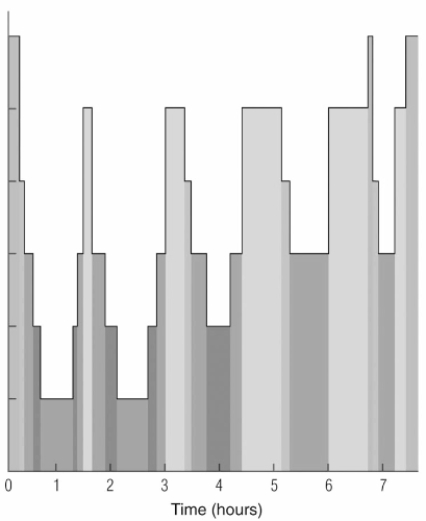 According to this illustration,most episodes of REM sleep follow an episode of Stage ____________________ NREM sleep and are followed by ____________________ or an episode of Stage ____________________ NREM.
 (Short Answer)
4.8/5 (70)
(70) The emotional quality of our dreams is most likely a result of the _________ during REM sleep
(Multiple Choice)
4.9/5 (77)
(77) The suprachiasmatic nucleus (SCN)is active during the daytime in diurnal animals,like humans,but is active during the night in nocturnal animals,like rodents.
(True/False)
4.9/5 (76)
(76) 
Filters
- Essay(0)
- Multiple Choice(0)
- Short Answer(0)
- True False(0)
- Matching(0)