



 Chat with AI
Exam 7: Consolidated Financial Statements - Ownership Patterns and Income Taxes

Exam 1: The Equity Method of Accounting for Investments119 Questions
Exam 2: Consolidation of Financial Information107 Questions
Exam 3: Consolidations - Subsequent to the Date of Acquisition122 Questions
Exam 4: Consolidated Financial Statements and Outside Ownership116 Questions
Exam 5: Consolidated Financial Statements Intra-Entity Asset Transactions127 Questions
Exam 6: Variable Interest Entities, Intra-Entity Debt, Consolidated Cash Flows, and Other Issues115 Questions
Exam 7: Consolidated Financial Statements - Ownership Patterns and Income Taxes115 Questions
Exam 8: Segment and Interim Reporting116 Questions
Exam 9: Foreign Currency Transactions and Hedging Foreign Exchange Risk93 Questions
Exam 10: Translation of Foreign Currency Financial Statements97 Questions
Exam 11: Worldwide Accounting Diversity and International Accounting Standards60 Questions
Exam 12: Financial Reporting and the Securities and Exchange Commission77 Questions
Exam 13: Accounting for Legal Reorganizations and Liquidations83 Questions
Exam 14: Partnerships: Formation and Operation88 Questions
Exam 15: Partnerships: Termination and Liquidation73 Questions
Exam 16: Accounting for State and Local Governments78 Questions
Exam 17: Accounting for State and Local Governments49 Questions
Exam 18: Accounting and Reporting for Private Not-For-Profit Organizations62 Questions
Exam 19: Accounting for Estates and Trusts80 Questions
Select questions type


Chase Company owns 80% of Lawrence Company and 40% of Ross Company. Lawrence Company also owns 30% of Ross Company. Separate operating incomes for 2013 of Chase, Lawrence, and Ross are $450,000, $300,000, and $250,000, respectively. Each company also retains a $20,000 unrealized gain in their current income figures. Annual amortization expense of $15,000 is assigned to Chase's investment in Lawrence and another $15,000 is assigned to Lawrence's investment in Ross.
Compute Lawrence's accrual-based income for 2013.
(Multiple Choice)
4.8/5  (69)
(69) Prescott Corp. owned 90% of Bell Inc., while Bell owned 10% of the outstanding common shares of Prescott. No goodwill or other allocations were recognized in connection with either of these acquisitions. Prescott reported operating income of $266,000 for 2013 whereas Bell earned $98,000 during the same period. No investment income was included within either of these income totals. How would the 10% investment in Prescott owned by Bell be presented in the consolidated balance sheet?
(Multiple Choice)
4.8/5 (80)
(80) Why might a consolidated group file separate income tax returns?
(Multiple Choice)
4.9/5 (78)
(78) Gamma Co. owns 80% of Delta Corp., and Delta Corp. owns 15% of Gamma Co. The two companies use the treasury stock approach to account for mutual ownership. How should Delta Corp.'s ownership interest in Gamma Co. be accounted for in the consolidation?
(Essay)
4.8/5 (87)
(87) River Co. owned 80% of Boat Inc. The two companies filed a consolidated income tax return and River used the initial value method to account for the investment. The following information was available from the two companies' financial statements:  Operating income included net unrealized gains, which are associated with transfers of inventories between the two companies, but it did not include dividends received from a subsidiary. The income tax rate was 30%.
What was the amount of income tax expense that should have been assigned to Boat using the separate return method?
Operating income included net unrealized gains, which are associated with transfers of inventories between the two companies, but it did not include dividends received from a subsidiary. The income tax rate was 30%.
What was the amount of income tax expense that should have been assigned to Boat using the separate return method? (Multiple Choice)
4.9/5 (77)
(77) Tate, Inc. owns 80 percent of Jeffrey, Inc. During the current year, Jeffrey sold merchandise costing $60,000 to Tate for $75,000. At the end of the year, 10 percent of this merchandise was still being held. The tax rate is 30 percent.
Assuming that a consolidated income tax return is being filed, what deferred income tax asset is created?
(Multiple Choice)
4.8/5 (67)
(67) Wilkins Inc. owned 60% of Motumbo Co. During the current year, Motumbo reported net income of $280,000 but paid a total cash dividend of only $56,000.
Required:
Assuming an income tax rate of 30%, what amount of Deferred Income Tax Liability arising this year must be recognized in the consolidated balance sheet?
(Essay)
4.9/5 (79)
(79) White Company owns 60% of Cody Company. Separate tax returns are required. For 2012, White's operating income (excluding taxes and any income from Cody) was $300,000 while Cody reported a pretax income of $125,000. During the period, Cody paid a total of $25,000 in cash dividends; $15,000 (60%) to White and $10,000 to the non-controlling interest. White paid dividends of $180,000. The income tax rate for both companies is 30%.
Compute White's deferred income taxes for 2013.
(Multiple Choice)
4.8/5 (71)
(71) Which of the following conditions will allow two companies to file a consolidated income tax return?
(Multiple Choice)
5.0/5 (81)
(81) Chase Company owns 80% of Lawrence Company and 40% of Ross Company. Lawrence Company also owns 30% of Ross Company. Separate operating incomes for 2013 of Chase, Lawrence, and Ross are $450,000, $300,000, and $250,000, respectively. Each company also retains a $20,000 unrealized gain in their current income figures. Annual amortization expense of $15,000 is assigned to Chase's investment in Lawrence and another $15,000 is assigned to Lawrence's investment in Ross.
Compute Chase's accrual-based income for 2013.
(Multiple Choice)
4.8/5 (71)
(71) Which of the following statements is true regarding the filing of income taxes for an affiliated group?
(Multiple Choice)
4.7/5 (76)
(76) Dog Corporation acquires all of Cat, Inc. for $400,000 cash. On that date, Cat has net assets with fair value of $350,000 but a book value and tax basis of $325,000. The tax rate is 30 percent. Prior to this date, neither Dog nor Cat has reported any deferred income tax assets or liabilities. What amount of goodwill should be recognized on the date of the acquisition?
(Multiple Choice)
5.0/5 (67)
(67) Alpha Corporation owns 100 percent of Beta Company, and Beta owns 80 percent of Gamma, Inc. all of which are domestic corporations. Information for the three companies for the year ending December 31, 2013 follows:  What is the non-controlling interest in Gamma's income for 2013?
 (Multiple Choice)
4.9/5 (70)
(70) On January 1, 2012, Jones Company bought 15% of Whitton Company. Jones paid $150,000 for these shares, an amount that exactly equaled the proportionate book value of Whitton. On January 1, 2013, Whitton acquired 80% ownership of Jones. The following data are available concerning Whitton's acquisition of Jones:  Excess fair value over book value (assigned to trademarks) is amortized over 20 years.
The initial value method is used by both companies.
The following information is available regarding Jones and Whitton:
 What would be included in a consolidation worksheet entry for 2013?
Excess fair value over book value (assigned to trademarks) is amortized over 20 years.
The initial value method is used by both companies.
The following information is available regarding Jones and Whitton:
What would be included in a consolidation worksheet entry for 2013? (Multiple Choice)
4.7/5 (76)
(76) Hardford Corp. held 80% of Inglestone Inc. which, in turn, owned 80% of Jade Co. Operating income figures (without investment income) as well as unrealized upstream gains included in the income for the current year follow:  The accrual-based income of Jade Co. is calculated to be
 (Multiple Choice)
4.8/5 (81)
(81) On January 1, 2012, Mace Co. acquired 75% of Lance Co.'s outstanding common stock. On the same date, Lance acquired an 80% interest in Curle Co. Both of these investments were acquired when book value was equal to fair value of identifiable net assets acquired. Both of these investments were accounted using the initial value method. No dividends were distributed by either Lance or Curle during 2012 or 2013. Mace paid cash dividends each year equal to 40% of operating income. Reported operating income totals for 2012 were as follows: 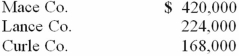 Following are the 2013 financial statements for these three companies. Curle made numerous transfers of inventory to Lance since the takeover: $112,000 (2012) and $140,000 (2013). These transactions included the same markup applicable to Curle's outside sales. In each of these years, Lance carried 20% of this inventory into the succeeding year before disposing of it.
An effective income tax rate of 45% was applicable to all companies.
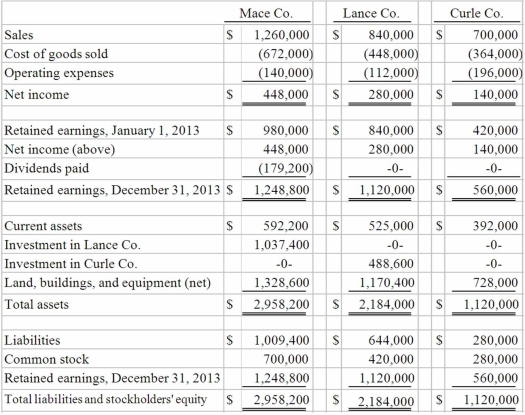 Required:
Determine the accrual-based income of Mace Co. for the year 2013.
Following are the 2013 financial statements for these three companies. Curle made numerous transfers of inventory to Lance since the takeover: $112,000 (2012) and $140,000 (2013). These transactions included the same markup applicable to Curle's outside sales. In each of these years, Lance carried 20% of this inventory into the succeeding year before disposing of it.
An effective income tax rate of 45% was applicable to all companies.
Required:
Determine the accrual-based income of Mace Co. for the year 2013. (Essay)
4.8/5 (87)
(87) Jull Corp. owned 80% of Solaver Co. Solaver paid $250,000 for 10% of Jull's common stock. In 2013, Jull and Solaver reported operating income (not including income from the investment) of $300,000 and $80,000, respectively. Jull and Solaver paid dividends of $120,000 and $50,000, respectively.
Required:
Under the treasury stock approach, what is the non-controlling interest in Solaver Co.'s net income?
(Essay)
4.8/5 (66)
(66) On January 1, 2013, a subsidiary buys 8 percent of the outstanding voting stock of its parent corporation. The payment of $350,000 exceeded book value of the acquired shares by $50,000, attributable to a copyright with a 10-year useful life. During the year, the parent reported operating income of $675,000 (excluding investment income from the subsidiary), and paid $100,000 in dividends. If the treasury stock approach is used, how is the Investment in Parent Stock reported in the consolidated balance sheet at December 31, 2013?
(Multiple Choice)
5.0/5 (85)
(85) Reggie, Inc. owns 70 percent of Nancy Corporation. During the current year, Nancy reported earnings before tax of $100,000 and paid a dividend of $30,000. The income tax rate for both companies is 30 percent. What deferred income tax liability arising in the current year must be recognized in the consolidated balance sheet?
(Multiple Choice)
4.9/5 (84)
(84) Dotes, Inc. owns 40% of Abner Co. Dotes accounts for its investment using the equity method. Abner follows a policy of paying dividends equal to 30% of its income each year. During the current year, Abner reported net income of $216,000. Dotes has an effective income tax rate of 32%.
Required:
What journal entry would Dotes record at the end of the current year for income taxes relating to the investment in Abner? Assume the investment is to be held for an indefinite time and that all amounts are to be rounded to the nearest dollar.
(Essay)
4.9/5 (83)
(83) 
Filters
- Essay(0)
- Multiple Choice(0)
- Short Answer(0)
- True False(0)
- Matching(0)