



 Chat with AI
Exam 7: Consolidated Financial Statements - Ownership Patterns and Income Taxes

Exam 1: The Equity Method of Accounting for Investments119 Questions
Exam 2: Consolidation of Financial Information107 Questions
Exam 3: Consolidations - Subsequent to the Date of Acquisition122 Questions
Exam 4: Consolidated Financial Statements and Outside Ownership116 Questions
Exam 5: Consolidated Financial Statements Intra-Entity Asset Transactions127 Questions
Exam 6: Variable Interest Entities, Intra-Entity Debt, Consolidated Cash Flows, and Other Issues115 Questions
Exam 7: Consolidated Financial Statements - Ownership Patterns and Income Taxes115 Questions
Exam 8: Segment and Interim Reporting116 Questions
Exam 9: Foreign Currency Transactions and Hedging Foreign Exchange Risk93 Questions
Exam 10: Translation of Foreign Currency Financial Statements97 Questions
Exam 11: Worldwide Accounting Diversity and International Accounting Standards60 Questions
Exam 12: Financial Reporting and the Securities and Exchange Commission77 Questions
Exam 13: Accounting for Legal Reorganizations and Liquidations83 Questions
Exam 14: Partnerships: Formation and Operation88 Questions
Exam 15: Partnerships: Termination and Liquidation73 Questions
Exam 16: Accounting for State and Local Governments78 Questions
Exam 17: Accounting for State and Local Governments49 Questions
Exam 18: Accounting and Reporting for Private Not-For-Profit Organizations62 Questions
Exam 19: Accounting for Estates and Trusts80 Questions
Select questions type


Which of the following statements is false concerning a father-son-grandson configuration?
(Multiple Choice)
4.8/5  (82)
(82) Delta Corporation owns 90 percent of Sigma Company, and Sigma owns 90 percent of Pi, Inc. all of which are domestic corporations. Information for the three companies for the year ending December 31, 2013 follows:  What is Sigma's accrual-based income for 2013?
 (Multiple Choice)
4.8/5 (81)
(81) Tower Company owns 85% of Hill Company. The two companies engaged in several intra-entity transactions. Each company's operating and dividend income for the current time period follow, as well as the effects of unrealized gains. No income tax accruals have been recognized within these totals. The tax rate for each company is 30%.  Compute accrual-based consolidated net income.
 (Multiple Choice)
4.8/5 (80)
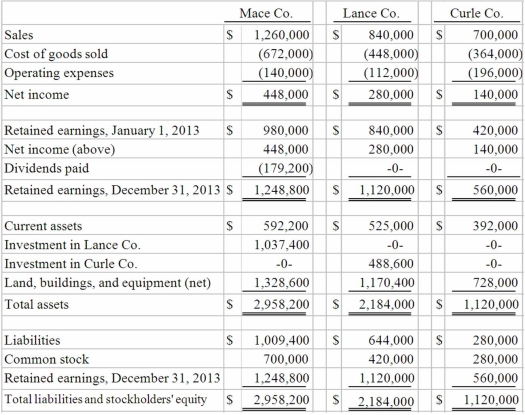
(80) On January 1, 2012, Mace Co. acquired 75% of Lance Co.'s outstanding common stock. On the same date, Lance acquired an 80% interest in Curle Co. Both of these investments were acquired when book value was equal to fair value of identifiable net assets acquired. Both of these investments were accounted using the initial value method. No dividends were distributed by either Lance or Curle during 2012 or 2013. Mace paid cash dividends each year equal to 40% of operating income. Reported operating income totals for 2012 were as follows: 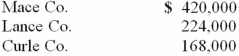 Following are the 2013 financial statements for these three companies. Curle made numerous transfers of inventory to Lance since the takeover: $112,000 (2012) and $140,000 (2013). These transactions included the same markup applicable to Curle's outside sales. In each of these years, Lance carried 20% of this inventory into the succeeding year before disposing of it.
An effective income tax rate of 45% was applicable to all companies.
 Required:
Determine the non-controlling interest in Lace Co.'s net income for the year 2013.
Following are the 2013 financial statements for these three companies. Curle made numerous transfers of inventory to Lance since the takeover: $112,000 (2012) and $140,000 (2013). These transactions included the same markup applicable to Curle's outside sales. In each of these years, Lance carried 20% of this inventory into the succeeding year before disposing of it.
An effective income tax rate of 45% was applicable to all companies.
Required:
Determine the non-controlling interest in Lace Co.'s net income for the year 2013. (Essay)
4.8/5 (77)
(77) Beagle Co. owned 80% of Maroon Corp. Maroon owned 90% of Eckston Inc. Operating income totals for 2013 are shown below; these figures contained no investment income. Amortization expense was not required by any of these acquisitions. Included in Eckston's operating income was a $56,000 unrealized gain on intra-entity transfers to Maroon.  The accrual-based income of Eckston Inc. is calculated to be
 (Multiple Choice)
5.0/5 (68)
(68) West Corp. owned 70% of the voting common stock of East Co. East owned 60% of Compass Co. West and East both used the initial value method to account for their investments. The following information was available from the financial statements and records of the three companies:  Operating income included unrealized intra-entity gains (which are related to inventory transfers) but did not include dividend income from investment in subsidiary.
The accrual-based income of West Corp. is calculated to be
Operating income included unrealized intra-entity gains (which are related to inventory transfers) but did not include dividend income from investment in subsidiary.
The accrual-based income of West Corp. is calculated to be (Multiple Choice)
4.7/5 (72)
(72) X Co. owned 80% of Y Corp., and Y Corp. owned 15% of X Co. Under the treasury stock approach, how would the dividends paid by X Co. to Y Corp. be handled on a consolidation worksheet?
(Essay)
4.8/5 (74)
(74) Which of the following statements is true regarding a subsidiary's investment in the parent company's stock?
(Multiple Choice)
4.9/5 (78)
(78) C Co. currently owns 80% of D Co. and several other subsidiaries. C Co. is interested in gaining control of H Co. Why might C Co. allow D Co. to acquire H Co., rather than purchasing H Co. directly?
(Essay)
4.8/5 (72)
(72) Alpha Corporation owns 100 percent of Beta Company, and Beta owns 80 percent of Gamma, Inc. all of which are domestic corporations. Information for the three companies for the year ending December 31, 2013 follows:  What is Gamma's accrual-based income for 2013?
 (Multiple Choice)
5.0/5 (81)
(81) Delta Corporation owns 90 percent of Sigma Company, and Sigma owns 90 percent of Pi, Inc. all of which are domestic corporations. Information for the three companies for the year ending December 31, 2013 follows:  What is the non-controlling interest in Sigma's income for 2013?
 (Multiple Choice)
4.9/5 (83)
(83) On January 1, 2013, a subsidiary buys 12 percent of the outstanding voting stock of its parent corporation. The payment of $400,000 exceeded book value of the acquired shares by $80,000, attributable to a copyright with a 10-year useful life. During the year, the parent reported operating income of $1,000,000 (excluding investment income from the subsidiary), and paid $120,000 in dividends. If the treasury stock approach is used, how is the Investment in Parent Stock reported in the consolidated balance sheet at December 31, 2013?
(Multiple Choice)
4.9/5 (82)
(82) Kurton Inc. owned 90% of Luvyn Corp.'s voting common stock. The consideration paid exceeded book value by $110,000. Of this amount, one half is attributable to a patent and is to be amortized over 5 years. Luvyn held 20% of Kurton's voting common stock which cost $28,000 more than fair value.
During the current year, Kurton reported operating income of $224,000 and dividend income from Luvyn of $37,800. At the same time, Luvyn reported operating income of $70,000 and dividend income from Kurton of $19,600.
Required:
Using the treasury stock approach, prepare a schedule to show what is reported as the non-controlling interest in Luvyn Corp.'s net income.
(Essay)
4.8/5 (81)
(81) Paris, Inc. owns 80 percent of the voting stock of Stance, Inc. The excess total fair value over book value was $75,000. Stance holds 10 percent of the voting stock of Paris. The payment for that investment was in excess of book value and fair value by $15,000. Any excess fair value is assigned to trademarks to be amortized over a 10-year period. During the current year, Paris reported operating income of $200,000 and dividend income from Stance of $20,000. At the same time, Stance reported operating income of $40,000 and dividend income from Paris of $5,000.
What will be reported as the non-controlling interest in Stance's net income?
(Multiple Choice)
4.7/5 (75)
(75) Chase Company owns 80% of Lawrence Company and 40% of Ross Company. Lawrence Company also owns 30% of Ross Company. Separate operating incomes for 2013 of Chase, Lawrence, and Ross are $450,000, $300,000, and $250,000, respectively. Each company also retains a $20,000 unrealized gain in their current income figures. Annual amortization expense of $15,000 is assigned to Chase's investment in Lawrence and another $15,000 is assigned to Lawrence's investment in Ross.
Compute the non-controlling interest in Ross' net income for 2013.
(Multiple Choice)
4.9/5 (85)
(85) On January 1, 2012, Jones Company bought 15% of Whitton Company. Jones paid $150,000 for these shares, an amount that exactly equaled the proportionate book value of Whitton. On January 1, 2013, Whitton acquired 80% ownership of Jones. The following data are available concerning Whitton's acquisition of Jones:  Excess fair value over book value (assigned to trademarks) is amortized over 20 years.
The initial value method is used by both companies.
The following information is available regarding Jones and Whitton:
 Compute the amount allocated to trademarks recognized in the January 1, 2013 consolidated balance sheet.
Excess fair value over book value (assigned to trademarks) is amortized over 20 years.
The initial value method is used by both companies.
The following information is available regarding Jones and Whitton:
Compute the amount allocated to trademarks recognized in the January 1, 2013 consolidated balance sheet. (Multiple Choice)
4.7/5 (71)
(71) Britain Corporation acquires all of English, Inc. for $800,000 cash. On that date, English has net assets with fair value of $750,000 but a book value and tax basis of $500,000. The tax rate is 35 percent. Prior to this date, neither Britain nor English has reported any deferred income tax assets or liabilities. What amount of goodwill should be recognized on the date of the acquisition?
(Multiple Choice)
5.0/5 (81)
(81) Alpha Corporation owns 100 percent of Beta Company, and Beta owns 80 percent of Gamma, Inc. all of which are domestic corporations. Information for the three companies for the year ending December 31, 2013 follows:  What is Alpha's accrual-based income for 2013?
 (Multiple Choice)
4.9/5 (56)
(56) What term is used to describe a parent and subsidiaries that are eligible to file a consolidated income tax return?
(Essay)
4.8/5 (76)
(76) 
Filters
- Essay(0)
- Multiple Choice(0)
- Short Answer(0)
- True False(0)
- Matching(0)