



 Chat with AI
Exam 7: Consolidated Financial Statements - Ownership Patterns and Income Taxes

Exam 1: The Equity Method of Accounting for Investments119 Questions
Exam 2: Consolidation of Financial Information107 Questions
Exam 3: Consolidations - Subsequent to the Date of Acquisition122 Questions
Exam 4: Consolidated Financial Statements and Outside Ownership116 Questions
Exam 5: Consolidated Financial Statements Intra-Entity Asset Transactions127 Questions
Exam 6: Variable Interest Entities, Intra-Entity Debt, Consolidated Cash Flows, and Other Issues115 Questions
Exam 7: Consolidated Financial Statements - Ownership Patterns and Income Taxes115 Questions
Exam 8: Segment and Interim Reporting116 Questions
Exam 9: Foreign Currency Transactions and Hedging Foreign Exchange Risk93 Questions
Exam 10: Translation of Foreign Currency Financial Statements97 Questions
Exam 11: Worldwide Accounting Diversity and International Accounting Standards60 Questions
Exam 12: Financial Reporting and the Securities and Exchange Commission77 Questions
Exam 13: Accounting for Legal Reorganizations and Liquidations83 Questions
Exam 14: Partnerships: Formation and Operation88 Questions
Exam 15: Partnerships: Termination and Liquidation73 Questions
Exam 16: Accounting for State and Local Governments78 Questions
Exam 17: Accounting for State and Local Governments49 Questions
Exam 18: Accounting and Reporting for Private Not-For-Profit Organizations62 Questions
Exam 19: Accounting for Estates and Trusts80 Questions
Select questions type


Buckette Co. owned 60% of Shuvelle Corp. and 40% of Tayle Corp., and Shuvelle owned 35% of Tayle.
What percentage of Tayle's income is attributed to Buckette's ownership interest?

Free
(Multiple Choice)
4.8/5  (79)
(79) Correct Answer: Verified
C
On January 1, 2012, Jones Company bought 15% of Whitton Company. Jones paid $150,000 for these shares, an amount that exactly equaled the proportionate book value of Whitton. On January 1, 2013, Whitton acquired 80% ownership of Jones. The following data are available concerning Whitton's acquisition of Jones:  Excess fair value over book value (assigned to trademarks) is amortized over 20 years.
The initial value method is used by both companies.
The following information is available regarding Jones and Whitton:
 Compute Whitton's accrual-based consolidated net income for 2013.
Excess fair value over book value (assigned to trademarks) is amortized over 20 years.
The initial value method is used by both companies.
The following information is available regarding Jones and Whitton:
Compute Whitton's accrual-based consolidated net income for 2013.Free
(Multiple Choice)
4.9/5 (78)
(78) Correct Answer:Verified
VerifiedC
Woods Company has one depreciable asset valued at $800,000. Because of recent losses, the company has a net operating loss carry-forward of $150,000. The tax rate is 30%. The company was acquired for $1,000,000. It is likely the benefit will be realized. Compute the goodwill realized in consolidation.
(Multiple Choice)
4.8/5 (72)
(72) Horse Corporation acquires all of Pony, Inc. for $300,000 cash. On that date, Pony has net assets with fair value of $250,000 but a book value and tax basis of $200,000. The tax rate is 40 percent. Prior to this date, neither Horse nor Pony has reported any deferred income tax assets or liabilities. What amount of goodwill should be recognized on the date of the acquisition?
(Multiple Choice)
4.9/5 (76)
(76) On January 1, 2012, Jones Company bought 15% of Whitton Company. Jones paid $150,000 for these shares, an amount that exactly equaled the proportionate book value of Whitton. On January 1, 2013, Whitton acquired 80% ownership of Jones. The following data are available concerning Whitton's acquisition of Jones:  Excess fair value over book value (assigned to trademarks) is amortized over 20 years.
The initial value method is used by both companies.
The following information is available regarding Jones and Whitton:
 Compute the non-controlling interest in net income for 2013.
Excess fair value over book value (assigned to trademarks) is amortized over 20 years.
The initial value method is used by both companies.
The following information is available regarding Jones and Whitton:
Compute the non-controlling interest in net income for 2013. (Multiple Choice)
4.7/5 (78)
(78) Dice Inc. owns 40% of the outstanding shares of Spalding Corp., an investment accounted for by the equity method. During 2013, Dice earned operating income (not including income from its investment in Spalding) of $370,000. For this same period, Spalding reported net income of $160,000 and paid cash dividends of $60,000. Dice has an effective income tax rate of 35% and anticipates holding its investment in Spalding for an indefinite period.
Required:
(A.) What income tax expense journal entry would Dice Inc. record at the end of 2013?
(B.) If Dice expects to sell its interest in Spalding in the near future, how does that decision change the 2013 income tax expense journal entry?
(Essay)
4.7/5 (90)
(90) Tower Company owns 85% of Hill Company. The two companies engaged in several intra-entity transactions. Each company's operating and dividend income for the current time period follow, as well as the effects of unrealized gains. No income tax accruals have been recognized within these totals. The tax rate for each company is 30%. 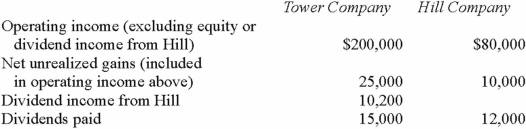 Under the separate return method, how much income tax expense will be assigned to Hill?
 (Multiple Choice)
4.7/5 (83)
(83) Delta Corporation owns 90 percent of Sigma Company, and Sigma owns 90 percent of Pi, Inc. all of which are domestic corporations. Information for the three companies for the year ending December 31, 2013 follows:  What is the non-controlling interest in Pi's income for 2013?
 (Multiple Choice)
4.9/5 (81)
(81) West Corp. owned 70% of the voting common stock of East Co. East owned 60% of Compass Co. West and East both used the initial value method to account for their investments. The following information was available from the financial statements and records of the three companies: 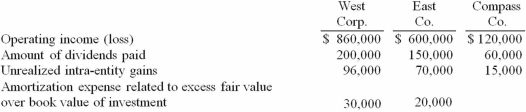 Operating income included unrealized intra-entity gains (which are related to inventory transfers) but did not include dividend income from investment in subsidiary.
The accrual-based income of East Co. is calculated to be
Operating income included unrealized intra-entity gains (which are related to inventory transfers) but did not include dividend income from investment in subsidiary.
The accrual-based income of East Co. is calculated to be (Multiple Choice)
5.0/5 (68)
(68) How is the amortization of goodwill treated for income tax purposes? How does the amortization of goodwill affect deferred income taxes?
(Essay)
4.9/5 (75)
(75) Dean, Inc. owns 90 percent of Ralph, Inc. During the current year, Dean sold merchandise costing $80,000 to Ralph for $100,000. At the end of the year, 30 percent of this merchandise was still on hand. The tax rate is 30 percent.
Assuming that separate income tax returns are being filed, what deferred income tax asset is created?
(Multiple Choice)
4.9/5 (80)
(80) Kurton Inc. owned 90% of Luvyn Corp.'s voting common stock. The consideration paid exceeded book value by $110,000. Of this amount, one half is attributable to a patent and is to be amortized over 5 years. Luvyn held 20% of Kurton's voting common stock which cost $28,000 more than fair value.
During the current year, Kurton reported operating income of $224,000 and dividend income from Luvyn of $37,800. At the same time, Luvyn reported operating income of $70,000 and dividend income from Kurton of $19,600.
Required:
Prepare a schedule to show consolidated net income.
(Essay)
4.9/5 (94)
(94) Pear, Inc. owns 80 percent of Apple Corporation. During the current year, Apple reported earnings before tax of $400,000 and paid a dividend of $120,000. The income tax rate for each company is 40 percent and separate tax returns are prepared. What deferred income tax liability arising this year must be recognized in the consolidated balance sheet?
(Multiple Choice)
4.9/5 (71)
(71) Tate, Inc. owns 80 percent of Jeffrey, Inc. During the current year, Jeffrey sold merchandise costing $60,000 to Tate for $75,000. At the end of the year, 10 percent of this merchandise was still being held. The tax rate is 30 percent.
Assuming that separate income tax returns are being filed, what deferred income tax asset is created?
(Multiple Choice)
4.7/5 (68)
(68) What ownership structure is referred to as a connecting affiliation? Describe briefly or illustrate with a diagram.
(Essay)
4.8/5 (74)
(74) For each of the following situations, select the best answer concerning accounting for income taxes in combinations:
(A) May file a consolidated income tax return.
(B) May not a file consolidated income tax return.
(C) Must file a consolidated income tax return.
_____1. Parent company owns 85% of the voting stock of the subsidiary, and there are significant intercompany transactions.
_____2. Subsidiary is a foreign corporation.
_____3. Parent company owns 90% of the voting stock of the subsidiary, but there are no intercompany inventory transactions.
_____4. Parent company owns 75% of the voting stock of the subsidiary but there are no intercompany inventory transactions.
_____5. Parent company owns 90% of the voting stock of the subsidiary, and there are intercompany inventory transactions with transferred goods in ending inventory.
_____6. Parent company owns 75% of the voting stock of the subsidiary and there are intercompany inventory transactions with transferred goods in ending inventory.
(Short Answer)
4.8/5 (72)
(72) Tower Company owns 85% of Hill Company. The two companies engaged in several intra-entity transactions. Each company's operating and dividend income for the current time period follow, as well as the effects of unrealized gains. No income tax accruals have been recognized within these totals. The tax rate for each company is 30%. 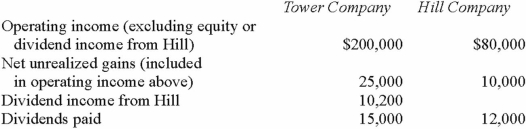 What is the tax liability for the current year if consolidated tax returns are prepared?
 (Multiple Choice)
4.8/5 (81)
(81) Evanston Co. owned 60% of Montgomery Corp. Montgomery owned 75% of Noir Inc., and Noir owned 15% of Montgomery. This pattern of ownership would be called
(Multiple Choice)
4.8/5 (80)
(80) What configuration of corporate ownership is described as a father-son-grandson relationship?
(Essay)
4.9/5 (80)
(80) 
Filters
- Essay(0)
- Multiple Choice(0)
- Short Answer(0)
- True False(0)
- Matching(0)