



 Chat with AI
Exam 10: Translation of Foreign Currency Financial Statements

Exam 1: The Equity Method of Accounting for Investments119 Questions
Exam 2: Consolidation of Financial Information107 Questions
Exam 3: Consolidations - Subsequent to the Date of Acquisition122 Questions
Exam 4: Consolidated Financial Statements and Outside Ownership116 Questions
Exam 5: Consolidated Financial Statements Intra-Entity Asset Transactions127 Questions
Exam 6: Variable Interest Entities, Intra-Entity Debt, Consolidated Cash Flows, and Other Issues115 Questions
Exam 7: Consolidated Financial Statements - Ownership Patterns and Income Taxes115 Questions
Exam 8: Segment and Interim Reporting116 Questions
Exam 9: Foreign Currency Transactions and Hedging Foreign Exchange Risk93 Questions
Exam 10: Translation of Foreign Currency Financial Statements97 Questions
Exam 11: Worldwide Accounting Diversity and International Accounting Standards60 Questions
Exam 12: Financial Reporting and the Securities and Exchange Commission77 Questions
Exam 13: Accounting for Legal Reorganizations and Liquidations83 Questions
Exam 14: Partnerships: Formation and Operation88 Questions
Exam 15: Partnerships: Termination and Liquidation73 Questions
Exam 16: Accounting for State and Local Governments78 Questions
Exam 17: Accounting for State and Local Governments49 Questions
Exam 18: Accounting and Reporting for Private Not-For-Profit Organizations62 Questions
Exam 19: Accounting for Estates and Trusts80 Questions
Select questions type


Farley Brothers, a U.S. company, had a subsidiary in Italy. Under what conditions would the U.S. dollar be the functional currency for this subsidiary?

Free
(Essay)
4.8/5  (72)
(72) Correct Answer: Verified
To determine the subsidiary's functional currency, Farley Brothers should look at the volume of the subsidiary's transactions in various currencies. If most of the subsidiary's sales and purchases are in dollars, the dollar may be the logical choice for the functional currency. If there are many transactions between the subsidiary and the parent, and if most of the subsidiary's financing comes from the U.S., the dollar may be a better choice than the euro.
Certain balance sheet accounts of a foreign subsidiary of the Tulip Co. had been stated in U.S. dollars as follows:  If the subsidiary's local currency is its functional currency, what total amount should be included in Tulip's balance sheet in U.S. dollars?
Free
(Multiple Choice)
4.8/5 (85)
(85) Correct Answer:Verified
VerifiedC
When consolidating a foreign subsidiary, which of the following statements is true?
Free
(Multiple Choice)
5.0/5 (77)
(77) Correct Answer:Verified
VerifiedC
Quadros Inc., a Portuguese firm was acquired by a U.S. company on January 1, 2012. Selected account balances are available for the year ended December 31, 2013, and are stated in Euro, the local currency.  Assume the functional currency is the U.S. Dollar; compute the U.S. statement of retained earnings amount for dividends for 2013.
 (Multiple Choice)
4.9/5 (71)
(71) Kennedy Company acquired all of the outstanding common stock of Hastie Company of Canada for U.S. $350,000 on January 1, 2013, when the exchange rate for the Canadian dollar (CAD) was U.S. $.70. The fair value of the net assets of Hastie was equal to their book value of CAD 450,000 on the date of acquisition. Any acquisition consideration excess over fair value was attributed to an unrecorded patent with a remaining life of five years. The functional currency of Hastie is the Canadian dollar.
For the year ended December 31, 2013, Hastie's trial balance net income was translated at U.S. $25,000. The average exchange rate for the Canadian dollar during 2013 was U.S. $.68, and the 2013 year-end exchange rate was U.S. $.65.
Amortization of the patent, translated, for 2013 would be
(Multiple Choice)
4.8/5 (95)
(95) Quadros Inc., a Portuguese firm was acquired by a U.S. company on January 1, 2012. Selected account balances are available for the year ended December 31, 2013, and are stated in Euro, the local currency.  Assume the functional currency is the U.S. Dollar; compute the U.S. balance sheet amount for equipment for 2013.
 (Multiple Choice)
5.0/5 (83)
(83) Contrast the purpose of remeasurement with the purpose of translation.
(Essay)
4.9/5 (87)
(87) Boerkian Co. started 2013 with two assets: Cash of §26,000 (Stickles) and Land that originally cost §72,000 when acquired on April 4, 2010. On May 1, 2013, the company rendered services to a customer for §36,000, an amount immediately paid in cash. On October 1, 2013, the company incurred an operating expense of §22,000 that was immediately paid. No other transactions occurred during the year so an average exchange rate is not necessary. Currency exchange rates were as follows: 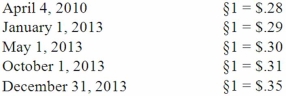 Required:
Assume that Boerkian was a foreign subsidiary of a U.S. multinational company and the local currency of the subsidiary (stickle) is the functional currency. On the December 31, 2013 balance sheet, what was the translated value of the Land account?
Required:
Assume that Boerkian was a foreign subsidiary of a U.S. multinational company and the local currency of the subsidiary (stickle) is the functional currency. On the December 31, 2013 balance sheet, what was the translated value of the Land account? (Essay)
4.8/5 (82)
(82) A net liability balance sheet exposure exists and the foreign currency depreciates. Which of the following statements is true?
(Multiple Choice)
4.9/5 (78)
(78) A foreign subsidiary of a U.S. corporation purchased equipment on January 4, 2010.
(A.) How would depreciation expense on the equipment be translated for 2013?
(B.) How would depreciation expense on the equipment be remeasured for 2013?
(Essay)
4.8/5 (78)
(78) Ginvold Co. began operating a subsidiary in a foreign country on January 1, 2013 by acquiring all of the common stock for §50,000 Stickles, the local currency. This subsidiary immediately borrowed §120,000 on a five-year note with ten percent interest payable annually beginning on January 1, 2014. A building was then purchased for §170,000 on January 1, 2013. This property had a ten-year anticipated life and no salvage value and was to be depreciated using the straight-line method. The building was immediately rented for three years to a group of local doctors for §6,000 per month. By year-end, payments totaling §60,000 had been received. On October 1, §5,000 were paid for a repair made on that date and it was the only transaction of this kind for the year. A cash dividend of §6,000 was transferred back to Ginvold on December 31, 2013. The functional currency for the subsidiary was the Stickle (§). Currency exchange rates were as follows: 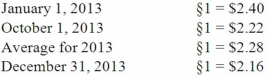 Prepare a statement of retained earnings for this subsidiary in stickles and then translate the amounts into U.S. dollars.
 (Essay)
4.8/5 (84)
(84) Which accounts are remeasured using current exchange rates?
(Multiple Choice)
4.9/5 (74)
(74) Under the temporal method, inventory at market would be remeasured at what rate?
(Multiple Choice)
4.8/5 (71)
(71) Esposito is an Italian subsidiary of a U.S. company.
Esposito's ending inventory is valued at the average cost for the last quarter of the year.
The following account balances are available for Esposito for 2013:  Compute the cost of goods sold for 2013 in U.S. dollars using the temporal method.
 (Multiple Choice)
4.8/5 (81)
(81) Where is the disposition of a translation loss reported in the parent company's financial statements?
(Multiple Choice)
4.8/5 (87)
(87) Kennedy Company acquired all of the outstanding common stock of Hastie Company of Canada for U.S. $350,000 on January 1, 2013, when the exchange rate for the Canadian dollar (CAD) was U.S. $.70. The fair value of the net assets of Hastie was equal to their book value of CAD 450,000 on the date of acquisition. Any acquisition consideration excess over fair value was attributed to an unrecorded patent with a remaining life of five years. The functional currency of Hastie is the Canadian dollar.
For the year ended December 31, 2013, Hastie's trial balance net income was translated at U.S. $25,000. The average exchange rate for the Canadian dollar during 2013 was U.S. $.68, and the 2013 year-end exchange rate was U.S. $.65.
Calculate the U.S. dollar amount allocated to the patent at January 1, 2013.
(Multiple Choice)
4.9/5 (71)
(71) Quadros Inc., a Portuguese firm was acquired by a U.S. company on January 1, 2012. Selected account balances are available for the year ended December 31, 2013, and are stated in Euro, the local currency.  Assume the functional currency is the U.S. Dollar; compute the U.S. income statement amount for sales for 2013.
 (Multiple Choice)
4.8/5 (76)
(76) Dilty Corp. owned a subsidiary in France. Dilty concluded that the subsidiary's functional currency was the U.S. dollar.
Which one of the following statements would justify this conclusion?
(Multiple Choice)
4.9/5 (85)
(85) Under the temporal method, depreciation expense would be remeasured at what rate?
(Multiple Choice)
4.9/5 (92)
(92) 
Filters
- Essay(0)
- Multiple Choice(0)
- Short Answer(0)
- True False(0)
- Matching(0)