



 Chat with AI
Exam 14: A Managers Guide to Government in the Marketplace

Exam 1: The Fundamentals of Managerial Economics143 Questions
Exam 2: Market Forces: Demand and Supply150 Questions
Exam 3: Quantitative Demand Analysis170 Questions
Exam 4: The Theory of Individual Behavior179 Questions
Exam 5: The Production Process and Costs173 Questions
Exam 6: The Organization of the Firm157 Questions
Exam 7: The Nature of Industry123 Questions
Exam 8: Managing in Competitive, Monopolistic, and Monopolistically Competitive Markets130 Questions
Exam 9: Basic Oligopoly Models134 Questions
Exam 10: Game Theory: Inside Oligopoly140 Questions
Exam 11: Pricing Strategies for Firms With Market Power140 Questions
Exam 12: The Economics of Information128 Questions
Exam 13: Advanced Topics in Business Strategy89 Questions
Exam 14: A Managers Guide to Government in the Marketplace112 Questions
Select questions type


Acme Water is a privately owned company that is the sole supplier of water to a rural town in Pennsylvania. The owner of the firm has provided the manager of the company an incentive to maximize the firm's profits, and the manager is currently selling 100,000 gallons of water per week at a price of $.05 per gallon. The marginal cost of water is zero, but the firm's average cost of this level of output is $.01 per gallon.
a. Determine Acme Water's profits.
b. Now suppose that the local government imposes a price ceiling on water at a price of $.01 per gallon. Will the firm earn economic profits of zero as a result of this price ceiling? Explain.
c. Does the price ceiling of $.01 per gallon result in a shortage of water in Acme's service area?
(Essay)
4.7/5  (79)
(79) The domestic demand and supply for sugar are Qd = 700 - 2P and QSD = 100 + 4P. The foreign supply is QSF = 150 + 3P. Suppose an import quota of 100 is imposed in the domestic market. How many units of sugar will domestic producers supply after the quota is imposed?
(Multiple Choice)
4.9/5 (78)
(78) Which of the following factors reduces the need for government involvement in the marketplace?
(Multiple Choice)
4.8/5 (73)
(73) Nonexclusionary, as it relates to public goods, means that:
(Multiple Choice)
4.9/5 (89)
(89) Consider the monopoly in the figure below with price regulated at $20 per unit. Consumer surplus at the regulated price is: 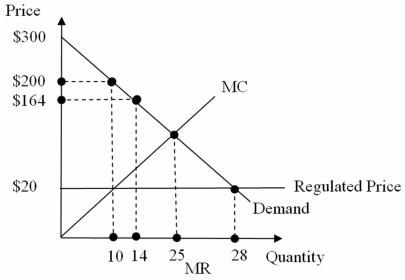
(Multiple Choice)
4.9/5 (81)
(81) If the government imposes a price ceiling below the monopolist's average cost curve, then in the long run the regulation makes:
(Multiple Choice)
5.0/5 (80)
(80) Suppose a monopoly faces an inverse demand curve of P = 300 - 10Q and has constant marginal cost of 20. If the government is considering legislation that would regulate price to the competitive level, what is the maximum amount the monopoly would spend on (legal) lobbying activities designed to thwart the regulation?
(Multiple Choice)
4.9/5 (78)
(78) Which of the following is true concerning negative externalities?
(Multiple Choice)
4.8/5 (63)
(63) Which of the following is NOT a result of certification of skills?
(Multiple Choice)
4.8/5 (68)
(68) Suppose a monopoly faces an inverse demand curve of P = 100 - 2Q and has constant marginal cost of 6Q. If the government is considering legislation that would regulate price to the competitive level, what is the maximum amount the monopoly would spend on (legal) lobbying activities designed to thwart the regulation?
(Multiple Choice)
4.9/5 (81)
(81) The domestic demand and supply for sugar are Qd = 700 - 2P and QSD = 100 + 4P. The foreign supply is QSF = 150 + 3P. What is the domestic market price of sugar?
(Multiple Choice)
4.8/5 (84)
(84) The domestic demand and supply for sugar are Qd = 40,000 - 200P and QSD = 10,000 + 300P. The foreign supply is QSF = 20,000 + 100P. Suppose an import quota of 5,000 is imposed in the domestic market. How many units of sugar will domestic producers supply after the quota is imposed?
(Multiple Choice)
4.9/5 (84)
(84) Consider the monopoly in the figure below with price regulated at $2 per unit. Monopoly profits at the regulated price (assuming the presence of fixed costs) are: 
(Multiple Choice)
4.9/5 (74)
(74) You are the CEO of a firm with an industry HHI equal to 1,000. Your firm currently controls 20 percent of the market. The board of trustees wants you to consider merging with a firm that controls 10 percent of the market. Should you be concerned about antitrust proceedings? Explain.
(Essay)
4.9/5 (70)
(70) As additional consumers obtain the benefits of a pure public good, such as national defense, the benefits to the existing consumers will:
(Multiple Choice)
4.8/5 (80)
(80) How much would consumers in the figure below spend to persuade politicians to regulate the monopoly's price to marginal (or average) cost? 
(Multiple Choice)
4.8/5 (94)
(94) 
Filters
- Essay(0)
- Multiple Choice(0)
- Short Answer(0)
- True False(0)
- Matching(0)