



 Chat with AI
Exam 14: A Managers Guide to Government in the Marketplace

Exam 1: The Fundamentals of Managerial Economics143 Questions
Exam 2: Market Forces: Demand and Supply150 Questions
Exam 3: Quantitative Demand Analysis170 Questions
Exam 4: The Theory of Individual Behavior179 Questions
Exam 5: The Production Process and Costs173 Questions
Exam 6: The Organization of the Firm157 Questions
Exam 7: The Nature of Industry123 Questions
Exam 8: Managing in Competitive, Monopolistic, and Monopolistically Competitive Markets130 Questions
Exam 9: Basic Oligopoly Models134 Questions
Exam 10: Game Theory: Inside Oligopoly140 Questions
Exam 11: Pricing Strategies for Firms With Market Power140 Questions
Exam 12: The Economics of Information128 Questions
Exam 13: Advanced Topics in Business Strategy89 Questions
Exam 14: A Managers Guide to Government in the Marketplace112 Questions
Select questions type


The external marginal cost of producing coal is MCexternal = 8Q while the internal marginal cost is MC internal = 6Q. The inverse demand for coal is given by P = 180 - 4Q. If the government taxed output at $2 per unit, what would a competitive industry produce?
(Multiple Choice)
4.9/5  (80)
(80) Suppose a monopoly faces an inverse demand curve of P = 6 - Q and has constant marginal cost of 2. If the government is considering legislation that would regulate price to the competitive level, what is the maximum amount the monopoly would spend on (legal) lobbying activities designed to thwart the regulation?
(Multiple Choice)
4.7/5 (85)
(85) The unregulated monopoly in the figure below will earn profit of: 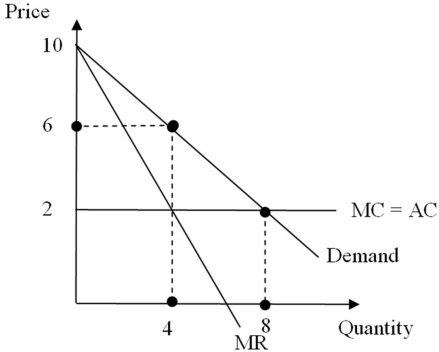
(Multiple Choice)
4.8/5 (71)
(71) A firm has a constant marginal social cost of producing that equals $2Q. What is the socially efficient level of production for a firm facing an inverse demand P = 60 - 2Q?
(Multiple Choice)
4.8/5 (90)
(90) Which of the following pieces of legislation is aimed at curbing the negative effects of externalities?
(Multiple Choice)
4.8/5 (76)
(76) Which of the following raises domestic prices only when demand is relatively low?
(Multiple Choice)
5.0/5 (77)
(77) Consider the monopoly in the figure below with price regulated at $20 per unit. Monopoly profits at the regulated price are: 
(Multiple Choice)
4.8/5 (77)
(77) The domestic demand and supply for sugar are Qd = 40,000 - 200P and QSD = 10,000 + 300P. The foreign supply is QSF = 20,000 + 100P. What is the domestic market price of sugar?
(Multiple Choice)
4.8/5 (78)
(78) When the government imposes an excise tax on foreign imports:
(Multiple Choice)
4.8/5 (79)
(79) The domestic demand and supply for sugar are Qd = 40,000 - 200P and QSD = 10,000 + 300P. The foreign supply is QSF = 20,000 + 100P. What is the total supply of sugar in the domestic market?
(Multiple Choice)
4.9/5 (68)
(68) Section 16(a) of the Securities and Exchange Act of 1934, as amended in 1990, requires that the officers, directors, and principal shareholders of companies disclose the extent of their ownership of equity securities of the company and any changes in the ownership. Section 16(b) permits companies to recover trading profits realized by such people arising from short-swing transactions in company securities. Do you think that, as a result of these laws, the government will be forced to spend more money on its auditing and enforcement efforts? Explain.
(Essay)
4.9/5 (81)
(81) The gadget industry is comprised of 10 firms, each with a 10 percent market share. What is the Herfindahl-Hirschman index for the industry? Based on the U.S. Department of Justice Merger Guidelines described in the text, do you think the Justice Department would be likely to block a merger between two of the firms?
(Essay)
4.9/5 (83)
(83) How much would the monopoly in the figure below spend to prevent its price being regulated to marginal (or average) cost? 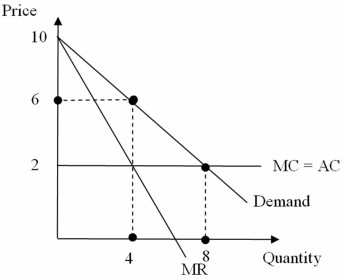
(Multiple Choice)
4.8/5 (76)
(76) Which cost measures the cost to society of producing a good?
(Multiple Choice)
4.9/5 (79)
(79) Suppose the supply of wine by domestic firms is QSD = 5 + P and the supply of wine by foreign firms is QSF = 5 + P. The domestic demand for wine is given by Qd = 40 - P.
a. In the absence of a quota, what is the total supply of wine?
b. What are the equilibrium price and quantity of wine?
c. Suppose a quota of 5 units is imposed. What is the total supply of wine?
d. Determine the equilibrium price and quantity of wine in the domestic market under the quota of 5 units.
e. What is the loss in consumer surplus caused by the quota?
(Essay)
4.9/5 (73)
(73) In the 1990s the Mobil Oil Corporation acquired the rights to increase pollution by 900 pounds of sulfur dioxide per day at its Torrance, California, refinery. These rights were purchased from South Gate, California, at a price of $3 million after the latter acquired them from General Motors. As a result of this change, Mobil increased its output of noxious vapors in Torrance, California, by 900 pounds per day. Do you think the environment was harmed as a result of the sale of these pollution rights? Explain.
(Essay)
4.9/5 (59)
(59) The external marginal cost of producing coal is MCexternal = 8Q while the internal marginal cost is MC internal = 6Q. The inverse demand for coal is given by P = 180 - 4Q. How much output would a competitive industry produce?
(Multiple Choice)
4.9/5 (76)
(76) You are the manager of a monopoly that faces an inverse demand curve  and has constant average and marginal costs of $20 per unit. The government is considering legislation that would regulate your firm's price at $20 per unit. What is the maximum amount your firm should be willing to spend to lobby against the regulation?
 (Essay)
4.7/5 (90)
(90) 
Filters
- Essay(0)
- Multiple Choice(0)
- Short Answer(0)
- True False(0)
- Matching(0)