



 Chat with AI
Exam 14: A Managers Guide to Government in the Marketplace

Exam 1: The Fundamentals of Managerial Economics143 Questions
Exam 2: Market Forces: Demand and Supply150 Questions
Exam 3: Quantitative Demand Analysis170 Questions
Exam 4: The Theory of Individual Behavior179 Questions
Exam 5: The Production Process and Costs173 Questions
Exam 6: The Organization of the Firm157 Questions
Exam 7: The Nature of Industry123 Questions
Exam 8: Managing in Competitive, Monopolistic, and Monopolistically Competitive Markets130 Questions
Exam 9: Basic Oligopoly Models134 Questions
Exam 10: Game Theory: Inside Oligopoly140 Questions
Exam 11: Pricing Strategies for Firms With Market Power140 Questions
Exam 12: The Economics of Information128 Questions
Exam 13: Advanced Topics in Business Strategy89 Questions
Exam 14: A Managers Guide to Government in the Marketplace112 Questions
Select questions type


The Clean Air Act and its amendments increase the production costs of the firms in a covered industry through increased:
(Multiple Choice)
4.8/5  (72)
(72) If the government regulates a monopoly's price below the socially efficient level, then:
(Multiple Choice)
4.9/5 (71)
(71) What is the immediate result of applying the Clean Air Act to a previously nonregulated industry?
(Multiple Choice)
4.8/5 (70)
(70) Consider the monopoly in the figure below with price regulated at $2 per unit. In this market, ___________ units will be exchanged. 
(Multiple Choice)
5.0/5 (87)
(87) Consumer surplus in the unregulated monopoly market in the figure below is: 
(Multiple Choice)
4.8/5 (79)
(79) The external marginal cost of producing coal is MCexternal = 6Q while the internal marginal cost is MCinternal = 4Q. The inverse demand for coal is given by P = 120 - 2Q. What is the socially efficient level of output?
(Multiple Choice)
4.8/5 (75)
(75) Suppose a monopolist has positive fixed costs and constant marginal costs. If the government regulates a monopoly's price to marginal cost, in the long run:
(Multiple Choice)
4.9/5 (81)
(81) In the United States, government is the sole property owner of:
(Multiple Choice)
4.9/5 (79)
(79) In the 1990s Japan reduced its exports of automobiles to the United States by 28 percent. If you were the manager of a Buick dealership, how would this affect your pricing strategy? Explain.
(Essay)
4.8/5 (78)
(78) Three years ago the CEO of a large firm instituted a plan that encourages division managers to share information obtained about the demographic characteristics of those who purchase the firm's final product. Since the plan was implemented, however, the CEO has noticed that less information is available than ever. Why do you think the CEO's plan backfired?
(Essay)
4.8/5 (79)
(79) Consider the monopoly in the figure below with price regulated at $20 per unit. The deadweight loss under the regulated price is: 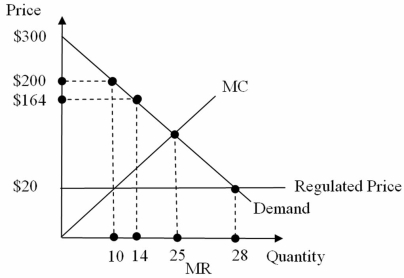
(Multiple Choice)
4.9/5 (74)
(74) The manager of a paper mill is preparing for her most important test yet. On Tuesday morning, she must testify before a Senate committee to "justify" the firm's high price. One senator is particularly angry with the firm because its price is twice the firm's marginal cost. On Tuesday afternoon, the manager is scheduled to appear before the House Subcommittee on the Environment to explain why the firm should not be slapped with a per-unit tax on the firm's output to compensate for the pollution it discharges into a major river. What do you think will be the manager's game plan?
(Essay)
4.8/5 (81)
(81) The Clean Air Act aids new entrants in a regulated industry when demand increases and provides an incentive for existing firms to invest in new antipollution technology by:
(Multiple Choice)
4.9/5 (94)
(94) To prevent air pollution and breach of contract, which tools does the government use?
(Multiple Choice)
4.8/5 (78)
(78) 
Filters
- Essay(0)
- Multiple Choice(0)
- Short Answer(0)
- True False(0)
- Matching(0)