



 Chat with AI
Exam 18: Process Cost Systems

Exam 1: Introduction to Accounting and Business188 Questions
Exam 2: Analyzing Transactions216 Questions
Exam 3: The Adjusting Process179 Questions
Exam 4: Completing the Accounting Cycle198 Questions
Exam 5: Accounting for Merchandising Businesses220 Questions
Exam 6: Inventories170 Questions
Exam 7: Sarbanes-Oxley, Internal Control, and Cash178 Questions
Exam 8: Receivables148 Questions
Exam 9: Fixed Assets and Intangible Assets177 Questions
Exam 10: Current Liabilities and Payroll174 Questions
Exam 11: Corporations: Organization, Stock Transactions, and Dividends172 Questions
Exam 12: Long-Term Liabilities: Bonds and Notes186 Questions
Exam 13: Investments and Fair Value Accounting133 Questions
Exam 14: Statement of Cash Flows161 Questions
Exam 15: Financial Statement Analysis184 Questions
Exam 16: Managerial Accounting Concepts and Principles175 Questions
Exam 17: Job Order Costing176 Questions
Exam 18: Process Cost Systems177 Questions
Exam 19: Cost Behavior and Cost-Volume-Profit Analysis215 Questions
Exam 20: Variable Costing for Management Analysis154 Questions
Exam 21: Budgeting185 Questions
Exam 22: Performance Evaluation Using Variances From Standard Costs160 Questions
Exam 23: Performance Evaluation for Decentralized Operations198 Questions
Exam 24: Differential Analysis and Product Pricing161 Questions
Exam 25: Capital Investment Analysis179 Questions
Exam 26: Cost Allocation and Activity-Based Costing111 Questions
Exam 27: Cost Management for Just-In-Time Environments122 Questions
Select questions type


Fast-Flow Paints produces mixer base paint through a two stage process, Mixing and Packaging. The following events depict the movement of value into and out of production. Journalize each event if appropriate, if not, provide a short narrative reason as to why you choose not to journalize that action. Bob, the Production Manager, accepts an order to continue processing the current run of mixer base paint.
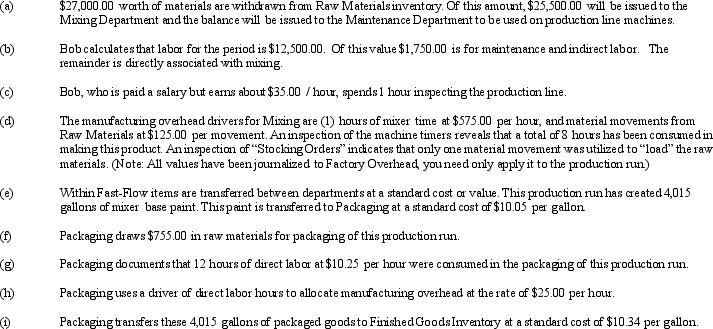 Round total cost to nearest dollar value.
 (Essay)
4.9/5  (88)
(88) Custom-made goods would be accounted for using a process costing system.
(True/False)
5.0/5 (90)
(90) If the costs for direct materials, direct labor, and factory overhead were $60,000, $35,000, and $25,000, respectively, for 20,000 equivalent units of production, the conversion cost per equivalent unit was $6.
(True/False)
4.9/5 (82)
(82) Mocha Company manufactures a single product by a continuous process, involving three production departments. The records indicate that direct materials, direct labor, and applied factory overhead for Department 1 were $100,000, $125,000, and $150,000, respectively. The records further indicate that direct materials, direct labor, and applied factory overhead for Department 2 were $55,000, $65,000, and $80,000, respectively. In addition, work in process at the beginning of the period for Department 1 totaled $75,000, and work in process at the end of the period totaled $60,000. The journal entry to record the flow of costs into Department 2 during the period for applied overhead is:
(Multiple Choice)
4.7/5 (78)
(78) For which of the following businesses would a process cost system be appropriate?
(Multiple Choice)
4.9/5 (72)
(72) In applying the first-in, first-out method of costing inventories, if 8,000 units which are 30% completed are in process at June 1, 28,000 units are completed during June, and 4,000 units were 80% completed at June 30, the number of equivalent units of production for June was 28,600.
(True/False)
4.7/5 (86)
(86) All costs of the processes in a process costing system ultimately pass through the Cost of Goods Sold account.
(True/False)
4.8/5 (86)
(86) If 10,000 units which were 50% completed are in process at November 1, 90,000 units were completed during November, and 20,000 were 20% completed at November 30, the number of equivalent units of production for November was 90,000. (Assume no loss of units in production and that inventories are costed by the first-in, first-out method.)
(True/False)
4.8/5 (83)
(83) The debits to Work in Process--Assembly Department for April, together with data concerning production, are as follows:  All direct materials are placed in process at the beginning of the process and the first-in, first-out method is used to cost inventories. The conversion cost per equivalent unit for April is:
 (Multiple Choice)
4.7/5 (88)
(88) The Brass Works is in the process of determining manufacturing overhead. Journalize events (a) - (d) to Factory Overhead, Miscellaneous Expense, or allocated between the two as appropriate. All items were paid in cash at the time of acquisition. Next calculate the overhead application rate and apply overhead to Work-in-Process.
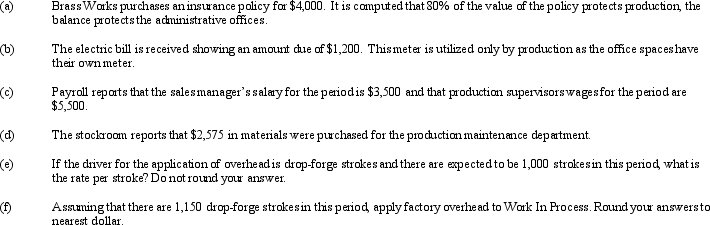 Round overhead rate to four decimal places and total cost to nearest dollar.
 (Essay)
4.8/5 (66)
(66) A firm produces its products by a continuous process involving three production departments, 1 through 3. Present entries to record the following selected transactions related to production during August:

(Essay)
4.9/5 (86)
(86) If Department H had 600 units, 60% completed, in process at the beginning of the period, 8,000 units were completed during the period, and 500 units were 30% completed at the end of the period, what was the number of equivalent units of production for the period for conversion if the first-in, first-out method is used to cost inventories? Assume the completion percentage applies to both direct materials and conversion cost.
(Multiple Choice)
4.9/5 (81)
(81) The Mountain Springs Water Company has two departments, Purifying and Bottling. The Bottling Department had 8,000 liters in beginning work in process inventory (60% complete). During the period 70,000 liters were completed. The ending work in process was 3,000 liters (60% completed). What are the total equivalent units for direct materials under the FIFO method if materials were added at the beginning of the process?
(Essay)
4.8/5 (81)
(81) The Bottling Department of Mountain Springs Water Company had 4,000 liters in beginning work in process inventory (40% complete). During the period, 66,000 liters were completed. The ending work in process inventory was 3,000 liters (70% complete). What are the equivalent units for conversion costs, using the FIFO method?
(Essay)
4.9/5 (77)
(77) Which of the following is not a use of the cost of production report?
(Multiple Choice)
4.9/5 (79)
(79) Explain the concept of equivalent units. Give an example to validate your explanation.
(Essay)
4.7/5 (79)
(79) Which of the following costs incurred by a paper manufacturer would be included in the group of costs referred to as conversion costs?
(Multiple Choice)
4.7/5 (89)
(89) The amount journalized showing the cost added to finished goods is taken from the cost of production report.
(True/False)
4.8/5 (84)
(84) Once equivalent units are calculated for materials, this number will also be used for direct labor and factory overhead.
(True/False)
4.9/5 (77)
(77) If 16,000 units of materials enter production during the first year of operations, 12,000 of the units are finished, and 4,000 are 75% completed, the number of equivalent units of production would be 15,000.
(True/False)
5.0/5 (88)
(88) 
Filters
- Essay(0)
- Multiple Choice(0)
- Short Answer(0)
- True False(0)
- Matching(0)