



 Chat with AI
Exam 6: Inventories

Exam 1: Introduction to Accounting and Business188 Questions
Exam 2: Analyzing Transactions216 Questions
Exam 3: The Adjusting Process179 Questions
Exam 4: Completing the Accounting Cycle198 Questions
Exam 5: Accounting for Merchandising Businesses220 Questions
Exam 6: Inventories170 Questions
Exam 7: Sarbanes-Oxley, Internal Control, and Cash178 Questions
Exam 8: Receivables148 Questions
Exam 9: Fixed Assets and Intangible Assets177 Questions
Exam 10: Current Liabilities and Payroll174 Questions
Exam 11: Corporations: Organization, Stock Transactions, and Dividends172 Questions
Exam 12: Long-Term Liabilities: Bonds and Notes186 Questions
Exam 13: Investments and Fair Value Accounting133 Questions
Exam 14: Statement of Cash Flows161 Questions
Exam 15: Financial Statement Analysis184 Questions
Exam 16: Managerial Accounting Concepts and Principles175 Questions
Exam 17: Job Order Costing176 Questions
Exam 18: Process Cost Systems177 Questions
Exam 19: Cost Behavior and Cost-Volume-Profit Analysis215 Questions
Exam 20: Variable Costing for Management Analysis154 Questions
Exam 21: Budgeting185 Questions
Exam 22: Performance Evaluation Using Variances From Standard Costs160 Questions
Exam 23: Performance Evaluation for Decentralized Operations198 Questions
Exam 24: Differential Analysis and Product Pricing161 Questions
Exam 25: Capital Investment Analysis179 Questions
Exam 26: Cost Allocation and Activity-Based Costing111 Questions
Exam 27: Cost Management for Just-In-Time Environments122 Questions
Select questions type


When merchandise sold is assumed to be in the order in which the purchases were made, the company is using

Free
(Multiple Choice)
4.9/5  (82)
(82) Correct Answer: Verified
C
Beginning inventory, purchases and sales data for T-shirts are as follows:
 Assuming the business maintains a periodic inventory system, calculate the cost of merchandise sold and ending inventory under the following assumptions:
a. FIFO
b. LIFO
c. Average cost (round cost of merchandise sold and ending inventory to the nearest dollar)
Assuming the business maintains a periodic inventory system, calculate the cost of merchandise sold and ending inventory under the following assumptions:
a. FIFO
b. LIFO
c. Average cost (round cost of merchandise sold and ending inventory to the nearest dollar)Free
(Essay)
4.9/5 (80)
(80) Correct Answer:Verified
Verifieda. Cost of Merchandise Sold = $642.00
Ending Inventory = $180 (12 units @ $15)
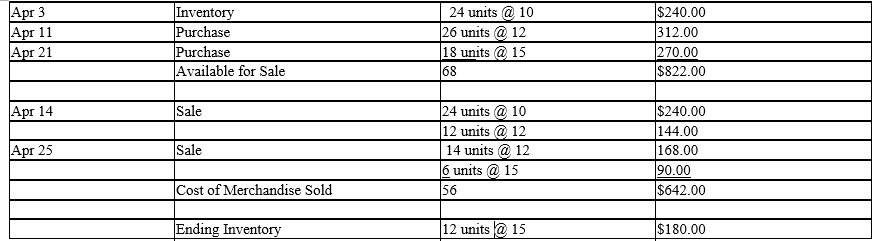 b. Cost of Merchandise Sold = $702.00
Ending Inventory = $120 (12 units @ $10)
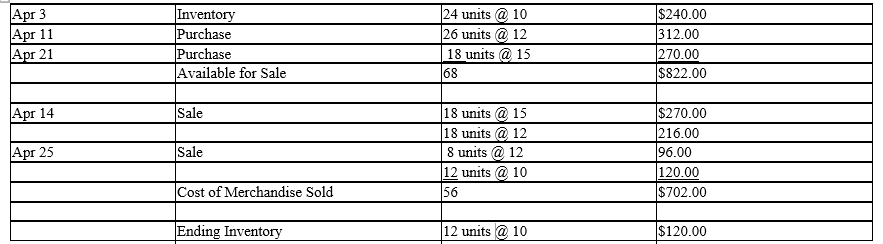 c. Cost of Merchandise Sold = $12.09 x 56 = $677.00
Ending Inventory = $12.09 x 12 units = $145.00
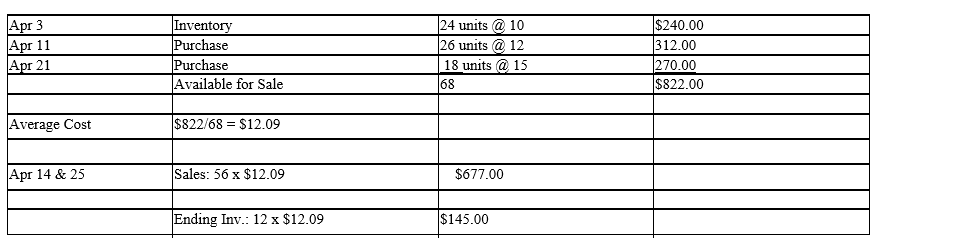
The beginning inventory and purchases of an item for the period were as follows:
 The company uses the periodic system, and there were 15 units in the inventory at the end of the period. Determine the cost of the 15 units in the inventory by each of the following methods, presenting details of your computations: (a) first-in, first-out; (b) last-in, first-out; (c) average cost. Do not round your intermediate calculations. Round your final answer to two decimal places.
Free
(Essay)
4.9/5 (79)
(79) Correct Answer:Verified
Verified(a)
 (b)
 (c)

A consignor who has goods out on consignment with an agent should include the goods in ending inventory even though they are in the possession of the consignor.
(True/False)
4.9/5 (67)
(67) The inventory data for an item for November are: Nov. 1 Inventory 20 units at \ 19 4 Sold 10 units 10 Purchased 30 units at \ 20 17 Sold 20 units 30 Purchased 10 units at \ 21 Using a perpetual system, what is the cost of the merchandise sold for November if the company uses LIFO?
(Multiple Choice)
4.9/5 (77)
(77) Generally, the lower the number of days' sales in inventory, the better.
(True/False)
4.9/5 (77)
(77) The units of Manganese Plus available for sale during the year were as follows:
 There are 15 units of the product in the physical inventory at November 30. The periodic inventory system is used. Determine the inventory cost by (a) FIFO, (b) LIFO, and (c) average cost methods.
 (Essay)
4.9/5 (71)
(71) The two most widely used methods for determining the cost of inventory are
(Multiple Choice)
4.8/5 (84)
(84) Describe three inventory cost flow assumptions and how they impact the financial statements.
(Essay)
4.9/5 (102)
(102) If the perpetual inventory system is used, the account entitled Merchandise Inventory is debited for purchases of merchandise.
(True/False)
4.8/5 (88)
(88) Average inventory is computed by adding the inventory at the beginning of the period to the inventory at the end of the period and dividing by two.
(True/False)
4.9/5 (90)
(90) Under the LIFO inventory costing method, the most recent costs are assigned to ending inventory.
(True/False)
4.9/5 (80)
(80) The following units of a particular item were available for sale during the year:
 The firm uses the perpetual inventory system and there are 240 units of the item on hand at the end of the year. What is the total cost of ending inventory according to LIFO?
 (Essay)
4.8/5 (66)
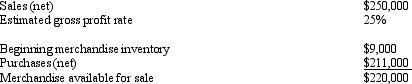
(66) Based upon the following data estimate the cost of ending merchandise inventory:
(Essay)
4.8/5 (84)
(84) The method of computing inventory that uses records of the selling prices of the merchandise is called
(Multiple Choice)
4.8/5 (60)
(60) Determine the total value of the merchandise using Net Realizable Value: Item Quantity Selling Price Commission Doll 10 \ 7 \ 2 Horse 5 9 3
(Multiple Choice)
4.7/5 (77)
(77) Beginning inventory, purchases and sales data for widgets are as follows:
 Complete the inventory cost card assuming the business maintains a perpetual inventory system and calculates the cost of merchandise sold and ending inventory using LIFO.
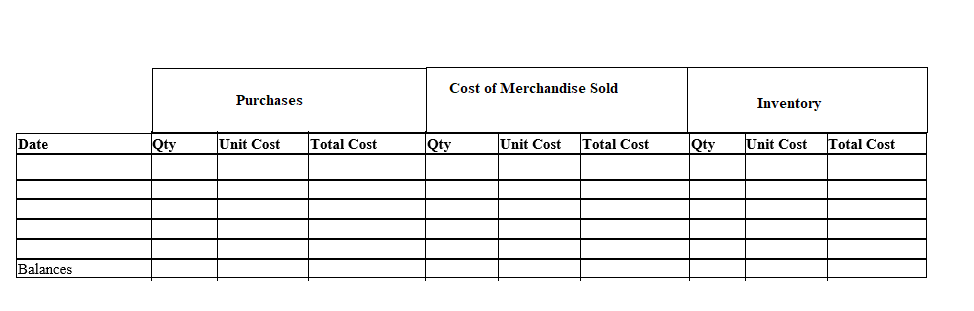
Complete the inventory cost card assuming the business maintains a perpetual inventory system and calculates the cost of merchandise sold and ending inventory using LIFO.
(Essay)
4.9/5 (79)
(79) One negative effect of carrying too much inventory is risk that customers will change their buying habits.
(True/False)
4.8/5 (70)
(70) Beginning inventory, purchases and sales data for tennis rackets are as follows:
 Complete the inventory cost card assuming the business maintains a perpetual inventory system and calculates the cost of merchandise sold and ending inventory using FIFO.
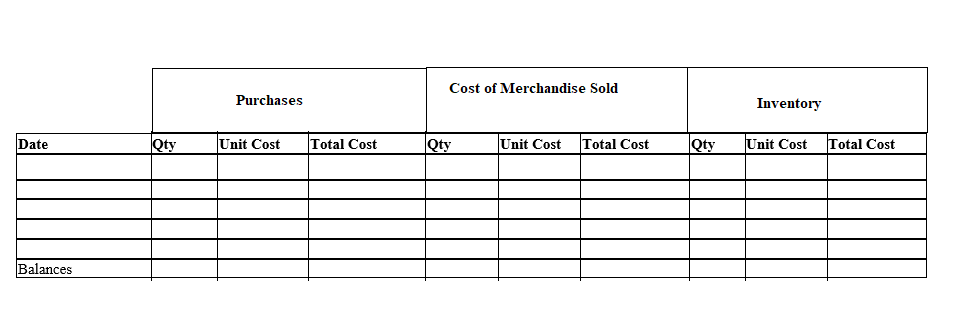
Complete the inventory cost card assuming the business maintains a perpetual inventory system and calculates the cost of merchandise sold and ending inventory using FIFO.
(Essay)
4.7/5 (73)
(73) Inventory controls start when the merchandise is shelved in the store area.
(True/False)
4.8/5 (75)
(75) 
Filters
- Essay(0)
- Multiple Choice(0)
- Short Answer(0)
- True False(0)
- Matching(0)