



 Chat with AI
Exam 22: Performance Evaluation Using Variances From Standard Costs

Exam 1: Introduction to Accounting and Business188 Questions
Exam 2: Analyzing Transactions216 Questions
Exam 3: The Adjusting Process179 Questions
Exam 4: Completing the Accounting Cycle198 Questions
Exam 5: Accounting for Merchandising Businesses220 Questions
Exam 6: Inventories170 Questions
Exam 7: Sarbanes-Oxley, Internal Control, and Cash178 Questions
Exam 8: Receivables148 Questions
Exam 9: Fixed Assets and Intangible Assets177 Questions
Exam 10: Current Liabilities and Payroll174 Questions
Exam 11: Corporations: Organization, Stock Transactions, and Dividends172 Questions
Exam 12: Long-Term Liabilities: Bonds and Notes186 Questions
Exam 13: Investments and Fair Value Accounting133 Questions
Exam 14: Statement of Cash Flows161 Questions
Exam 15: Financial Statement Analysis184 Questions
Exam 16: Managerial Accounting Concepts and Principles175 Questions
Exam 17: Job Order Costing176 Questions
Exam 18: Process Cost Systems177 Questions
Exam 19: Cost Behavior and Cost-Volume-Profit Analysis215 Questions
Exam 20: Variable Costing for Management Analysis154 Questions
Exam 21: Budgeting185 Questions
Exam 22: Performance Evaluation Using Variances From Standard Costs160 Questions
Exam 23: Performance Evaluation for Decentralized Operations198 Questions
Exam 24: Differential Analysis and Product Pricing161 Questions
Exam 25: Capital Investment Analysis179 Questions
Exam 26: Cost Allocation and Activity-Based Costing111 Questions
Exam 27: Cost Management for Just-In-Time Environments122 Questions
Select questions type


If the standard to produce a given amount of product is 600 direct labor hours at $15 and the actual was 600 hours at $17, the rate variance was $1,200 unfavorable.

Free
(True/False)
4.8/5  (76)
(76) Correct Answer: Verified
True
A company should only use nonfinancial performance measures when financial measures cannot be calculated.
Free
(True/False)
4.7/5 (89)
(89) Correct Answer:Verified
VerifiedFalse
An unfavorable volume variance may be due to a failure of supervisors to maintain an even flow of work.
Free
(True/False)
4.9/5 (74)
(74) Correct Answer:Verified
VerifiedTrue
Hsu Company produces a part with a standard of 5 yds. of material per unit. The standard price of one yard of material is $8.50. During the month, 8,800 parts were manufactured, using 45,700 yards of material at a cost of $8.30.
Required:
Determine the (a) price variance, (b) quantity variance, and (c) cost variance.
(Essay)
4.9/5 (81)
(81) If the actual quantity of direct materials used in producing a commodity differs from the standard quantity, the variance is termed a:
(Multiple Choice)
4.9/5 (71)
(71) The following data relate to direct labor costs for February:  What is the direct labor rate variance?
 (Multiple Choice)
4.9/5 (86)
(86) The standard costs and actual costs for factory overhead for the manufacture of 2,500 units of actual production are as follows: 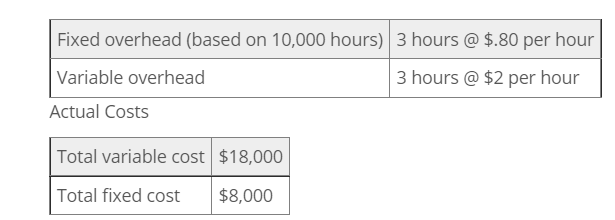 The amount of the total factory overhead cost variance is:
 (Multiple Choice)
4.9/5 (84)
(84) The unfavorable volume variance may be due to all of the following factors except:
(Multiple Choice)
4.8/5 (70)
(70)  Calculate the Total Direct Materials cost variance using the above information:
 (Multiple Choice)
4.9/5 (84)
(84) Incurring actual indirect factory wages in excess of budgeted amounts for actual production results in a:
(Multiple Choice)
4.7/5 (91)
(91) It is correct to rely exclusively on past cost data when establishing standards.
(True/False)
4.9/5 (61)
(61) A company must choice either a standard system or nonfinancial performance measures to evaluate the performance of a company.
(True/False)
5.0/5 (90)
(90) Standards are more widely used for nonmanufacturing expenses than for manufacturing costs.
(True/False)
4.7/5 (88)
(88) Greyson Company produced 8,300 units of their product that required 4.25 standard hours per unit. Determine the standard fixed overhead cost per unit at 27,000 hours, which is 100% of normal capacity, if the favorable fixed factory overhead volume variance is $14,895.
(Essay)
4.8/5 (88)
(88) Define ideal and currently attainable standards. Which type of standard should be used and why?
(Essay)
4.7/5 (81)
(81) The Trumpet Company produced 8,700 units of a product that required 3.25 standard hours per unit. The standard fixed overhead cost per unit is $1.20 per hour at 29,000 hours, which is 100% of normal capacity. Determine the fixed factory overhead volume variance.
(Essay)
4.8/5 (75)
(75)  Calculate the Direct Labor Time Variance using the above information
 (Multiple Choice)
4.7/5 (74)
(74) Robin Company purchased and used 500 pounds of direct materials to produce a product with a 520 pound standard direct materials requirement. The standard materials price is $1.90 per pound. The actual materials price was $2.00 per pound. Prepare the journal entries to record (1) the purchase of the materials and (2) the material entering production. Robin records standards and variances in the general ledger.
(Essay)
4.8/5 (91)
(91) 
Filters
- Essay(0)
- Multiple Choice(0)
- Short Answer(0)
- True False(0)
- Matching(0)