



 Chat with AI
Exam 18: Process Cost Systems

Exam 1: Introduction to Accounting and Business188 Questions
Exam 2: Analyzing Transactions216 Questions
Exam 3: The Adjusting Process179 Questions
Exam 4: Completing the Accounting Cycle198 Questions
Exam 5: Accounting for Merchandising Businesses220 Questions
Exam 6: Inventories170 Questions
Exam 7: Sarbanes-Oxley, Internal Control, and Cash178 Questions
Exam 8: Receivables148 Questions
Exam 9: Fixed Assets and Intangible Assets177 Questions
Exam 10: Current Liabilities and Payroll174 Questions
Exam 11: Corporations: Organization, Stock Transactions, and Dividends172 Questions
Exam 12: Long-Term Liabilities: Bonds and Notes186 Questions
Exam 13: Investments and Fair Value Accounting133 Questions
Exam 14: Statement of Cash Flows161 Questions
Exam 15: Financial Statement Analysis184 Questions
Exam 16: Managerial Accounting Concepts and Principles175 Questions
Exam 17: Job Order Costing176 Questions
Exam 18: Process Cost Systems177 Questions
Exam 19: Cost Behavior and Cost-Volume-Profit Analysis215 Questions
Exam 20: Variable Costing for Management Analysis154 Questions
Exam 21: Budgeting185 Questions
Exam 22: Performance Evaluation Using Variances From Standard Costs160 Questions
Exam 23: Performance Evaluation for Decentralized Operations198 Questions
Exam 24: Differential Analysis and Product Pricing161 Questions
Exam 25: Capital Investment Analysis179 Questions
Exam 26: Cost Allocation and Activity-Based Costing111 Questions
Exam 27: Cost Management for Just-In-Time Environments122 Questions
Select questions type


Which of the following is not characteristic of a process cost system?
(Multiple Choice)
4.9/5  (94)
(94) On March 1, Upton Company's packaging department had Work in Process inventory of
8,820 units, which had been transferred in from the finishing department. These units had accumulated costs of $315,000 in previous departments and $16,000 for conversion costs in the packaging department.
During March, 30,000 units were transferred into the department. These units had
accumulated costs of $770,000 in the previous departments. The packaging department incurred $54,000 in conversion costs during the month.
Seven hundred units remained in ending inventory on March 31. These units were 80% complete with respect to conversion costs.
Required:
Calculate the cost per equivalent unit for transferred-in costs and for conversion costs for the packaging department using the average cost method.
(Essay)
4.7/5 (82)
(82) The cost of direct materials transferred into the Bottling Department of the Mountain Springs Water Company is $28,072. The conversion cost for the period in the Bottling Department is $10,275. The total equivalent units for direct materials and conversion are 63,800 and 68,500 respectively. Determine the direct materials and conversion cost per equivalent unit.
Round answers to nearest cent.
(Essay)
4.9/5 (70)
(70) The following production data were taken from the records of the Finishing Department for June:  Determine the number of conversion equivalent units of production in the June 30 Finishing Department inventory, assuming that the first-in, first-out method is used to cost inventories.
 (Multiple Choice)
4.7/5 (83)
(83) Penny, Inc. employs a process costing system. Direct materials are added at the beginning of the process. Here is information about July's activities: 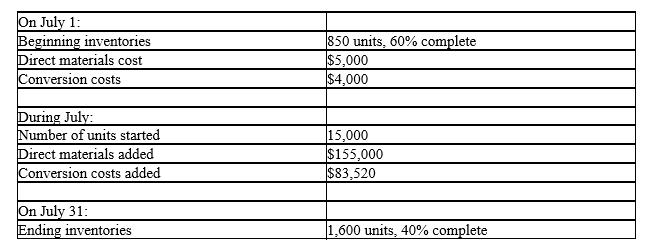 Using the FIFO method, the number of units started and completed in July was
 (Multiple Choice)
4.7/5 (91)
(91) The following production data were taken from the records of the Finishing Department for June:  Determine the number of equivalent units of production in the June 30 Finishing Department inventory, assuming that the first-in, first-out method is used to cost inventories. Assume the completion percentage of 25% applies to both direct materials and conversion costs.
 (Multiple Choice)
4.9/5 (76)
(76) If Department H had 600 units, 60% completed, in process at the beginning of the period, 6,000 units were completed during the period, and 700 units were 30% completed at the end of the period, what was the number of equivalent units of production for conversion costs for the period, if the first-in, first-out method is used to cost inventories?
(Multiple Choice)
4.9/5 (78)
(78) Department W had 2,400 units, one-third completed at the beginning of the period, 16,000 units were transferred to Department X from Department W during the period, and 1,800 units were one-half completed at the end of the period. Assume the completion ratios apply to direct materials and conversion costs. What is the equivalent units of production used to compute unit conversion cost on the cost of production report for Department W (Assuming the company uses FIFO)?
(Multiple Choice)
4.9/5 (76)
(76) The debits to Work in Process--Assembly Department for April, together with data concerning production, are as follows:  All direct materials are placed in process at the beginning of the process and the first-in, first-out method is used to cost inventories. The materials cost per equivalent unit for April is:
 (Multiple Choice)
4.9/5 (86)
(86) Job order manufacturing and process manufacturing are two major costing systems used in manufacturing. Briefly contrast the characteristics of these two systems.
(Essay)
4.9/5 (87)
(87) Process manufacturing usually reflects a manufacturer that produces small quantities of unique items.
(True/False)
4.7/5 (90)
(90) A form prepared periodically for each processing department summarizing (1) the units for which the department is accountable and the units to be assigned costs and (2) the costs charged to the department and the allocation of these costs is termed a:
(Multiple Choice)
4.9/5 (75)
(75) On August 1, Jones Corporation's packaging department had Work in Process inventory of 8,000 units that were 75% complete with respect to materials and 30% complete with respect to conversion costs. The cost of these units was $99,525 ($62,000 transferred-in from previous departments, $28,775 in materials, and $8,750 in labor and overhead). During August, 125,000 units were transferred into the department. These units had accumulated costs in previous departments of $1,418,560. The packaging department incurred costs of $799,225 for materials and $498,010 for conversion costs in August and transferred 131,000 units out of the department. The 2,000 units remaining in ending inventory are 50% complete with respect to materials and 20% complete with respect to conversion costs. Jones Corporation uses the average cost method to cost its inventories.
Required
a. Calculate the cost per equivalent unit for transferred-in costs, materials, and conversion costs.
b. Calculate the cost of the units transferred out of the department.
c. Calculate the cost of the ending inventory.
(Essay)
4.8/5 (85)
(85) The estimated total factory overhead cost and total machine hours for Department 40 for the current year are $250,000 and 56,250 respectively. During January, the first month of the current year, actual machine hours used totaled 5,100 and factory overhead cost incurred totaled $22,000.
 Round total cost to nearest dollar value.
 (Essay)
4.8/5 (83)
(83) The last step in the accounting procedure for process costing is the calculation of equivalent units of production.
(True/False)
4.7/5 (84)
(84) Process manufacturers typically use large machines to process a continuous flow of raw materials into a finished state.
(True/False)
4.8/5 (90)
(90) Department G had 3,600 units, 40% completed at the beginning of the period, 12,000 units were completed during the period, 2,000 units were one-fifth completed at the end of the period, and the following manufacturing costs were debited to the departmental work in process account during the period:  Assuming that all direct materials are placed in process at the beginning of production and that the first-in, first-out method of inventory costing is used, what is the material and conversion cost per unit (to the nearest penny), respectively.
 (Multiple Choice)
4.9/5 (90)
(90) If the costs for direct materials, direct labor, and factory overhead were $277,300, $52,600, and $61,000, respectively, for 14,000 equivalent units of production, the total conversion cost was $390,900.
(True/False)
4.9/5 (75)
(75) The cost of production report summarizes (1) the units for which the department is accountable and the units to be assigned costs and (2) the costs charged to the department and the allocation of those costs.
(True/False)
4.8/5 (62)
(62) The FIFO method of process costing is simpler than the Average cost method.
(True/False)
4.8/5 (93)
(93) 
Filters
- Essay(0)
- Multiple Choice(0)
- Short Answer(0)
- True False(0)
- Matching(0)