



 Chat with AI
Exam 11: Investor Losses


Samantha invested $75,000 in a passive activity several years ago,and on January 1,2009,her amount at risk was $15,000.Her shares of the income and losses in the activity for the next three years are as follows:
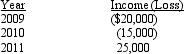 How much can Samantha deduct in 2009 and 2010? What is her taxable income from the activity in 2011? (Consider both the at-risk rules as well as the passive loss rules. )
 (78)
 Verified
If losses were limited only by the at-risk rules,Samantha would be able to deduct the following amounts in 2009 and 2010.
 *Allowed under the at-risk rules,then reclassified as passive losses and subject to the passive loss limitations.
However,the losses are limited by the passive loss rules as follows:
 In 2011,the $25,000 income increases Samantha's at-risk amount to $25,000 so she is now allowed to deduct the $20,000 of disallowed losses.The $25,000 is passive income,which can be offset by $25,000 of suspended losses,leaving a suspended loss of $10,000.At the end of 2011,Samantha has no unused losses under the at-risk rules,$10,000 of suspended passive losses,and a $5,000 at-risk amount ($15,000 at-risk amount on 1/1/09 - $15,000 loss in 2009 - $0 loss in 2010 + $25,000 income in 2011 - $20,000 reclassified passive loss in 2011).
Joyce,an attorney,earns $100,000 from her law practice in the current year.In addition,she receives $35,000 in dividends and interest during the year.Further,she incurs a loss of $35,000 from an investment in a passive activity.What is Joyce's AGI for the year after considering the passive investment?
(83) VerifiedJoyce cannot deduct the passive loss against active or portfolio income.Therefore,her AGI after considering the passive investment is $135,000 ($100,000 active income + $35,000 portfolio income).
In 2010,Emily invests $100,000 in a limited partnership that is not a passive activity.During 2010,her share of the partnership loss is $70,000.In 2011,her share of the partnership loss is $50,000.How much can Emily deduct in 2010 and 2011?
(75) VerifiedAlthough the passive loss rules do not apply,the at-risk rules limit Emily's deductions.She can deduct $70,000 in 2010 and her at-risk amount will be reduced to $30,000 ($100,000 - $70,000 deducted).She will be limited to a $30,000 deduction in 2011 unless she increases her amount at risk.For example,if Emily invests an additional $20,000 in 2010,her at-risk amount would be $50,000 ($30,000 balance + $20,000 additional investment),and she would be able to deduct the entire $50,000 loss in 2011.
Paul owns and actively participates in the operations of an apartment building which produces a $40,000 loss during the year.He has AGI of $150,000 from an active business.He may not deduct any of the loss.
(86) Hugh has four passive activities.The following income and losses are generated in the current year.
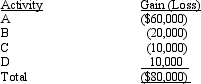 How much of the $80,000 net passive loss can Hugh deduct this year? Calculate the suspended losses (by activity).
 (78) Faye dies owning an interest in a passive activity property (adjusted basis of $150,000,suspended losses of $52,000,and a fair market value of $180,000).What,if any,can be deducted on her final income tax return?
(78) Tess owns a building in which she rents apartments to tenants and operates a restaurant.Which of the following statements is incorrect?
(82) In 2009,Kelly,who earns a salary of $200,000,invests $40,000 for a 20% interest in a partnership not subject to the passive loss rules.Through the use of $800,000 of nonrecourse financing,the partnership acquires assets worth $1 million.Depreciation,interest,and other deductions related to the activity produce a loss of $150,000,of which Kelly's share is $30,000.In 2010,Kelly's share of the loss from the partnership is $15,000.How much of the loss from the partnership can Kelly deduct?
(80) Rita earns a salary of $150,000,and invests $40,000 for a 20% interest in a passive activity.Operations of the activity result in a loss of $250,000,of which Rita's share is $50,000.How is her loss characterized?
(80) Maria,who owns a 50% interest in a restaurant,has been a material participant in the restaurant activity for the last 20 years.She retired from the restaurant at the end of last year and will not participate in the restaurant activity in the future.However,she continues to be a material participant in a retail store in which she is a 50% partner.The restaurant operations produce a loss for the current year,and Maria's share of the loss is $80,000.Her share of the income from the retail store is $150,000.She does not own interests in any other activities.
(77) Rachel acquired a passive activity several years ago.Until 2007,the activity was profitable,and Rachel's at-risk amount at the beginning of 2007 was $300,000.The activity produced losses for Rachel of $80,000 in 2007,$50,000 in 2008,and $70,000 in 2009.In 2010,the activity produced income of $90,000.How much is Rachel's suspended passive loss at the beginning of 2011?
(76) Vic's at-risk amount in a passive activity is $200,000 at the beginning of the current year.His current loss from the activity is $80,000.Vic had no passive activity income during the year.At the end of the current year:
(71) Several years ago,Joy acquired a passive activity.Until 2008,the activity was profitable.Joy's at-risk amount at the beginning of 2008 was $250,000.The activity produced losses of $100,000 in 2008,$80,000 in 2009,and $90,000 in 2010.During the same period,no passive income was recognized.How much is suspended under the at-risk rules and the passive loss rules at the beginning of 2011? At-risk Passive loss
(75) Which of the following factors should be considered in determining whether an activity is treated as an appropriate economic unit?
(77) Sherri owns an interest in a business that is not a passive activity and in which she has $20,000 at risk.If the business incurs a $32,000 loss from operations during the year,this loss will be fully deductible.
(85) Anne sells a rental house for $100,000 that has an adjusted basis of $55,000.During the years of her ownership,$60,000 of losses have been incurred that were suspended under the passive activity loss rules.Determine the tax treatment to Anne on the disposition of the property.
(73) Ken has a $40,000 loss from an investment in a partnership in which he does not materially participate.He paid $30,000 for his interest.How much of the loss is disallowed by the at-risk rules? How much is disallowed by the passive loss rules?
(92) Investment income includes gross income from interest,dividends,annuities,and royalties not derived in the ordinary course of a trade or business;income from a passive activity;and income from a real estate activity in which the taxpayer actively participates.
(92) Jack owns a 10% interest in a partnership (not real estate)in which his at-risk amount is $42,000 at the beginning of the year.During the year,the partnership borrows $80,000 on a nonrecourse note and incurs a loss of $60,000 from operations.Jack's at-risk amount at the end of the year is $44,000.
(78) Which of the following is not a factor that should be considered in determining whether an activity is treated as an appropriate economic unit?
(84) 
Filters
- Essay(0)
- Multiple Choice(0)
- Short Answer(0)
- True False(0)
- Matching(0)