



 Chat with AI
Exam 15: Monopoly and Antitrust Policy

Exam 1: Economics: Foundations and Models233 Questions
Exam 2: Trade-Offs, comparative Advantage, and the Market System259 Questions
Exam 3: Where Prices Come From: the Interaction of Demand and Supply242 Questions
Exam 4: Economic Efficiency, government Price Setting, and Taxes208 Questions
Exam 5: Externalities, environmental Policy, and Public Goods267 Questions
Exam 6: Elasticity: The Responsiveness of Demand and Supply295 Questions
Exam 7: The Economics of Health Care169 Questions
Exam 8: Firms, the Stock Market, and Corporate Governance278 Questions
Exam 9: Comparative Advantage and the Gains From International Trade189 Questions
Exam 10: Consumer Choice and Behavioral Economics302 Questions
Exam 11: Technology, production, and Costs330 Questions
Exam 12: Firms in Perfectly Competitive Markets298 Questions
Exam 13: Monopolistic Competition: the Competitive Model in a More Realistic Setting278 Questions
Exam 14: Oligopoly: Firms in Less Competitive Markets262 Questions
Exam 15: Monopoly and Antitrust Policy271 Questions
Exam 16: Pricing Strategy263 Questions
Exam 17: The Markets for Labor and Other Factors of Production286 Questions
Exam 18: Public Choice,taxes,and the Distribution of Income258 Questions
Select questions type


A narrow definition of monopoly is that a firm is a monopoly if it can ignore
(Multiple Choice)
4.7/5  (78)
(78) If a monopolist's price is $50 at the output where marginal revenue equals marginal cost and average total cost is $43,then the incremental profit from the last unit sold is $7.
(True/False)
4.8/5 (72)
(72) Explain whether a monopoly that maximizes profit will also be maximizing revenue and production.
(Essay)
4.9/5 (78)
(78) Baxter International,a manufacturer of hospital supplies,acquired American Hospital Supply,a distributor of hospital supplies.This is an example of
(Multiple Choice)
4.7/5 (90)
(90) Microsoft hires marketing and sales specialists to decide what prices it should set for its products,whereas a wealthy corn farmer in Iowa,who sells his output in the world commodity market,does not.Why is this so?
(Multiple Choice)
4.7/5 (85)
(85) How do the price and quantity of a monopoly compare to that of a perfectly competitive industry?
(Essay)
4.7/5 (87)
(87) Holding everything else constant,government approval of horizontal mergers is more likely to be granted if the "market" that firms are in are broadly defined rather than narrowly defined.
(True/False)
4.9/5 (83)
(83) Consider an industry that is made up of nine firms each with a market share (percent of sales)as follows:
a.Firm A: 30%
b.Firm B: 20%
c.Firms C,D and E: 10% each
d.Firms F,G,H and J: 5% each
What is the value of the Herfindahl-Hirschman Index and how is the industry categorized?
(Multiple Choice)
4.9/5 (78)
(78) The possibility that the economy may benefit from having market power,rather than being very competitive,is closely identified with which famous economist?
(Multiple Choice)
5.0/5 (67)
(67) Figure 15-5 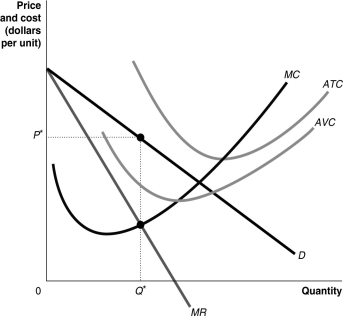 -Refer to Figure 15-5.If the monopolist charges price P* for output Q*,in order to maximize profit or minimize loss in the short run,it should
 (Multiple Choice)
4.8/5 (80)
(80) The De Beers diamond mining and marketing company of South Africa became one of the most profitable and longest-lived monopolies in history.Which of the following has always threatened De Beers' control of the diamond market?
(Multiple Choice)
4.9/5 (87)
(87) Figure 15-8 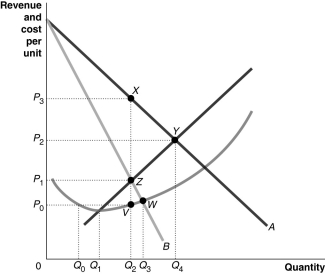 Figure 15-8 reflects the cost and revenue structure for a monopoly that has been in business for a very long time.
-Refer to Figure 15-8.Use the figure above to answer the following questions.
a. Identify the curves labeled A and B.Identify the curve which contains both point Y and point Z.Identify the curve which contains both point V and point W.
b.What is the profit-maximizing quantity and what price will the monopolist charge?
c.What area represents total revenue at the profit-maximizing output level?
d.What area represents total cost at the profit-maximizing output level?
e.What area represents profit?
f.What is the profit per unit (average profit)at the profit-maximizing output level?
g.If this industry was organized as a perfectly competitive industry,what would be the profit-maximizing price and quantity?
h.What area represents the deadweight loss as a result of a monopoly?
Figure 15-8 reflects the cost and revenue structure for a monopoly that has been in business for a very long time.
-Refer to Figure 15-8.Use the figure above to answer the following questions.
a. Identify the curves labeled A and B.Identify the curve which contains both point Y and point Z.Identify the curve which contains both point V and point W.
b.What is the profit-maximizing quantity and what price will the monopolist charge?
c.What area represents total revenue at the profit-maximizing output level?
d.What area represents total cost at the profit-maximizing output level?
e.What area represents profit?
f.What is the profit per unit (average profit)at the profit-maximizing output level?
g.If this industry was organized as a perfectly competitive industry,what would be the profit-maximizing price and quantity?
h.What area represents the deadweight loss as a result of a monopoly? (Essay)
4.8/5 (72)
(72) Figure 15-6  Figure 15-6 shows the cost and demand curves for a monopolist.
-Refer to Figure 15-6.The monopolist earns a profit of
Figure 15-6 shows the cost and demand curves for a monopolist.
-Refer to Figure 15-6.The monopolist earns a profit of (Multiple Choice)
5.0/5 (87)
(87) Which of the following statements applies to a monopolist but not to a perfectly competitive firm at their profit maximizing outputs?
(Multiple Choice)
4.9/5 (81)
(81) If a monopolist's marginal revenue is $25 a unit and its marginal cost is $25,then
(Multiple Choice)
4.7/5 (82)
(82) Figure 15-4  Figure 15-4 shows the demand and cost curves for a monopolist.
-Refer to Figure 15-4.What is the amount of the monopoly's profit?
Figure 15-4 shows the demand and cost curves for a monopolist.
-Refer to Figure 15-4.What is the amount of the monopoly's profit? (Multiple Choice)
4.9/5 (79)
(79) A monopolist's demand curve is the same as the marginal revenue curve for the product.
(True/False)
4.8/5 (78)
(78) 
Filters
- Essay(0)
- Multiple Choice(0)
- Short Answer(0)
- True False(0)
- Matching(0)