



 Chat with AI
Exam 15: Monopoly and Antitrust Policy

Exam 1: Economics: Foundations and Models233 Questions
Exam 2: Trade-Offs, comparative Advantage, and the Market System259 Questions
Exam 3: Where Prices Come From: the Interaction of Demand and Supply242 Questions
Exam 4: Economic Efficiency, government Price Setting, and Taxes208 Questions
Exam 5: Externalities, environmental Policy, and Public Goods267 Questions
Exam 6: Elasticity: The Responsiveness of Demand and Supply295 Questions
Exam 7: The Economics of Health Care169 Questions
Exam 8: Firms, the Stock Market, and Corporate Governance278 Questions
Exam 9: Comparative Advantage and the Gains From International Trade189 Questions
Exam 10: Consumer Choice and Behavioral Economics302 Questions
Exam 11: Technology, production, and Costs330 Questions
Exam 12: Firms in Perfectly Competitive Markets298 Questions
Exam 13: Monopolistic Competition: the Competitive Model in a More Realistic Setting278 Questions
Exam 14: Oligopoly: Firms in Less Competitive Markets262 Questions
Exam 15: Monopoly and Antitrust Policy271 Questions
Exam 16: Pricing Strategy263 Questions
Exam 17: The Markets for Labor and Other Factors of Production286 Questions
Exam 18: Public Choice,taxes,and the Distribution of Income258 Questions
Select questions type


Consider an industry that is made up of six firms with the following market shares: Firm A - 50%,Firm B - 20%,Firms C and D - 10% each,and Firms E and F - 5% each.What is the value of the Herfindahl-Hirschman Index and how will the industry be categorized?
(Multiple Choice)
4.9/5  (85)
(85) Figure 15-11  In 2011, Verizon was granted permission to enter the market for cable TV in Upstate New York, ending the virtual monopoly that Time Warner Cable had in most local communities in the region. Figure 15-11 shows the cable television market in Upstate New York.
-Refer to Figure 15-11.Suppose the local government imposes a $2.50 per month tax on cable companies.What happens to the price charged by the cable company following the imposition of this tax?
In 2011, Verizon was granted permission to enter the market for cable TV in Upstate New York, ending the virtual monopoly that Time Warner Cable had in most local communities in the region. Figure 15-11 shows the cable television market in Upstate New York.
-Refer to Figure 15-11.Suppose the local government imposes a $2.50 per month tax on cable companies.What happens to the price charged by the cable company following the imposition of this tax? (Multiple Choice)
4.9/5 (76)
(76) Why are laws aimed at regulating monopolies called "antitrust" laws?
(Multiple Choice)
4.9/5 (84)
(84) If a theatre company expects $250,000 in ticket revenue from five performances and $288,000 in ticket revenue if it adds a sixth performance,the
(Multiple Choice)
4.8/5 (85)
(85) Table 15-3
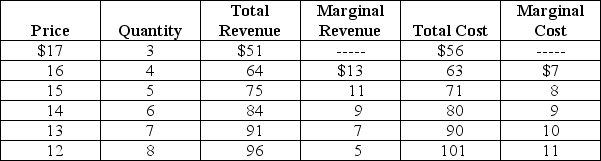 Assume Table 15-3 gives the monthly demand and costs for subscriptions to basic cable for Comcast, a cable television monopoly in Philadelphia.
-Refer to Table 15-3.If Comcast maximizes its profits how much profit will it earn?
Assume Table 15-3 gives the monthly demand and costs for subscriptions to basic cable for Comcast, a cable television monopoly in Philadelphia.
-Refer to Table 15-3.If Comcast maximizes its profits how much profit will it earn? (Multiple Choice)
4.8/5 (86)
(86) If a per-unit tax on output sold is imposed on a monopoly's product,the monopolist will increase its market price by the full amount of the tax.
(True/False)
4.9/5 (78)
(78) For a natural monopoly,the marginal cost of producing an additional unit of its product is relatively small.
(True/False)
4.9/5 (83)
(83) One reason patent protection is vitally important to pharmaceutical firms is
(Multiple Choice)
4.9/5 (67)
(67) Figure 15-15  Figure 15-15 shows the cost and demand curves for the Erickson Power Company.
-Refer to Figure 15-15.What is the economically efficient output level and what is the price at that level?
Figure 15-15 shows the cost and demand curves for the Erickson Power Company.
-Refer to Figure 15-15.What is the economically efficient output level and what is the price at that level? (Multiple Choice)
4.8/5 (68)
(68) If a monopolist's price is $50 at 63 units of output and marginal revenue equals marginal cost and average total cost equals $43,then the firm's total profit is
(Multiple Choice)
4.8/5 (82)
(82) Figure 15-12  Figure 15-12 shows the cost and demand curves for a monopolist.
-Refer to Figure 15-12.What is the amount of consumer surplus if,instead of monopoly,the industry was organized as a perfectly competitive industry?
Figure 15-12 shows the cost and demand curves for a monopolist.
-Refer to Figure 15-12.What is the amount of consumer surplus if,instead of monopoly,the industry was organized as a perfectly competitive industry? (Multiple Choice)
4.9/5 (83)
(83) What happens to a monopoly's revenue when it sells more units of its product?
(Essay)
4.8/5 (75)
(75) In the United States,government policies with respect to monopolies and collusion are embodied in
(Multiple Choice)
4.7/5 (77)
(77) Equilibrium in a perfectly competitive market results in the greatest amount of economic surplus,or total benefit to society,from the production of a good.Why,then,did Joseph Schumpeter argue that an economy may benefit more from firms that have market power than from firms that are perfectly competitive?
(Essay)
4.8/5 (68)
(68) Firms do not have market power in which of the following market structures?
(Multiple Choice)
4.8/5 (83)
(83) A snack shop inside a hotel in a busy city has a monopoly on food sales if it is the only food vendor in the hotel that is open 24 hours a day.
(True/False)
4.8/5 (94)
(94) 
Filters
- Essay(0)
- Multiple Choice(0)
- Short Answer(0)
- True False(0)
- Matching(0)