



 Chat with AI
Exam 15: Monopoly and Antitrust Policy

Exam 1: Economics: Foundations and Models233 Questions
Exam 2: Trade-Offs, comparative Advantage, and the Market System259 Questions
Exam 3: Where Prices Come From: the Interaction of Demand and Supply242 Questions
Exam 4: Economic Efficiency, government Price Setting, and Taxes208 Questions
Exam 5: Externalities, environmental Policy, and Public Goods267 Questions
Exam 6: Elasticity: The Responsiveness of Demand and Supply295 Questions
Exam 7: The Economics of Health Care169 Questions
Exam 8: Firms, the Stock Market, and Corporate Governance278 Questions
Exam 9: Comparative Advantage and the Gains From International Trade189 Questions
Exam 10: Consumer Choice and Behavioral Economics302 Questions
Exam 11: Technology, production, and Costs330 Questions
Exam 12: Firms in Perfectly Competitive Markets298 Questions
Exam 13: Monopolistic Competition: the Competitive Model in a More Realistic Setting278 Questions
Exam 14: Oligopoly: Firms in Less Competitive Markets262 Questions
Exam 15: Monopoly and Antitrust Policy271 Questions
Exam 16: Pricing Strategy263 Questions
Exam 17: The Markets for Labor and Other Factors of Production286 Questions
Exam 18: Public Choice,taxes,and the Distribution of Income258 Questions
Select questions type


Figure 15-1  -Refer to Figure 15-1.Which of the following statements about the firm depicted in the diagram is true?
 (Multiple Choice)
4.9/5  (60)
(60) Figure 15-16  Figure 15-16 shows the market demand and cost curves facing a natural monopoly.
-Refer to Figure 15-16.Suppose the government regulates this industry in order to remove the inefficiency implied by the behavior of the profit maximizing owners.If regulators require that the firm produces the economically efficient output level,what is this level and what price will be charged?
Figure 15-16 shows the market demand and cost curves facing a natural monopoly.
-Refer to Figure 15-16.Suppose the government regulates this industry in order to remove the inefficiency implied by the behavior of the profit maximizing owners.If regulators require that the firm produces the economically efficient output level,what is this level and what price will be charged? (Multiple Choice)
4.9/5 (88)
(88) Figure 15-3  Figure 15-3 above shows the demand and cost curves facing a monopolist.
-Refer to Figure 15-3.What happens to the monopolist represented in the diagram in the long run?
Figure 15-3 above shows the demand and cost curves facing a monopolist.
-Refer to Figure 15-3.What happens to the monopolist represented in the diagram in the long run? (Multiple Choice)
4.9/5 (84)
(84) If a natural monopoly regulatory commission sets a price where marginal cost is equal to demand
(Multiple Choice)
4.9/5 (76)
(76) A possible advantage of a horizontal merger for the economy is that
(Multiple Choice)
4.9/5 (90)
(90) Some economists believe that the economy benefits from firms having market power.Which of the following is an argument that has been made to support this position?
(Multiple Choice)
4.8/5 (85)
(85) Table 15-2
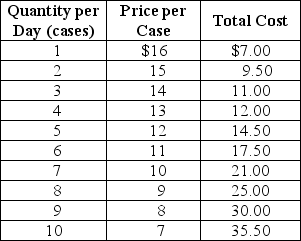 The government of a small developing country has granted exclusive rights to Linden Enterprises for the production of plastic syringes. Table 15-2 shows the cost and demand data for this government protected monopolist.
-Refer to Table 15-2.What is the amount of profit that the firm earns?
The government of a small developing country has granted exclusive rights to Linden Enterprises for the production of plastic syringes. Table 15-2 shows the cost and demand data for this government protected monopolist.
-Refer to Table 15-2.What is the amount of profit that the firm earns? (Multiple Choice)
5.0/5 (72)
(72) Because a monopoly's demand curve is the same as the market demand curve for its product
(Multiple Choice)
4.8/5 (70)
(70) Figure 15-16 Figure 15-16 shows the market demand and cost curves facing a natural monopoly.
-Refer to Figure 15-16.Which of the following would be true if government regulators require the natural monopoly to produce at the economically efficient output level?
Figure 15-16 shows the market demand and cost curves facing a natural monopoly.
-Refer to Figure 15-16.Which of the following would be true if government regulators require the natural monopoly to produce at the economically efficient output level? (Multiple Choice)
4.9/5 (78)
(78) Consider two industries,industry Q and industry Z.In industry Q there are 10 companies,each with a market share of 10% of total sales.In industry Z,there are eight companies.One company has a 65% market share and each of the other seven firms has a market share of 5%.
a.Calculate the four-firm concentration ratio for each industry.
b.Calculate the Herfindahl-Hirschman Index (HHI)for each industry.
c.What do the values of the two concentration measures imply about the degree of market power in the two industries?
(Essay)
4.7/5 (75)
(75) When a proposed merger between two companies is reviewed by the government,the relevant market is defined by
(Multiple Choice)
4.9/5 (73)
(73) The Google search engine has a market share of ________ in the United States and ________ in Europe.
(Multiple Choice)
4.9/5 (85)
(85) Figure 15-15  Figure 15-15 shows the cost and demand curves for the Erickson Power Company.
-Refer to Figure 15-15.If the government regulates Erickson Power Company so that the firm can earn a normal profit,the price would be set at ________ and the output level is ________.
Figure 15-15 shows the cost and demand curves for the Erickson Power Company.
-Refer to Figure 15-15.If the government regulates Erickson Power Company so that the firm can earn a normal profit,the price would be set at ________ and the output level is ________. (Multiple Choice)
4.8/5 (83)
(83) Figure 15-16 Figure 15-16 shows the market demand and cost curves facing a natural monopoly.
-Refer to figure 15-16.In the absence of any government regulation,the profit-maximizing owners of this firm will produce ________ units and charge a price of ________.
Figure 15-16 shows the market demand and cost curves facing a natural monopoly.
-Refer to figure 15-16.In the absence of any government regulation,the profit-maximizing owners of this firm will produce ________ units and charge a price of ________. (Multiple Choice)
4.8/5 (63)
(63) Figure 15-11  In 2011, Verizon was granted permission to enter the market for cable TV in Upstate New York, ending the virtual monopoly that Time Warner Cable had in most local communities in the region. Figure 15-11 shows the cable television market in Upstate New York.
-Refer to Figure 15-11.What is the size of the deadweight loss prior to Verizon entering the market and what happens to this deadweight loss after Verizon does enter the market?
In 2011, Verizon was granted permission to enter the market for cable TV in Upstate New York, ending the virtual monopoly that Time Warner Cable had in most local communities in the region. Figure 15-11 shows the cable television market in Upstate New York.
-Refer to Figure 15-11.What is the size of the deadweight loss prior to Verizon entering the market and what happens to this deadweight loss after Verizon does enter the market? (Multiple Choice)
4.8/5 (85)
(85) How does a network externality serve as a barrier to entry? Is this barrier surmountable? Explain.
(Essay)
4.9/5 (74)
(74) If a restaurant was a natural monopoly,dividing the restaurant equally into two separate restaurants would
(Multiple Choice)
4.8/5 (71)
(71) 
Filters
- Essay(0)
- Multiple Choice(0)
- Short Answer(0)
- True False(0)
- Matching(0)