



 Chat with AI
Exam 29: Heredity

Exam 1: The Human Body: an Orientation118 Questions
Exam 2: Chemistry Comes Alive137 Questions
Exam 3: Cells: the Living Units131 Questions
Exam 4: Tissue: the Living Fabric109 Questions
Exam 5: The Integumentary System112 Questions
Exam 6: Bones and Skeletal Tissue106 Questions
Exam 7: The Skeleton125 Questions
Exam 8: Joints103 Questions
Exam 9: Muscles and Muscle Tissue129 Questions
Exam 10: The Muscular System100 Questions
Exam 11: Fundamentals of the Nervous System and Nervous Tissue95 Questions
Exam 12: The Central Nervous System138 Questions
Exam 13: The Peripheral Nervous System and Reflex Activity103 Questions
Exam 14: The Autonomic Nervous System103 Questions
Exam 15: The Special Senses147 Questions
Exam 16: The Endocrine System129 Questions
Exam 17: Blood126 Questions
Exam 18: The Cardiovascular System: the Heart107 Questions
Exam 19: The Cardiovascular System: Blood Vessels133 Questions
Exam 20: The Lymphatic System and Lymphoid Organs and Tissues88 Questions
Exam 21: The Immune System: Innate and Adaptive Body Defenses124 Questions
Exam 22: The Respiratory System123 Questions
Exam 23: The Digestive System148 Questions
Exam 24: Nutrition,metabolism,and Body Temperature Regulation123 Questions
Exam 25: The Urinary System129 Questions
Exam 26: Fluid,electrolyte,and Acid-Base Balance110 Questions
Exam 27: The Reproductive System131 Questions
Exam 28: Pregnancy and Human Development99 Questions
Exam 29: Heredity120 Questions
Select questions type


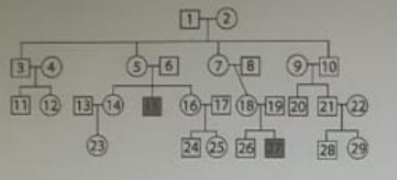 Figure 29.2
Use Figure 29.2 to answer the following:
-Is the trait dominant or recessive?
Figure 29.2
Use Figure 29.2 to answer the following:
-Is the trait dominant or recessive? (Short Answer)
4.8/5  (80)
(80) When two genes are on the same chromosome,they are considered linked.
(True/False)
4.7/5 (90)
(90) Which of the following statements is true concerning genetic screening?
(Multiple Choice)
4.8/5 (74)
(74) The expression of all physical traits is strictly due to the inheritance of specific genes.
(True/False)
4.9/5 (78)
(78) Match the following:
-The gene allele that suppresses or masks the expression of the other allele.
(Multiple Choice)
4.9/5 (82)
(82) Match the following:
-Results in chromosomes that have mixed contributions from each parent.
(Multiple Choice)
4.8/5 (76)
(76) Match the following:
-A chromosome pair that may be very different in size.
(Multiple Choice)
4.9/5 (67)
(67) Match the following:
-A disorder of brain lipid metabolism.
(Multiple Choice)
4.8/5 (78)
(78) Assume that the allele controlling brown eyes (B)is dominant over that controlling blue eyes (B)in human beings.(In actuality,eye color in humans is an example of polygene inheritance,which is much more complex than this.)A blue-eyed man marries a brown-eyed woman,and they have six children,all brown-eyed.What is the most likely genotype of the father? What is the most likely genotype of the mother? If a seventh child had blue eyes,what can you conclude about the parents' genotypes?
(Essay)
4.7/5 (78)
(78) Environmentally produced phenotypes that mimic conditions that may be caused by genetic mutation are called phenocopies.
(True/False)
4.8/5 (82)
(82) The ABO blood type is a good example of a(n)________ inheritance.
(Short Answer)
5.0/5 (85)
(85) Match the following:
-Inheritance that results in continuous or qualitative phenotypic variations between two extremes; an example is skin color.
(Multiple Choice)
4.9/5 (70)
(70) Match the following:
-Chromosomes regulating most body characteristics.
(Multiple Choice)
4.9/5 (78)
(78) In humans,farsightedness is inherited by possession of a dominant gene.If a man who is homozygous for normal vision (aa)marries a woman who is heterozygous for farsightedness,what proportion of their children would be expected to be farsighted?
(Essay)
4.9/5 (67)
(67) For which of the following are newborn infants not routinely screened at birth?
(Multiple Choice)
4.8/5 (86)
(86) Dominant alleles are so called because under most circumstances they ________.
(Multiple Choice)
5.0/5 (75)
(75) 
Filters
- Essay(0)
- Multiple Choice(0)
- Short Answer(0)
- True False(0)
- Matching(0)