



 Chat with AI
Exam 23: The Digestive System

Exam 1: The Human Body: an Orientation118 Questions
Exam 2: Chemistry Comes Alive137 Questions
Exam 3: Cells: the Living Units131 Questions
Exam 4: Tissue: the Living Fabric109 Questions
Exam 5: The Integumentary System112 Questions
Exam 6: Bones and Skeletal Tissue106 Questions
Exam 7: The Skeleton125 Questions
Exam 8: Joints103 Questions
Exam 9: Muscles and Muscle Tissue129 Questions
Exam 10: The Muscular System100 Questions
Exam 11: Fundamentals of the Nervous System and Nervous Tissue95 Questions
Exam 12: The Central Nervous System138 Questions
Exam 13: The Peripheral Nervous System and Reflex Activity103 Questions
Exam 14: The Autonomic Nervous System103 Questions
Exam 15: The Special Senses147 Questions
Exam 16: The Endocrine System129 Questions
Exam 17: Blood126 Questions
Exam 18: The Cardiovascular System: the Heart107 Questions
Exam 19: The Cardiovascular System: Blood Vessels133 Questions
Exam 20: The Lymphatic System and Lymphoid Organs and Tissues88 Questions
Exam 21: The Immune System: Innate and Adaptive Body Defenses124 Questions
Exam 22: The Respiratory System123 Questions
Exam 23: The Digestive System148 Questions
Exam 24: Nutrition,metabolism,and Body Temperature Regulation123 Questions
Exam 25: The Urinary System129 Questions
Exam 26: Fluid,electrolyte,and Acid-Base Balance110 Questions
Exam 27: The Reproductive System131 Questions
Exam 28: Pregnancy and Human Development99 Questions
Exam 29: Heredity120 Questions
Select questions type


Select the best explanation for why protease enzymes are secreted in inactive forms.
(Multiple Choice)
5.0/5  (77)
(77) Which of the following are types of papillae on the tongue that contain taste buds?
(Multiple Choice)
4.7/5 (85)
(85) 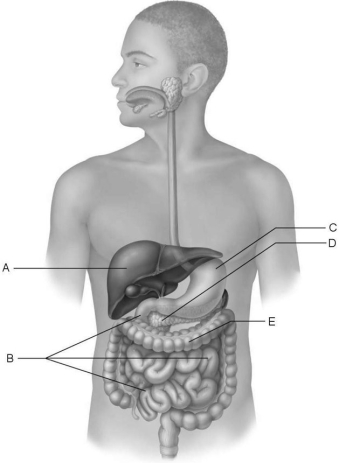 Figure 23.3
Using Figure 23.3, match the following:
-Produces intrinsic factor.
Figure 23.3
Using Figure 23.3, match the following:
-Produces intrinsic factor. (Multiple Choice)
4.9/5 (92)
(92) Which of the following enzymes would be most active in the presents of a high concentrations of protein fragments?
(Multiple Choice)
4.8/5 (64)
(64) The capillaries that nourish the epithelium and absorb digested nutrients lie in the ________.
(Multiple Choice)
4.8/5 (68)
(68) The bolus is liquefied in the ________ and it is now called chyme.
(Multiple Choice)
4.8/5 (80)
(80) Match the following:
-Enzymatic breakdown of any type of food molecule.
(Multiple Choice)
4.7/5 (88)
(88) The pharyngeal-esophageal phase of swallowing is involuntary and is controlled by the swallowing center in the thalamus and lower pons.
(True/False)
4.8/5 (95)
(95) Mumps is an inflammation of the parotid glands caused by myxovirus.
(True/False)
4.8/5 (76)
(76) Jose is brought to the emergency room complaining of a burning sensation in his chest,increased salivation,and difficulty in swallowing.He is having difficulty breathing and feels the presence of a "lump in his throat." The diagnosis is gastroesophageal reflux disease.Explain.
(Essay)
4.9/5 (74)
(74) The protective outermost layer of the esophagus is the ________.
(Short Answer)
4.9/5 (83)
(83) Stellate macrophages are found in the liver and are responsible for removing bacteria and worn-out cells.
(True/False)
4.8/5 (76)
(76) The major stimulus for production of intestinal fluid is distention or irritation of the intestinal mucosa by hypertonic or acidic chyme.
(True/False)
5.0/5 (73)
(73) Which of the following is (are)not important as a stimulus in the gastric phase of gastric secretion?
(Multiple Choice)
4.9/5 (78)
(78) A 45-year-old patient was admitted to the hospital with a diagnosis of cirrhosis of the liver.He is thin and malnourished.His abdomen is very large due to an accumulation of fluid in the abdominal cavity.His lower extremities are very swollen.Explain why these changes have occurred.
(Essay)
4.7/5 (65)
(65) 
Filters
- Essay(0)
- Multiple Choice(0)
- Short Answer(0)
- True False(0)
- Matching(0)