



 Chat with AI
Exam 16: The Endocrine System

Exam 1: The Human Body: an Orientation118 Questions
Exam 2: Chemistry Comes Alive137 Questions
Exam 3: Cells: the Living Units131 Questions
Exam 4: Tissue: the Living Fabric109 Questions
Exam 5: The Integumentary System112 Questions
Exam 6: Bones and Skeletal Tissue106 Questions
Exam 7: The Skeleton125 Questions
Exam 8: Joints103 Questions
Exam 9: Muscles and Muscle Tissue129 Questions
Exam 10: The Muscular System100 Questions
Exam 11: Fundamentals of the Nervous System and Nervous Tissue95 Questions
Exam 12: The Central Nervous System138 Questions
Exam 13: The Peripheral Nervous System and Reflex Activity103 Questions
Exam 14: The Autonomic Nervous System103 Questions
Exam 15: The Special Senses147 Questions
Exam 16: The Endocrine System129 Questions
Exam 17: Blood126 Questions
Exam 18: The Cardiovascular System: the Heart107 Questions
Exam 19: The Cardiovascular System: Blood Vessels133 Questions
Exam 20: The Lymphatic System and Lymphoid Organs and Tissues88 Questions
Exam 21: The Immune System: Innate and Adaptive Body Defenses124 Questions
Exam 22: The Respiratory System123 Questions
Exam 23: The Digestive System148 Questions
Exam 24: Nutrition,metabolism,and Body Temperature Regulation123 Questions
Exam 25: The Urinary System129 Questions
Exam 26: Fluid,electrolyte,and Acid-Base Balance110 Questions
Exam 27: The Reproductive System131 Questions
Exam 28: Pregnancy and Human Development99 Questions
Exam 29: Heredity120 Questions
Select questions type


Which of the following is NOT a change typically produced by a hormonal stimulus?
(Multiple Choice)
4.8/5  (75)
(75) Glucagon and insulin both target the cells of the liver and are both made in the pancreas,yet they have very different effects on the cells they target.What accounts for this fact?
(Essay)
4.9/5 (78)
(78) 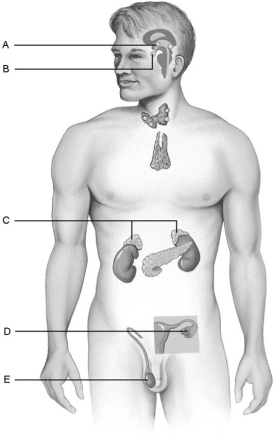 Figure 16.1
Using Figure 16.1, match the following:
-Produce hormones involved in electrolyte balance and the stress response.
Figure 16.1
Using Figure 16.1, match the following:
-Produce hormones involved in electrolyte balance and the stress response. (Multiple Choice)
4.8/5 (80)
(80) Dave has discovered a new lipid-soluble hormone.Which of the following is true regarding this hormone?
(Multiple Choice)
4.9/5 (80)
(80) Virtually all amino acid-based hormones exert their signaling effects through intracellular ________.
(Multiple Choice)
4.8/5 (71)
(71) The second-messenger mechanism of hormone action operates by ________.
(Multiple Choice)
4.8/5 (80)
(80) Mineralocorticoid is to aldosterone as glucocorticoid is to ________.
(Multiple Choice)
4.8/5 (90)
(90) Which hormone has only one known effect: to stimulate milk production by the breasts?
(Multiple Choice)
4.9/5 (68)
(68) The endocrine gland that is probably malfunctioning if a person has a high metabolic rate is the parathyroid.
(True/False)
4.9/5 (69)
(69)
Figure 16.1
Using Figure 16.1, match the following:
-Produces the hormones that direct the production of the secondary male sex characteristics.
Figure 16.1
Using Figure 16.1, match the following:
-Produces the hormones that direct the production of the secondary male sex characteristics. (Multiple Choice)
4.9/5 (91)
(91) List three factors that target cell activation depends on,after the hormone binds to the receptor.
(Essay)
4.8/5 (79)
(79) 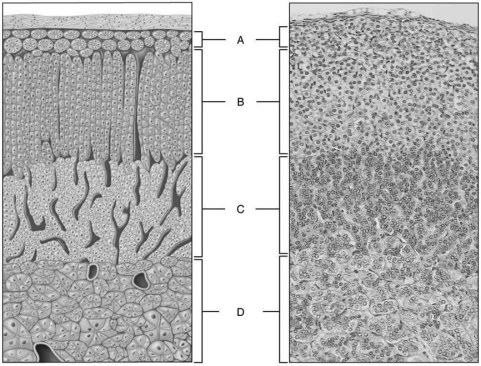 Figure 16.3
Using Figure 16.3, match the following:
-Produces aldosterone.
Figure 16.3
Using Figure 16.3, match the following:
-Produces aldosterone. (Multiple Choice)
5.0/5 (72)
(72)
Figure 16.1
Using Figure 16.1, match the following:
-Produces hormones and is considered a neuroendocrine organ.
Figure 16.1
Using Figure 16.1, match the following:
-Produces hormones and is considered a neuroendocrine organ. (Multiple Choice)
4.8/5 (84)
(84) Figure 16.3
Using Figure 16.3, match the following:
-Hormones mimic sympathetic nervous system neurotransmitters.
Figure 16.3
Using Figure 16.3, match the following:
-Hormones mimic sympathetic nervous system neurotransmitters. (Multiple Choice)
4.9/5 (91)
(91) The ability of a specific tissue or organ to respond to the presence of a hormone is dependent on ________.
(Multiple Choice)
4.7/5 (90)
(90) Which of the following can act on receptors inside the target cell that directly activate specific genes?
(Multiple Choice)
4.9/5 (66)
(66) What ion is sometimes used as a second messenger of amino acid-based hormones?
(Multiple Choice)
4.9/5 (84)
(84) 
Filters
- Essay(0)
- Multiple Choice(0)
- Short Answer(0)
- True False(0)
- Matching(0)