



 Chat with AI
Exam 10: The Muscular System

Exam 1: The Human Body: an Orientation118 Questions
Exam 2: Chemistry Comes Alive137 Questions
Exam 3: Cells: the Living Units131 Questions
Exam 4: Tissue: the Living Fabric109 Questions
Exam 5: The Integumentary System112 Questions
Exam 6: Bones and Skeletal Tissue106 Questions
Exam 7: The Skeleton125 Questions
Exam 8: Joints103 Questions
Exam 9: Muscles and Muscle Tissue129 Questions
Exam 10: The Muscular System100 Questions
Exam 11: Fundamentals of the Nervous System and Nervous Tissue95 Questions
Exam 12: The Central Nervous System138 Questions
Exam 13: The Peripheral Nervous System and Reflex Activity103 Questions
Exam 14: The Autonomic Nervous System103 Questions
Exam 15: The Special Senses147 Questions
Exam 16: The Endocrine System129 Questions
Exam 17: Blood126 Questions
Exam 18: The Cardiovascular System: the Heart107 Questions
Exam 19: The Cardiovascular System: Blood Vessels133 Questions
Exam 20: The Lymphatic System and Lymphoid Organs and Tissues88 Questions
Exam 21: The Immune System: Innate and Adaptive Body Defenses124 Questions
Exam 22: The Respiratory System123 Questions
Exam 23: The Digestive System148 Questions
Exam 24: Nutrition,metabolism,and Body Temperature Regulation123 Questions
Exam 25: The Urinary System129 Questions
Exam 26: Fluid,electrolyte,and Acid-Base Balance110 Questions
Exam 27: The Reproductive System131 Questions
Exam 28: Pregnancy and Human Development99 Questions
Exam 29: Heredity120 Questions
Select questions type


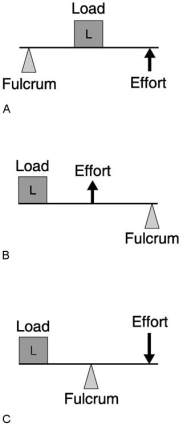 Figure 10.1
Using Figure 10.1, match the following:
-Humerus-ulna joint.
Figure 10.1
Using Figure 10.1, match the following:
-Humerus-ulna joint. (Multiple Choice)
4.8/5  (83)
(83) Donna was rushing to class and slipped on a patch of ice and fell backward.An X-ray revealed a broken coccyx.All the associated muscles were bruised.Name these muscles.
(Essay)
4.8/5 (73)
(73) The buccinator muscle compresses the cheek and is well developed in nursing infants.
(True/False)
4.9/5 (94)
(94) A patient has a stroke and has weakness on his right side.How will the weakness affect his ability to swallow?
(Essay)
4.8/5 (78)
(78) 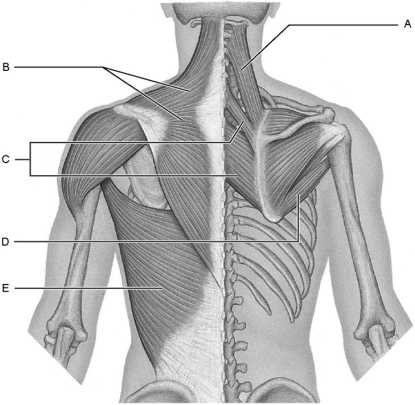 Figure 10.3
Using Figure 10.3, match the following:
-Retract scapula.
Figure 10.3
Using Figure 10.3, match the following:
-Retract scapula. (Multiple Choice)
4.9/5 (80)
(80) Tom has been told that he has an inguinal hernia.What is an inguinal hernia and what is its possible cause?
(Essay)
4.7/5 (86)
(86) 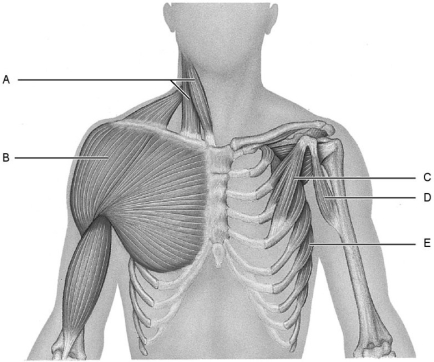 Figure 10.2
Using Figure 10.2, match the following:
-Serratus anterior.
Figure 10.2
Using Figure 10.2, match the following:
-Serratus anterior. (Multiple Choice)
4.8/5 (86)
(86) A young pregnant woman went to a childbirth class and the instructor informed them about strengthening the muscles of the pelvic floor.What are these muscles?
(Essay)
4.8/5 (88)
(88) Which of the following muscles is NOT a member of the hamstrings group?
(Multiple Choice)
4.9/5 (84)
(84) The abnormal protrusion of the small intestine through a weak point in the muscle of the abdominal wall is called a ________.
(Multiple Choice)
4.8/5 (72)
(72) Which of the following muscles is involved in producing horizontal wrinkles in the forehead?
(Multiple Choice)
4.9/5 (81)
(81) Which of the following muscles serves as a common intramuscular injection site,particularly in infants as the buttocks and arm muscles are poorly developed?
(Multiple Choice)
4.8/5 (78)
(78)
Figure 10.1
Using Figure 10.1, match the following:
-Tibia-calcaneus joint.
Figure 10.1
Using Figure 10.1, match the following:
-Tibia-calcaneus joint. (Multiple Choice)
4.9/5 (67)
(67) Figure 10.2
Using Figure 10.2, match the following:
-Pectoralis minor.
Figure 10.2
Using Figure 10.2, match the following:
-Pectoralis minor. (Multiple Choice)
4.7/5 (84)
(84) Figure 10.3
Using Figure 10.3, match the following:
-The latissimus dorsi.
Figure 10.3
Using Figure 10.3, match the following:
-The latissimus dorsi. (Multiple Choice)
4.8/5 (61)
(61) In order to propel food down to the esophagus,the pharyngeal constrictor muscles are used.
(True/False)
5.0/5 (72)
(72) The deltoid is a prime mover of the arm that acts in adduction.
(True/False)
4.8/5 (75)
(75) 
Filters
- Essay(0)
- Multiple Choice(0)
- Short Answer(0)
- True False(0)
- Matching(0)