



 Chat with AI
Exam 8: Joints

Exam 1: The Human Body: an Orientation118 Questions
Exam 2: Chemistry Comes Alive137 Questions
Exam 3: Cells: the Living Units131 Questions
Exam 4: Tissue: the Living Fabric109 Questions
Exam 5: The Integumentary System112 Questions
Exam 6: Bones and Skeletal Tissue106 Questions
Exam 7: The Skeleton125 Questions
Exam 8: Joints103 Questions
Exam 9: Muscles and Muscle Tissue129 Questions
Exam 10: The Muscular System100 Questions
Exam 11: Fundamentals of the Nervous System and Nervous Tissue95 Questions
Exam 12: The Central Nervous System138 Questions
Exam 13: The Peripheral Nervous System and Reflex Activity103 Questions
Exam 14: The Autonomic Nervous System103 Questions
Exam 15: The Special Senses147 Questions
Exam 16: The Endocrine System129 Questions
Exam 17: Blood126 Questions
Exam 18: The Cardiovascular System: the Heart107 Questions
Exam 19: The Cardiovascular System: Blood Vessels133 Questions
Exam 20: The Lymphatic System and Lymphoid Organs and Tissues88 Questions
Exam 21: The Immune System: Innate and Adaptive Body Defenses124 Questions
Exam 22: The Respiratory System123 Questions
Exam 23: The Digestive System148 Questions
Exam 24: Nutrition,metabolism,and Body Temperature Regulation123 Questions
Exam 25: The Urinary System129 Questions
Exam 26: Fluid,electrolyte,and Acid-Base Balance110 Questions
Exam 27: The Reproductive System131 Questions
Exam 28: Pregnancy and Human Development99 Questions
Exam 29: Heredity120 Questions
Select questions type


Greg is somewhat of a "weekend athlete" who has overextended himself by pitching multiple baseball games for a local team during the week and by playing golf on the weekends for several hours.He presented himself to the emergency room last week with severe shoulder pain (at the glenohumeral joint).The physician told him that the X-ray was not conclusive,but he may have damage to his rotator cuff.What is the rotator cuff,and how might he have caused this damage? What remedies will the physician recommend?
(Essay)
4.9/5  (84)
(84) Which of the following is a true statement regarding gliding movements?
(Multiple Choice)
4.9/5 (76)
(76) 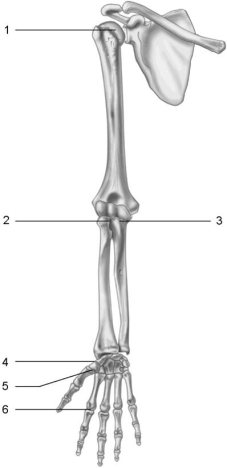 Figure 8.2
Using Figure 8.2, what type of axial movement does each joint have?
-Joint 5.
Figure 8.2
Using Figure 8.2, what type of axial movement does each joint have?
-Joint 5. (Multiple Choice)
4.9/5 (75)
(75) Moving your jaw forward,causing an underbite,is called ________.
(Multiple Choice)
4.8/5 (80)
(80) The hip joint is a good example of a(n)________ synovial joint.
(Multiple Choice)
4.8/5 (63)
(63) The ligaments that protect the alignment of the femoral and tibial condyles and limit the movement of the femur anteriorly and posteriorly are called ________.
(Multiple Choice)
5.0/5 (91)
(91) Bending your head back until it hurts is an example of ________.
(Multiple Choice)
4.8/5 (90)
(90) The articular surfaces of synovial joints play a minimal role in joint stability.
(True/False)
4.9/5 (80)
(80) A person who has been diagnosed with rheumatoid arthritis would be suffering loss of the synovial fluids.
(True/False)
4.9/5 (88)
(88) Figure 8.2
Using Figure 8.2, what type of axial movement does each joint have?
-Joint 6.
Figure 8.2
Using Figure 8.2, what type of axial movement does each joint have?
-Joint 6. (Multiple Choice)
4.9/5 (82)
(82) Why is muscle tone the most important stabilizing factor for most joints?
(Essay)
4.9/5 (73)
(73) Baseball pitchers often require "Tommy John" surgery to repair damage to their elbow.Which ligament would this surgery target?
(Multiple Choice)
4.9/5 (83)
(83) For each of the following movements,indicate the specific kind of joint involved (e.g.,hinge,etc.)and the movement performed (e.g.,extension,etc.).
a.Bending the elbow: ________,________.
b.Turning head side to side: ________,________.
c.Lowering your arm to your side in the frontal plane: ________,________.
d.Turning the sole of foot medially: ________,________.
(Short Answer)
4.9/5 (86)
(86) 
Filters
- Essay(0)
- Multiple Choice(0)
- Short Answer(0)
- True False(0)
- Matching(0)