



 Chat with AI
Exam 7: The Skeleton

Exam 1: The Human Body: an Orientation118 Questions
Exam 2: Chemistry Comes Alive137 Questions
Exam 3: Cells: the Living Units131 Questions
Exam 4: Tissue: the Living Fabric109 Questions
Exam 5: The Integumentary System112 Questions
Exam 6: Bones and Skeletal Tissue106 Questions
Exam 7: The Skeleton125 Questions
Exam 8: Joints103 Questions
Exam 9: Muscles and Muscle Tissue129 Questions
Exam 10: The Muscular System100 Questions
Exam 11: Fundamentals of the Nervous System and Nervous Tissue95 Questions
Exam 12: The Central Nervous System138 Questions
Exam 13: The Peripheral Nervous System and Reflex Activity103 Questions
Exam 14: The Autonomic Nervous System103 Questions
Exam 15: The Special Senses147 Questions
Exam 16: The Endocrine System129 Questions
Exam 17: Blood126 Questions
Exam 18: The Cardiovascular System: the Heart107 Questions
Exam 19: The Cardiovascular System: Blood Vessels133 Questions
Exam 20: The Lymphatic System and Lymphoid Organs and Tissues88 Questions
Exam 21: The Immune System: Innate and Adaptive Body Defenses124 Questions
Exam 22: The Respiratory System123 Questions
Exam 23: The Digestive System148 Questions
Exam 24: Nutrition,metabolism,and Body Temperature Regulation123 Questions
Exam 25: The Urinary System129 Questions
Exam 26: Fluid,electrolyte,and Acid-Base Balance110 Questions
Exam 27: The Reproductive System131 Questions
Exam 28: Pregnancy and Human Development99 Questions
Exam 29: Heredity120 Questions
Select questions type


The glenohumeral joint that articulates the humerus to the pectoral girdle is a highly mobile joint.This mobility comes at a cost because ________.
(Multiple Choice)
4.9/5  (76)
(76) The frontal bone articulates with the parietal bone by means of the sagittal suture.
(True/False)
4.9/5 (81)
(81) The shallow socket of the shoulder joint restricts the movement of the humerus but does increase the stability of the joint.
(True/False)
4.8/5 (75)
(75) The lacrimal bone contains a grove that forms part of lacrimal fossa.Along with the soft tissue of the lacrimal sac,these structures drain tears from the eye into the nasal passage.
(True/False)
4.8/5 (77)
(77) The vomer along with the perpendicular plate of the ethmoid bone forms the bony part of the nasal septum.
(True/False)
4.7/5 (70)
(70) The superior orbital fissure is formed in the sphenoid bone,whereas the inferior orbital fissure is formed between the sphenoid and ________.
(Multiple Choice)
4.9/5 (72)
(72) The sphenoid bone is sometimes referred to as a "key stone" of the skull.This is due to the fact that ________.
(Multiple Choice)
4.9/5 (78)
(78) 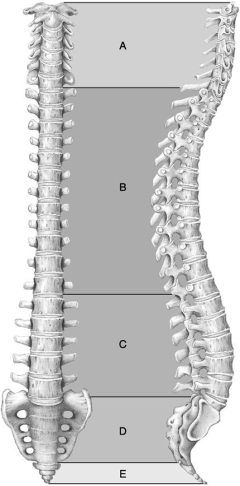 Figure 7.1
Using Figure 7.1, match the following:
-Includes the atlas and the axis.
Figure 7.1
Using Figure 7.1, match the following:
-Includes the atlas and the axis. (Multiple Choice)
4.7/5 (77)
(77) The sella turcica is part of the ________ bone and houses the ________ gland.
(Multiple Choice)
4.9/5 (78)
(78) Match the following:
-This bone houses the apparatus of the internal and middle ear.
(Multiple Choice)
4.7/5 (79)
(79) The vertebral column is held in place primarily by the anterior and posterior longitudinal ligaments.
(True/False)
4.9/5 (81)
(81) Identify the arches of the foot and describe how they are maintained.
(Essay)
4.8/5 (76)
(76) You are a school nurse in a middle school.You are responsible for screening the children for scoliosis.What is involved in this screening?
(Essay)
4.9/5 (81)
(81) There are seven cervical,twelve thoracic,and five lumbar vertebrae.
(True/False)
4.9/5 (84)
(84) 
Filters
- Essay(0)
- Multiple Choice(0)
- Short Answer(0)
- True False(0)
- Matching(0)