



 Chat with AI
Exam 1: The Human Body: an Orientation

Exam 1: The Human Body: an Orientation118 Questions
Exam 2: Chemistry Comes Alive137 Questions
Exam 3: Cells: the Living Units131 Questions
Exam 4: Tissue: the Living Fabric109 Questions
Exam 5: The Integumentary System112 Questions
Exam 6: Bones and Skeletal Tissue106 Questions
Exam 7: The Skeleton125 Questions
Exam 8: Joints103 Questions
Exam 9: Muscles and Muscle Tissue129 Questions
Exam 10: The Muscular System100 Questions
Exam 11: Fundamentals of the Nervous System and Nervous Tissue95 Questions
Exam 12: The Central Nervous System138 Questions
Exam 13: The Peripheral Nervous System and Reflex Activity103 Questions
Exam 14: The Autonomic Nervous System103 Questions
Exam 15: The Special Senses147 Questions
Exam 16: The Endocrine System129 Questions
Exam 17: Blood126 Questions
Exam 18: The Cardiovascular System: the Heart107 Questions
Exam 19: The Cardiovascular System: Blood Vessels133 Questions
Exam 20: The Lymphatic System and Lymphoid Organs and Tissues88 Questions
Exam 21: The Immune System: Innate and Adaptive Body Defenses124 Questions
Exam 22: The Respiratory System123 Questions
Exam 23: The Digestive System148 Questions
Exam 24: Nutrition,metabolism,and Body Temperature Regulation123 Questions
Exam 25: The Urinary System129 Questions
Exam 26: Fluid,electrolyte,and Acid-Base Balance110 Questions
Exam 27: The Reproductive System131 Questions
Exam 28: Pregnancy and Human Development99 Questions
Exam 29: Heredity120 Questions
Select questions type


Match the following systems to their functions:
-Prevents water loss,entry of germs into the body and synthesizes vitamin D.
(Multiple Choice)
5.0/5  (83)
(83) Some of the nerve endings in the skin are sensitive to changes in temperature.They are part of a negative feedback mechanism regulating body temperature.These nerve endings represent a(n)________ in the negative feedback mechanism.
(Multiple Choice)
4.9/5 (76)
(76) One of the functional characteristics of life is excitability or responsiveness.This refers to ________.
(Multiple Choice)
4.8/5 (88)
(88) The integumentary system helps to maintain a boundary between the internal and external environment.Give an example of something that is prevented entry to the body and an example of something prevented from escaping the body by the integumentary system.
(Essay)
4.8/5 (81)
(81) Match the following systems and organs:
-Kidneys,bladder,ureters.
(Multiple Choice)
4.9/5 (70)
(70) In which quadrant of the abdominopelvic cavity is the stomach located?
(Multiple Choice)
4.9/5 (90)
(90) One of the descriptions below is from the perspective of physiological study,the rest are from an anatomical perspective.Select the description below that comes from physiological perspective.
(Multiple Choice)
4.7/5 (71)
(71) 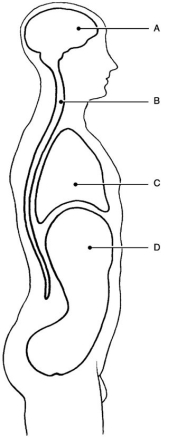 Figure 1.1
Using Figure 1.1, match the following cavities:
-Cranial cavity.
Figure 1.1
Using Figure 1.1, match the following cavities:
-Cranial cavity. (Multiple Choice)
4.8/5 (86)
(86) Similar cells that have a common function are called ________.
(Short Answer)
4.7/5 (67)
(67) Which feedback mechanism causes the variable to deviate further and further from its original value or range?
(Short Answer)
4.8/5 (88)
(88) What is a dynamic equilibrium of your internal environment termed?
(Short Answer)
4.8/5 (80)
(80) What is the pathway between the receptor and the control center in the reflex pathway called?
(Short Answer)
4.9/5 (69)
(69) Match the following regional terms and common terms:
-Chest.
(Multiple Choice)
4.7/5 (73)
(73)
Figure 1.1
Using Figure 1.1, match the following cavities:
-Vertebral cavity.
Figure 1.1
Using Figure 1.1, match the following cavities:
-Vertebral cavity. (Multiple Choice)
4.8/5 (68)
(68) Match the following systems and organs:
-Adrenal glands,pancreas,pituitary.
(Multiple Choice)
4.7/5 (80)
(80) A tissue consists of groups of similar cells that have a common function.
(True/False)
4.8/5 (85)
(85) Positive feedback mechanisms tend to enhance the original stimulus so that the response is accelerated.
(True/False)
4.8/5 (88)
(88) Which of the following is the best explanation for why cells are considered the smallest units of living things.
(Multiple Choice)
4.9/5 (75)
(75) 
Filters
- Essay(0)
- Multiple Choice(0)
- Short Answer(0)
- True False(0)
- Matching(0)