



 Chat with AI
Exam 9: Cash and Receivables

Exam 1: Uses of Accounting Information and the Financial Statements167 Questions
Exam 2: Analyzing Business Transactions189 Questions
Exam 3: Measuring Business Income171 Questions
Exam 4: Completing the Accounting Cycle176 Questions
Exam 5: Financial Reporting and Analysis177 Questions
Exam 6: The Operating Cycle and Merchandising Operations145 Questions
Exam 7: Internal Control117 Questions
Exam 8: Inventories154 Questions
Exam 9: Cash and Receivables177 Questions
Exam 10: Current Liabilities and Fair Value Accounting180 Questions
Exam 11: Long Term Assets241 Questions
Exam 12: Contributed Capital189 Questions
Exam 13: Long Term Liabilities194 Questions
Exam 14: The Corporate Income Statement and the Statement of Stockholders Equity176 Questions
Exam 15: The Statement of Cash Flows149 Questions
Exam 16: Financial Performance Measurement163 Questions
Exam 17: Partnerships129 Questions
Exam 18: The Changing Business Environment-A Managers Pers130 Questions
Exam 19: Cost Concepts and Cost Allocation188 Questions
Exam 20: Costing Systems: Job Order Costing88 Questions
Exam 21: Costing Systems Process Costing136 Questions
Exam 22: Activity-Based Systems-Abm and Lean152 Questions
Exam 23: Cost Behavior Analysis166 Questions
Exam 24: The Budgeting Process116 Questions
Exam 25: Performance Management and Evaluation117 Questions
Exam 26: Standard Costing and Variance Analysis120 Questions
Exam 27: Short Run Decision Analysis90 Questions
Exam 28: Capital Investment Analysis123 Questions
Select questions type


A company's acceptance of credits cards, like MasterCard, is an example of factoring with recourse.
(True/False)
4.7/5  (68)
(68) Which of the following would not be included in Cash or Cash Equivalents?
(Multiple Choice)
4.9/5 (80)
(80) Interest on a note receivable may be calculated without knowledge of the
(Multiple Choice)
4.9/5 (79)
(79) Explain the difference between the two methods used to estimate uncollectible accounts and identify which financial statement is emphasized by each method.
(Essay)
4.9/5 (72)
(72) Using the percentage of net sales method, uncollectible accounts expense for the year is estimated to be $54,000. If the balance of the Allowance for Uncollectible Accounts is an $18,000 credit before adjustment, what is the balance after adjustment?
(Multiple Choice)
4.8/5 (74)
(74) Which of the following statements is false regarding promissory notes?
(Multiple Choice)
4.7/5 (65)
(65) The SEC requires companies to disclose the amount of compensating balances in a note to the financial statements.
(True/False)
4.9/5 (82)
(82) When the allowance method is used, the write-off of an account receivable results in an expense at the time of write-off.
(True/False)
4.9/5 (76)
(76) Customers' accounts with credit balances should be disclosed as a(n)
(Multiple Choice)
4.9/5 (87)
(87) A check for $235 is incorrectly recorded by a company as $253. On the bank reconciliation the $18 error should be
(Multiple Choice)
4.7/5 (75)
(75) Determine the interest on the following notes payable:
a. $3,000 at 10 percent for 60 days
b. $600 at 16 percent for 4 months
c. $5,000 at 12 percent for 45 days
d. $900 at 14 percent for 30 days
(Essay)
4.8/5 (82)
(82) In a petty cash fund, the current cash amount minus the receipts submitted should equal the original fixed amount.
(True/False)
4.9/5 (69)
(69) Debit balances in customer accounts appear on the balance sheet as a current liability.
(True/False)
4.9/5 (75)
(75) Assume that part of accounts and other receivables on Thompson Toys' balance sheet is $16 million as of February 2, 2010. Also assume that Allowance for Uncollectible Accounts has a credit balance of $550,000 and that Thompson estimates its uncollectible accounts as 0.1 percent of net sales and the amount of sales is $11,019,000,000. Record the adjusting entry to recognize uncollectible accounts using the percentage of net sales method.
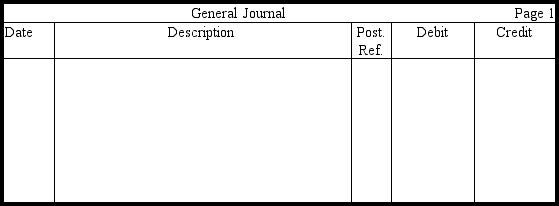
(Essay)
4.9/5 (91)
(91) 
Filters
- Essay(0)
- Multiple Choice(0)
- Short Answer(0)
- True False(0)
- Matching(0)