



 Chat with AI
Exam 9: Cash and Receivables

Exam 1: Uses of Accounting Information and the Financial Statements167 Questions
Exam 2: Analyzing Business Transactions189 Questions
Exam 3: Measuring Business Income171 Questions
Exam 4: Completing the Accounting Cycle176 Questions
Exam 5: Financial Reporting and Analysis177 Questions
Exam 6: The Operating Cycle and Merchandising Operations145 Questions
Exam 7: Internal Control117 Questions
Exam 8: Inventories154 Questions
Exam 9: Cash and Receivables177 Questions
Exam 10: Current Liabilities and Fair Value Accounting180 Questions
Exam 11: Long Term Assets241 Questions
Exam 12: Contributed Capital189 Questions
Exam 13: Long Term Liabilities194 Questions
Exam 14: The Corporate Income Statement and the Statement of Stockholders Equity176 Questions
Exam 15: The Statement of Cash Flows149 Questions
Exam 16: Financial Performance Measurement163 Questions
Exam 17: Partnerships129 Questions
Exam 18: The Changing Business Environment-A Managers Pers130 Questions
Exam 19: Cost Concepts and Cost Allocation188 Questions
Exam 20: Costing Systems: Job Order Costing88 Questions
Exam 21: Costing Systems Process Costing136 Questions
Exam 22: Activity-Based Systems-Abm and Lean152 Questions
Exam 23: Cost Behavior Analysis166 Questions
Exam 24: The Budgeting Process116 Questions
Exam 25: Performance Management and Evaluation117 Questions
Exam 26: Standard Costing and Variance Analysis120 Questions
Exam 27: Short Run Decision Analysis90 Questions
Exam 28: Capital Investment Analysis123 Questions
Select questions type


Using the following transactions for 2010, show how the T account below would appear after all appropriate postings have been made. Assume an opening balance of $900.

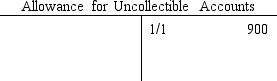
(Essay)
4.8/5  (82)
(82) The account Allowance for Uncollectible Accounts is classified as a(n)
(Multiple Choice)
4.9/5 (83)
(83) On a bank reconciliation, outstanding checks are deducted from the balance per books.
(True/False)
4.9/5 (82)
(82) A company's acceptance of credit cards like Visa is an example of
(Multiple Choice)
4.8/5 (86)
(86) Which of the following would not be a valid reason to keep some currency on hand at a place of business?
(Multiple Choice)
4.9/5 (77)
(77) Which of the following would be deducted from the balance per bank?
(Multiple Choice)
4.8/5 (88)
(88) Which of the following methods of recording uncollectible accounts expense would be described best as a balance sheet method?
(Multiple Choice)
4.7/5 (89)
(89) What is a contingent liability, and how does it relate to the discounting of a note receivable at the bank?
(Essay)
4.8/5 (72)
(72) At year end, Gorgin Design Company has a $1,800 credit balance in Allowance for Uncollectible Accounts. If an accounts receiving aging method analysis indicates that an estimated $11,400 of year-end receivables are uncollectible, what will be the balance in Allowance for Uncollectible Accounts after the appropriate adjusting entry for uncollectible accounts has been made? Indicate if the balance is a debit or credit.
(Short Answer)
4.9/5 (85)
(85) The allowance method of handling bad debts violates the matching principle.
(True/False)
4.8/5 (68)
(68) Interest on a 90-day, 10 percent, $10,000 note receivable is
(Multiple Choice)
4.8/5 (94)
(94) Which of the following accounts is classified as a short-term financial asset?
(Multiple Choice)
4.8/5 (75)
(75) The balance of Accounts Receivable, net of the allowance account, is $35,000 before the write-off of a $2,800 account. What is the Accounts Receivable balance, net of the allowance account, after the write-off?
(Multiple Choice)
4.9/5 (74)
(74) Under the allowance method, Uncollectible Accounts Expense is recorded when an individual customer defaults.
(True/False)
4.8/5 (77)
(77) If the amount of uncollectible accounts expense is understated at year end,
(Multiple Choice)
4.8/5 (86)
(86) Which of the following would be added to the balance per books on a bank reconciliation?
(Multiple Choice)
4.9/5 (90)
(90) 
Filters
- Essay(0)
- Multiple Choice(0)
- Short Answer(0)
- True False(0)
- Matching(0)