



 Chat with AI
Exam 9: Cash and Receivables

Exam 1: Uses of Accounting Information and the Financial Statements167 Questions
Exam 2: Analyzing Business Transactions189 Questions
Exam 3: Measuring Business Income171 Questions
Exam 4: Completing the Accounting Cycle176 Questions
Exam 5: Financial Reporting and Analysis177 Questions
Exam 6: The Operating Cycle and Merchandising Operations145 Questions
Exam 7: Internal Control117 Questions
Exam 8: Inventories154 Questions
Exam 9: Cash and Receivables177 Questions
Exam 10: Current Liabilities and Fair Value Accounting180 Questions
Exam 11: Long Term Assets241 Questions
Exam 12: Contributed Capital189 Questions
Exam 13: Long Term Liabilities194 Questions
Exam 14: The Corporate Income Statement and the Statement of Stockholders Equity176 Questions
Exam 15: The Statement of Cash Flows149 Questions
Exam 16: Financial Performance Measurement163 Questions
Exam 17: Partnerships129 Questions
Exam 18: The Changing Business Environment-A Managers Pers130 Questions
Exam 19: Cost Concepts and Cost Allocation188 Questions
Exam 20: Costing Systems: Job Order Costing88 Questions
Exam 21: Costing Systems Process Costing136 Questions
Exam 22: Activity-Based Systems-Abm and Lean152 Questions
Exam 23: Cost Behavior Analysis166 Questions
Exam 24: The Budgeting Process116 Questions
Exam 25: Performance Management and Evaluation117 Questions
Exam 26: Standard Costing and Variance Analysis120 Questions
Exam 27: Short Run Decision Analysis90 Questions
Exam 28: Capital Investment Analysis123 Questions
Select questions type


The matching rule relates to credit losses by stating that Uncollectible Accounts Expense should be recorded
(Multiple Choice)
4.8/5  (74)
(74) Days' sales uncollected cannot be calculated without first knowing the receivable turnover.
(True/False)
4.9/5 (70)
(70) Carlson Corporation engaged in the following transactions involving promissory notes in 2009 and 2010. Journalize these transactions in the journal provided. (Omit explanations.) Round to nearest whole dollar.
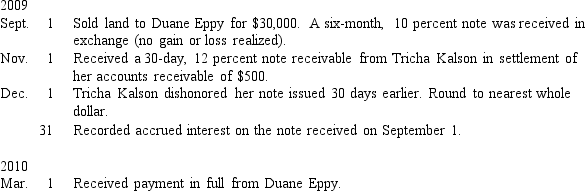
(Essay)
4.8/5 (83)
(83) Assuming that the allowance method is being used, prepare journal entries to record the following transactions. Omit explanations.
Mar. 15 Sold merchandise to Faust for $6,000 on account.
Apr. 15 Received $3,000 from Faust.
Aug. 15 Wrote off Faust's account as uncollectible.
Nov. 15 Unexpectedly received payment in full from Faust.
(Essay)
4.9/5 (72)
(72) The holder of a note adjusts for accrued interest by debiting Interest Receivable and crediting Interest Income.
(True/False)
4.9/5 (55)
(55) A discounted note represents a contingent liability because a potential liability exists.
(True/False)
4.9/5 (101)
(101) A compensating balance refers to a minimum amount that must remain in a bank account as part of a credit-granting arrangement
(True/False)
4.8/5 (90)
(90) One might infer from a debit balance in Allowance for Uncollectible Accounts that
(Multiple Choice)
4.8/5 (86)
(86) Assume that on December 1, a $3,000, 90-day, 10 percent note receivable was received from a customer as an extension of his of past - due account. The entry that would be made to record the note is: 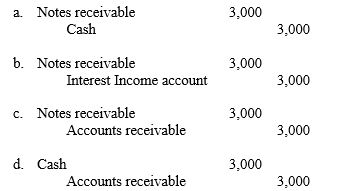
(Short Answer)
4.8/5 (74)
(74) The general ledger account for Accounts Receivable shows a debit balance of $25,000. Allowance for Uncollectible Accounts has a credit balance of $1,500. Net sales for the year were $250,000. In the past, 3 percent of sales have proved uncollectible, and an aging of accounts receivable resulted in an estimate of $10,000 of uncollectible accounts receivable. Using the accounts receivable aging method, the Allowance for Uncollectible Accounts balance (after adjustment) would be
(Multiple Choice)
4.8/5 (80)
(80) Which of the following bank reconciliation items would not result in a journal entry?
(Multiple Choice)
4.9/5 (70)
(70) The general ledger account for Accounts Receivable shows a debit balance of $37,500. The Allowance for Uncollectible Accounts has a debit balance of $1,000. Net sales for the year were $375,000. In the past, 2 percent of net sales have proved uncollectible. An aging of accounts receivable accounts results in an estimate of $6,250 of uncollectible accounts receivable. Calculate (1) Uncollectible Accounts Expense and (2) the ending balance of the Allowance for Uncollectible Accounts using (a) the percentage of net sales method and (b) the accounts receivable aging method.
(Essay)
4.9/5 (73)
(73) Under what specific circumstance will application of the direct charge-off method be in accordance with the matching principle?
(Essay)
4.8/5 (90)
(90) When an account receivable that was previously written off is collected, it is necessary to reverse the entry for the write-off before recording the collection.
(True/False)
4.8/5 (85)
(85) If a promissory note is dishonored, the payee should record interest income.
(True/False)
4.7/5 (79)
(79) The direct charge-off method of recognizing uncollectible accounts is not in accordance with good accounting practice.
(True/False)
4.7/5 (82)
(82) Which of the following account names should not be used in modern practice?
(Multiple Choice)
4.7/5 (85)
(85) Under the allowance method, uncollectible accounts must be estimated if the matching rule is to be followed.
(True/False)
4.9/5 (81)
(81) Assume that on January 15, a customer who owes Shawni sales company $1,000 is declared bankrupt by a federal court. The entry that would be made to write off this account is: a. Allowance for uncollectible 1,000 Accounts receivable, customer account 1,000
b. Accounts receivable 1,000 Cash 1,000
c. Accounts receivable 1,000 Notes receivable 1,000
d. Cash 1,000 Accounts Receivable 1,000
(Short Answer)
4.7/5 (76)
(76) 
Filters
- Essay(0)
- Multiple Choice(0)
- Short Answer(0)
- True False(0)
- Matching(0)