



 Chat with AI
Exam 9: Cash and Receivables

Exam 1: Uses of Accounting Information and the Financial Statements167 Questions
Exam 2: Analyzing Business Transactions189 Questions
Exam 3: Measuring Business Income171 Questions
Exam 4: Completing the Accounting Cycle176 Questions
Exam 5: Financial Reporting and Analysis177 Questions
Exam 6: The Operating Cycle and Merchandising Operations145 Questions
Exam 7: Internal Control117 Questions
Exam 8: Inventories154 Questions
Exam 9: Cash and Receivables177 Questions
Exam 10: Current Liabilities and Fair Value Accounting180 Questions
Exam 11: Long Term Assets241 Questions
Exam 12: Contributed Capital189 Questions
Exam 13: Long Term Liabilities194 Questions
Exam 14: The Corporate Income Statement and the Statement of Stockholders Equity176 Questions
Exam 15: The Statement of Cash Flows149 Questions
Exam 16: Financial Performance Measurement163 Questions
Exam 17: Partnerships129 Questions
Exam 18: The Changing Business Environment-A Managers Pers130 Questions
Exam 19: Cost Concepts and Cost Allocation188 Questions
Exam 20: Costing Systems: Job Order Costing88 Questions
Exam 21: Costing Systems Process Costing136 Questions
Exam 22: Activity-Based Systems-Abm and Lean152 Questions
Exam 23: Cost Behavior Analysis166 Questions
Exam 24: The Budgeting Process116 Questions
Exam 25: Performance Management and Evaluation117 Questions
Exam 26: Standard Costing and Variance Analysis120 Questions
Exam 27: Short Run Decision Analysis90 Questions
Exam 28: Capital Investment Analysis123 Questions
Select questions type


Which of the following topics involves a contingent liability?
(Multiple Choice)
4.9/5  (82)
(82) The interest on a three-month, 12 percent, $8,100 note receivable is
(Multiple Choice)
4.8/5 (65)
(65) Which of the following would be deducted from the balance per books on a bank reconciliation?
(Multiple Choice)
4.8/5 (83)
(83) Compensating balances are kept separate from the Cash account balance on the balance sheet.
(True/False)
4.9/5 (90)
(90) Uncollectible accounts must be estimated because it is not possible to know which accounts will not be collected.
(True/False)
4.9/5 (88)
(88) Which of the following would be added to the balance per bank?
(Multiple Choice)
4.9/5 (84)
(84) After a bank reconciliation is completed, journal entries are prepared for items in the balance per books section only.
(True/False)
4.9/5 (76)
(76) A promissory note may be issued for an amount to be determined at a future date.
(True/False)
4.9/5 (85)
(85) Which of the following is not classified as a short-term financial asset?
(Multiple Choice)
4.9/5 (87)
(87) The balance in Allowance for Uncollectible Accounts must be considered prior to end-of-period adjustment when using which of the following methods?
(Multiple Choice)
4.7/5 (71)
(71) Installment accounts receivable covering periods longer than twelve months are classified as long-term assets.
(True/False)
4.8/5 (72)
(72) Under the allowance method, when a year-end adjustment is made for estimated uncollectible accounts,
(Multiple Choice)
4.9/5 (77)
(77) Under the direct charge-off method of dealing with uncollectible accounts,
(Multiple Choice)
4.8/5 (88)
(88) In the journal provided, prepare the entries for the following transactions. (Omit explanations.)
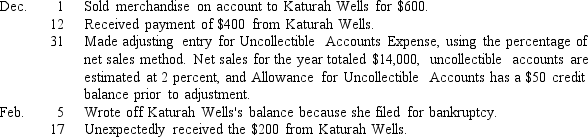
(Essay)
4.7/5 (85)
(85) Assume that the $1,000, 90-day, 8 percent note was received on August 31 and that the fiscal year ended on September 30. The adjusting entry that would be made to record the interest receivable is (amounts rounded to nearest dollar): 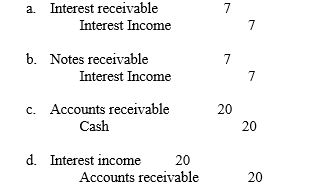
(Short Answer)
4.8/5 (81)
(81) When a bank reconciliation balances, no errors could have been made by the bank or the company.
(True/False)
4.8/5 (77)
(77) In the journal provided, prepare entries for the following (assume a calendar-year accounting period): Omit explanations

(Essay)
4.8/5 (69)
(69) State the amount of cash that would appear on the balance sheet as of September 30.
(Essay)
4.8/5 (72)
(72) 
Filters
- Essay(0)
- Multiple Choice(0)
- Short Answer(0)
- True False(0)
- Matching(0)