



 Chat with AI
Exam 14: The Bank of Canada and Monetary Policy

Exam 1: The Nature of Economics171 Questions
Exam 2: Production Possibilities and Economic Systems137 Questions
Exam 3: Demand and Supply177 Questions
Exam 4: Introduction to Macroeconomics112 Questions
Exam 5: Measuring the Economys Performance106 Questions
Exam 6: Modelling Real Gdp and the Price Level in the Long Run115 Questions
Exam 7: Economic Growth and Development109 Questions
Exam 8: Modelling Real Gdp and the Price Level in the Short Run115 Questions
Exam 9: Consumption, investment, and the Multiplier120 Questions
Exam 10: The Public Sector129 Questions
Exam 11: Fiscal Policy and the Public Debt116 Questions
Exam 12: Money and the Banking System112 Questions
Exam 13: Money Creation and Deposit Insurance115 Questions
Exam 14: The Bank of Canada and Monetary Policy131 Questions
Exam 15: Issues in Stabilization Policy115 Questions
Exam 16: Comparative Advantage and the Open Economy92 Questions
Exam 17: Exchange Rates and the Balance of Payments105 Questions
Select questions type


Figure 14-4 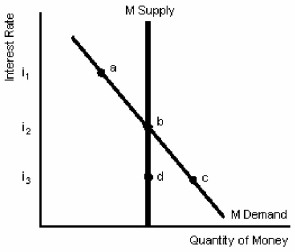 -In Figure 14-4,let i3 represent any interest rate below the equilibrium interest rate of i2.Thus,when the economy is at i2,people will tend to
 (Multiple Choice)
4.9/5  (71)
(71) Suppose the typical household holds $1,000 when the interest rate is 5 percent.When the interest rate rises to 6 percent,the typical household would most likely hold
(Multiple Choice)
4.8/5 (77)
(77) The desired reserve ratio equals 20 percent and all banks initially have zero excess reserves.The Bank of Canada buys $1 million in Canadian government securities.The most the money supply can increase is
(Multiple Choice)
4.8/5 (69)
(69) If the Bank of Canada buys $500 of government securities when the desired reserve ratio is 20 percent,the money supply may ultimately
(Multiple Choice)
4.7/5 (74)
(74) When the Bank of Canada buys a Canadian bond in the open market
(Multiple Choice)
4.9/5 (81)
(81) If the Bank of Canada sells $100 of securities through a commercial bank when the reserve requirement is 10 percent,the money supply may ultimately
(Multiple Choice)
4.8/5 (79)
(79) If the Bank of Canada wishes to increase the money supply by $500 when the desired reserve ratio is 10 percent,it should
(Multiple Choice)
4.8/5 (66)
(66) Figure 14-3  -In Figure 14-3,assume the economy starts at an equilibrium at point d.If there the Bank of Canada increases the money supply so that the new aggregate demand curve is AD₃,then the new short run equilibrium will be at point
 (Multiple Choice)
4.9/5 (71)
(71) What are monetarists? How do they differ from Keynesians with respect to the effects of monetary policy on the macroeconomy?
(Essay)
4.8/5 (93)
(93) If the Bank of Canada wishes to reduce the money supply by $1,000 when desired reserves are 20 percent,it should
(Multiple Choice)
4.7/5 (81)
(81) According to the monetarists,policy makers should follow a monetary rule,which means that
(Multiple Choice)
4.9/5 (87)
(87) Figure 14-2  -In Figure 14-2,suppose the economy is at an equilibrium at point D and you are considering policy options to eliminate unemployment.What is the opportunity cost of any aggregate demand based policy option?
 (Multiple Choice)
4.7/5 (76)
(76) 
Filters
- Essay(0)
- Multiple Choice(0)
- Short Answer(0)
- True False(0)
- Matching(0)