



 Chat with AI
Exam 8: Perfect Competition

Exam 1: Thinking Like an Economist89 Questions
Exam 2: Applying Graphs to Economics37 Questions
Exam 3: Production Possibilities and Opportunity Cost122 Questions
Exam 4: Market Demand and Supply120 Questions
Exam 5: Markets in Action120 Questions
Exam 6: Elasticity of Demand and Supply118 Questions
Exam 7: Production Costs119 Questions
Exam 8: Perfect Competition124 Questions
Exam 9: Monopoly120 Questions
Exam 10: Monopolistic Competition and Oligopoly124 Questions
Exam 11: Policy Issues: Housing Affordability and Climate Change79 Questions
Exam 12: Measuring the Size of the Economy124 Questions
Exam 13: Business Cycles and Economic Growth120 Questions
Exam 14: Inflation and Unemployment116 Questions
Exam 15: A Simple Model of the Macro Economy134 Questions
Exam 16: The Monetary and Financial System123 Questions
Exam 17: Macroeconomic Policy I: Monetary Policy120 Questions
Exam 18: Macroeconomic Policy II: Fiscal Policy123 Questions
Exam 19: International Trade and Finance132 Questions
Select questions type


In the short run, the profit maximising (or minimising) quantity of output for any firm to produce exists at that output level at which marginal revenue equals marginal cost.
(True/False)
4.9/5  (79)
(79) How long will the state of short-run equilibrium remain unchanged?
(Multiple Choice)
4.8/5 (75)
(75) Narrbegin Exhibit 7.7 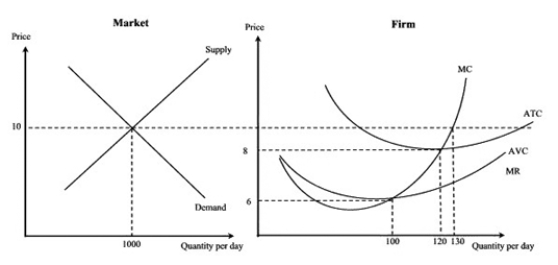 -According to Exhibit 7.7, the firm's short-run economic profit will be:
 (Multiple Choice)
4.9/5 (85)
(85) If a perfectly competitive industry's long-run supply curve is downward-sloping, what can we conclude about input prices?
(Multiple Choice)
4.8/5 (76)
(76) A perfectly competitive firm shuts down in the short run when the market price is less than the average variable cost.
(True/False)
4.7/5 (89)
(89) A sandwich shop owner has the following information: P = $4, ATC = $2, AVC = $1, MC = 4 and Q = 500. From this, she can determine:
(Multiple Choice)
5.0/5 (87)
(87) Suppose that, in the long run, the price of feature films rises as the movie production industry expands. We can conclude that movie production is a/an:
(Multiple Choice)
5.0/5 (81)
(81) Narrbegin Exhibit 7.7
-Refer to Exhibit 7.7. The short-run results for this firm are:
-Refer to Exhibit 7.7. The short-run results for this firm are: (Multiple Choice)
4.8/5 (83)
(83) A perfectly competitive industry's short-run market supply curve is derived from:
(Multiple Choice)
4.8/5 (63)
(63) A perfectly competitive firm minimises losses in the short run by producing at the output level at which:
(Multiple Choice)
4.8/5 (93)
(93) If a perfectly competitive firm sells 50 units of output at a market price of $10 per unit, its marginal revenue is:
(Multiple Choice)
4.9/5 (64)
(64) A firm operating in a perfectly competitive market is a price taker because:
(Multiple Choice)
4.8/5 (69)
(69) Under perfect competition, a firm is a price taker because:
(Multiple Choice)
4.9/5 (81)
(81) Narrbegin Exhibit 7.7
-According to Exhibit 7.7, given the short-run equilibrium of this firm, we would expect in the long run:
-According to Exhibit 7.7, given the short-run equilibrium of this firm, we would expect in the long run: (Multiple Choice)
4.7/5 (90)
(90) If ATC = $10, AVC = $8, market price = $25 and MC = $25, then the result for a perfectly competitive firm will:
(Multiple Choice)
4.9/5 (69)
(69) Which of the following is true of a perfectly competitive market?
(Multiple Choice)
4.9/5 (64)
(64) The body charged with increasing or maintaining competition in the Australian economy is:
(Multiple Choice)
4.9/5 (84)
(84) Assume the market equilibrium price is $100. In a perfectly competitive market, some firms can sell a good at the price of $120 and:
(Multiple Choice)
4.8/5 (97)
(97) If input prices for a perfectly competitive industry remain constant as the output of the industry expands in the long run, the industry supply curve will:
(Multiple Choice)
4.8/5 (79)
(79) 
Filters
- Essay(0)
- Multiple Choice(0)
- Short Answer(0)
- True False(0)
- Matching(0)