



 Chat with AI
Exam 7: Production Costs

Exam 1: Thinking Like an Economist89 Questions
Exam 2: Applying Graphs to Economics37 Questions
Exam 3: Production Possibilities and Opportunity Cost122 Questions
Exam 4: Market Demand and Supply120 Questions
Exam 5: Markets in Action120 Questions
Exam 6: Elasticity of Demand and Supply118 Questions
Exam 7: Production Costs119 Questions
Exam 8: Perfect Competition124 Questions
Exam 9: Monopoly120 Questions
Exam 10: Monopolistic Competition and Oligopoly124 Questions
Exam 11: Policy Issues: Housing Affordability and Climate Change79 Questions
Exam 12: Measuring the Size of the Economy124 Questions
Exam 13: Business Cycles and Economic Growth120 Questions
Exam 14: Inflation and Unemployment116 Questions
Exam 15: A Simple Model of the Macro Economy134 Questions
Exam 16: The Monetary and Financial System123 Questions
Exam 17: Macroeconomic Policy I: Monetary Policy120 Questions
Exam 18: Macroeconomic Policy II: Fiscal Policy123 Questions
Exam 19: International Trade and Finance132 Questions
Select questions type


Narrbegin Exhibit 6.8 Cost schedule for producing pizzas
-By filling in the blanks in Exhibit 6.8, the AFC of three pizzas is shown to be equal to:
(Multiple Choice)
4.7/5  (82)
(82) Which of the following is true if the total variable cost curve is rising?
(Multiple Choice)
4.8/5 (83)
(83) Which of the following is considered to be a fixed cost of operating a hairdressing salon?
(Multiple Choice)
4.9/5 (84)
(84) Narrbegin Exhibit 6.1: The production function 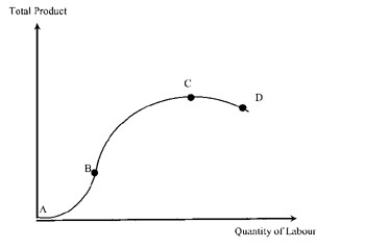 -In Exhibit 6.1, total output increases from A to C because:
 (Multiple Choice)
4.9/5 (86)
(86) Narrbegin Exhibit 6.6 Cost schedule for firm X
-As shown in Exhibit 6.6, the total cost of producing five units is:
(Multiple Choice)
5.0/5 (83)
(83) Narrbegin Exhibit 6.5 Cost schedule for a firm
-In Exhibit 6.5, by filling in the blanks it can be determined that the marginal cost of the third unit of output is:
(Multiple Choice)
4.9/5 (83)
(83) A farm can produce 10 000 bushels of wheat per year with five workers and 12 000 bushels with six workers. The marginal product of the sixth worker for this farm is:
(Multiple Choice)
4.8/5 (87)
(87) The law of diminishing marginal returns causes a firm's short-run marginal cost curve to be U-shaped.
(True/False)
4.8/5 (71)
(71) Which of the following are implicit costs for a typical firm?
(Multiple Choice)
4.8/5 (82)
(82) If a firm increases output and its average total cost declines, then the firm is experiencing economies of scale.
(True/False)
4.8/5 (85)
(85) Narrbegin Exhibit 6.10 Long-run average cost 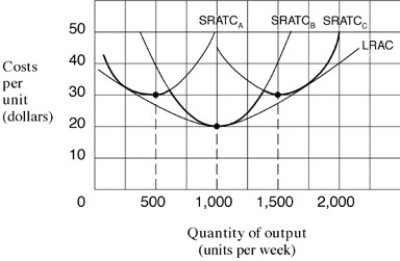 Narrend
-In Exhibit 6.10, short-run average total cost, short-run marginal cost and long-run average cost are all equal at which level of output per week?
Narrend
-In Exhibit 6.10, short-run average total cost, short-run marginal cost and long-run average cost are all equal at which level of output per week? (Multiple Choice)
4.9/5 (90)
(90) Narrbegin Exhibit 6.3 A marginal product curve  -As shown in Exhibit 6.3, what was the marginal product of labour when the second worker was hired?
 (Multiple Choice)
4.9/5 (98)
(98) If ATC = $10, AVC = $6, AFC = $3 and MC = $5; then if output increased by one unit:
(Multiple Choice)
4.9/5 (85)
(85) If a firm has total revenue of $200 million, explicit costs of $190 million and implicit costs of $10 million, its economic profit is:
(Multiple Choice)
4.7/5 (66)
(66) Narrbegin Exhibit 6.6 Cost schedule for firm X
-As shown in Exhibit 6.6, the total cost of producing four units is:
(Multiple Choice)
4.9/5 (85)
(85) 
Filters
- Essay(0)
- Multiple Choice(0)
- Short Answer(0)
- True False(0)
- Matching(0)