



 Chat with AI
Exam 5: Markets in Action

Exam 1: Thinking Like an Economist89 Questions
Exam 2: Applying Graphs to Economics37 Questions
Exam 3: Production Possibilities and Opportunity Cost122 Questions
Exam 4: Market Demand and Supply120 Questions
Exam 5: Markets in Action120 Questions
Exam 6: Elasticity of Demand and Supply118 Questions
Exam 7: Production Costs119 Questions
Exam 8: Perfect Competition124 Questions
Exam 9: Monopoly120 Questions
Exam 10: Monopolistic Competition and Oligopoly124 Questions
Exam 11: Policy Issues: Housing Affordability and Climate Change79 Questions
Exam 12: Measuring the Size of the Economy124 Questions
Exam 13: Business Cycles and Economic Growth120 Questions
Exam 14: Inflation and Unemployment116 Questions
Exam 15: A Simple Model of the Macro Economy134 Questions
Exam 16: The Monetary and Financial System123 Questions
Exam 17: Macroeconomic Policy I: Monetary Policy120 Questions
Exam 18: Macroeconomic Policy II: Fiscal Policy123 Questions
Exam 19: International Trade and Finance132 Questions
Select questions type


Which of the following is an example of a pure public good?
(Multiple Choice)
4.9/5  (80)
(80) Competition in the presence of negative externality will result in the following outcome:
(Multiple Choice)
4.9/5 (61)
(61) Albert, Betty, Christine and David are all very good students. When they hold their study sessions, they often discuss very difficult concepts in great detail. Christine's roommate, Elizabeth, who takes completely different classes, still learns from the discussions of the others. This is the case of a/an _____, which _____ a _____.
(Multiple Choice)
4.8/5 (70)
(70) Voluntary recycling is available in many parts of the country. If citizens of these areas have collected recyclable material at home, they can bring it to a recycling centre. These materials reduce landfill space, reduce the need for virgin material extraction and provide an inexpensive input in many production processes. The information in this question suggests: what about areas without voluntary recycling?
(Multiple Choice)
4.9/5 (82)
(82) Narrbegin Exhibit 4.2 Supply and demand curves 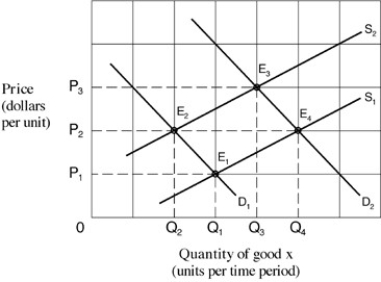 -In Exhibit 4.2, a decrease in quantity demanded would cause a move from which equilibrium point to another, other things being equal?
 (Multiple Choice)
4.9/5 (72)
(72) If each of us relied exclusively on the market to determine what to buy, we would probably end up with few, if any:
(Multiple Choice)
4.9/5 (77)
(77) The presence of negative externalities that are incorporated in price, results in misallocation of resources.
(True/False)
4.8/5 (75)
(75) Which of the following would raise both the equilibrium price and the equilibrium quantity of strawberries?
(Multiple Choice)
4.8/5 (74)
(74) Which of the following is the best example of a public good?
(Multiple Choice)
4.8/5 (79)
(79) If a good gives rise to substantial external benefits to society that are associated with its production and/or consumption, then the good likely has too many resources devoted to its production.
(True/False)
5.0/5 (85)
(85) Assume that the production of a good imposes external costs upon third parties. If the price and quantity of this good is set by supply and demand, the price will be too:
(Multiple Choice)
4.8/5 (76)
(76) In the case of negative externalities in production, the firm's internal costs:
(Multiple Choice)
4.8/5 (76)
(76) If consumers expect the price of sugar to increase next month, the quantity of sugar demanded will:
(Multiple Choice)
4.9/5 (80)
(80) There are apartments in Perth whose rooftops overlook Subiaco Oval. On game day you can find free riders on the roof enjoying _____.
(Multiple Choice)
4.8/5 (77)
(77) If it costs $2000 to pick up the litter along a highway, then the cost of the externality is:
(Multiple Choice)
4.8/5 (84)
(84) 
Filters
- Essay(0)
- Multiple Choice(0)
- Short Answer(0)
- True False(0)
- Matching(0)