



 Chat with AI
Exam 3: Production Possibilities and Opportunity Cost

Exam 1: Thinking Like an Economist89 Questions
Exam 2: Applying Graphs to Economics37 Questions
Exam 3: Production Possibilities and Opportunity Cost122 Questions
Exam 4: Market Demand and Supply120 Questions
Exam 5: Markets in Action120 Questions
Exam 6: Elasticity of Demand and Supply118 Questions
Exam 7: Production Costs119 Questions
Exam 8: Perfect Competition124 Questions
Exam 9: Monopoly120 Questions
Exam 10: Monopolistic Competition and Oligopoly124 Questions
Exam 11: Policy Issues: Housing Affordability and Climate Change79 Questions
Exam 12: Measuring the Size of the Economy124 Questions
Exam 13: Business Cycles and Economic Growth120 Questions
Exam 14: Inflation and Unemployment116 Questions
Exam 15: A Simple Model of the Macro Economy134 Questions
Exam 16: The Monetary and Financial System123 Questions
Exam 17: Macroeconomic Policy I: Monetary Policy120 Questions
Exam 18: Macroeconomic Policy II: Fiscal Policy123 Questions
Exam 19: International Trade and Finance132 Questions
Select questions type


If a country has a comparative advantage in the production of all goods, it should:
(Multiple Choice)
4.9/5  (76)
(76) The production possibilities frontier demonstrates the basic economic principle that:
(Multiple Choice)
4.8/5 (83)
(83) People in poor countries may have difficulties achieving economic growth because:
(Multiple Choice)
4.9/5 (77)
(77) The process through which an economy's production possibilities curve shifts outward is:
(Multiple Choice)
4.7/5 (82)
(82) Narrbegin Exhibit 2.4 Production possibilities curve data
A B C D E F Capital goods 150 140 120 90 50 0 Consumer goods 0 20 40 60 80 100 Narrend
-In Exhibit 2.4, the concept of increasing opportunity costs is represented by the fact that:
(Multiple Choice)
4.8/5 (72)
(72) Without the increase in immigration after the Second World War, Australia's population would now be around:
(Multiple Choice)
4.8/5 (71)
(71) The production possibility curve is bowed outward from the origin because of:
(Multiple Choice)
4.9/5 (85)
(85) Narrbegin Exhibit 2.6 Production possibilities frontier data
A B C D E F Capital goods 15 14 12 5 5 0 Cansumer guods 0 2 4 6 10 Narrend
-As shown in Exhibit 2.6, the concept of increasing opportunity costs is reflected in the fact that:
(Multiple Choice)
4.8/5 (90)
(90) In order for an economy to shift its production possibilities curve rightward, it must:
(Multiple Choice)
4.7/5 (98)
(98) Narrbegin Exhibit 2.2 Production possibilities frontier  Narrend
-The production possibilities in Exhibit 2.2 indicates that the opportunity cost of corn is:
Narrend
-The production possibilities in Exhibit 2.2 indicates that the opportunity cost of corn is: (Multiple Choice)
4.9/5 (102)
(102) Narrbegin Exhibit 2.8 Production possibilities frontier data
A B C D E Capital goods 0 1 2 3 4 Consumption goods 25 23 19 13 0 Narrend
-Suppose an economy is faced with the production possibilities table shown in Exhibit 2.8. The first unit of capital goods will cost the economy _____ units of consumption goods.
(Multiple Choice)
4.8/5 (84)
(84) When the opportunity cost of producing laptops increases as more laptops are produced, then:
(Multiple Choice)
4.7/5 (70)
(70) Narrbegin Exhibit 2.5 Production possibilities frontier 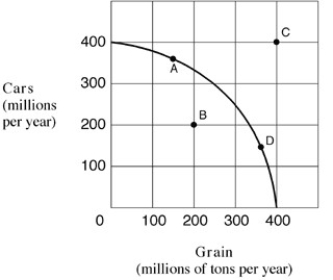 Narrend
-For the economy shown in Exhibit 2.5, which of the following is true when the economy is at point A?
Narrend
-For the economy shown in Exhibit 2.5, which of the following is true when the economy is at point A? (Multiple Choice)
4.9/5 (63)
(63) The production possibilities curve for the nation of Economania shifts to the right. This could have been caused by:
(Multiple Choice)
4.9/5 (86)
(86) Production possibilities frontier analysis allows us to identify:
(Multiple Choice)
4.8/5 (86)
(86) If an economy is producing at full employment, it means that:
(Multiple Choice)
4.8/5 (94)
(94) 
Filters
- Essay(0)
- Multiple Choice(0)
- Short Answer(0)
- True False(0)
- Matching(0)