



 Chat with AI
Exam 3: Where Prices Come From: the Interaction of Demand and Supply

Exam 1: Economics: Foundations and Models444 Questions
Exam 2: Trade-Offs, Comparative Advantage, and the Market System498 Questions
Exam 3: Where Prices Come From: the Interaction of Demand and Supply475 Questions
Exam 4: Economic Efficiency, Government Price Setting, and Taxes419 Questions
Exam 5: Externalities, Environmental Policy, and Public Goods266 Questions
Exam 6: Elasticity: the Responsiveness of Demand and Supply295 Questions
Exam 7: The Economics of Health Care334 Questions
Exam 8: Firms, the Stock Market, and Corporate Governance278 Questions
Exam 9: Comparative Advantage and the Gains From International Trade379 Questions
Exam 10: Consumer Choice and Behavioral Economics302 Questions
Exam 11: Technology, Production, and Costs330 Questions
Exam 12: Firms in Perfectly Competitive Markets298 Questions
Exam 13: Monopolistic Competition: the Competitive Model in a More Realistic Setting276 Questions
Exam 14: Oligopoly: Firms in Less Competitive Markets262 Questions
Exam 15: Monopoly and Antitrust Policy271 Questions
Exam 16: Pricing Strategy263 Questions
Exam 17: The Markets for Labor and Other Factors of Production286 Questions
Exam 18: Public Choice, Taxes, and the Distribution of Income258 Questions
Exam 19: GDP: Measuring Total Production and Income266 Questions
Exam 20: Unemployment and Inflation292 Questions
Exam 21: Economic Growth, the Financial System, and Business Cycles257 Questions
Exam 22: Long-Run Economic Growth: Sources and Policies268 Questions
Exam 23: Aggregate Expenditure and Output in the Short Run306 Questions
Exam 24: Aggregate Demand and Aggregate Supply Analysis284 Questions
Exam 25: Money, Banks, and the Federal Reserve System280 Questions
Exam 26: Monetary Policy277 Questions
Exam 27: Fiscal Policy303 Questions
Exam 28: Inflation, Unemployment, and Federal Reserve Policy257 Questions
Exam 29: Macroeconomics in an Open Economy278 Questions
Exam 30: The International Financial System262 Questions
Select questions type


Figure 3-7 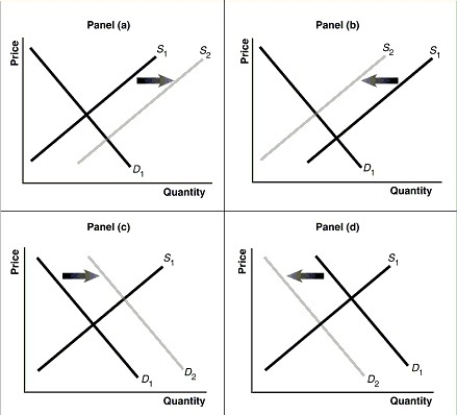 -Refer to Figure 3-7. Assume that the graphs in this figure represent the demand and supply curves for bicycle helmets. Which panel best describes what happens in this market if there is a substantial increase in the price of bicycles?
 (Multiple Choice)
4.9/5  (82)
(82) An increase in the demand for lobster due to changes in consumer tastes, accompanied by a decrease in the supply of lobster as a result bad weather reducing the number of fishermen trapping lobster, will result in
(Multiple Choice)
4.8/5 (78)
(78) Vineyards can grow either red wine grapes or white wine grapes on their land. Which of the following would cause the supply of red wine grapes to decrease?
(Multiple Choice)
4.8/5 (102)
(102) Table 3-1
 -Refer to Table 3-1. The table above shows the demand schedules for loose-leaf tea of two individuals (Sunil and Mia) and the rest of the market. If the price of loose-leaf tea rises from $3 to $4, the market quantity demanded would
 (Multiple Choice)
5.0/5 (84)
(84) Apple's decision in 2002 to focus on developing a smartphone rather than a tablet computer exemplifies the
(Multiple Choice)
4.9/5 (79)
(79) Farmers can raise either goats or ostriches on their land. Which of the following would cause the supply of goats to decrease?
(Multiple Choice)
4.9/5 (78)
(78) Figure 3-6 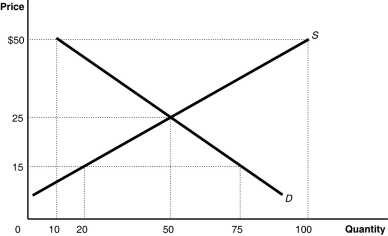 -If, for a product, the quantity supplied exceeds the quantity demanded, the market price will fall until
 (Multiple Choice)
4.9/5 (84)
(84) If the price of beef jerky rises, the substitution effect due to the price change will cause
(Multiple Choice)
4.8/5 (66)
(66) Which of the following is evidence of a shortage of chocolate?
(Multiple Choice)
4.8/5 (86)
(86) Figure 3-7
-Refer to Figure 3-7. Assume that the graphs in this figure represent the demand and supply curves for rice. What happens in this market if buyers expect the price of rice to fall?
-Refer to Figure 3-7. Assume that the graphs in this figure represent the demand and supply curves for rice. What happens in this market if buyers expect the price of rice to fall? (Multiple Choice)
4.7/5 (78)
(78) Figure 3-1 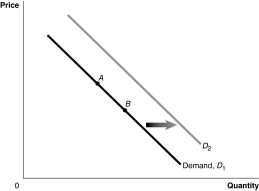 -Technological advances have resulted in lower prices for digital cameras. What is the impact of this on the market for traditional (non-digital) cameras?
 (Multiple Choice)
4.9/5 (85)
(85) Assume that the demand curve for MP3 players shifts to the right and the supply curve for MP3 players shift to the left, but the supply curve shifts more than the demand curve. As a result
(Multiple Choice)
5.0/5 (71)
(71) All else equal, as the price of a product falls, the quantity supplied decreases.
(True/False)
4.9/5 (73)
(73) In each of the following situations, list what will happen to the equilibrium price and the equilibrium quantity for a particular product, which is an inferior good.
a. The population decreases and productivity increases.
b. The income increases and the price of inputs increase.
c. The number of firms in the market decreases and income decreases.
d. Consumer preference decreases and the price of a complement increases.
e. The price of a substitute in consumption increases and the price of a substitute in production increases.
(Essay)
4.8/5 (81)
(81) In September, buyers of silver expect that the price of silver will rise in October. What happens in the silver market in September, holding all else constant?
(Multiple Choice)
4.8/5 (67)
(67) An increase in the demand for peanuts due to changes in consumer tastes, accompanied by an increase in the supply of peanuts as a result of favorable growing conditions, will result in
(Multiple Choice)
4.8/5 (72)
(72) Table 3-4
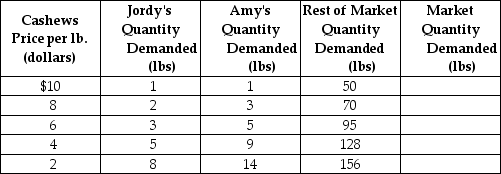 -Refer to Table 3-4. The table above shows the demand schedules for cashews of two individuals (Jordy and Amy) and the rest of the market. If the price of cashews rises from $4 to $6, the market quantity demanded would
 (Multiple Choice)
4.9/5 (84)
(84) The law of demand implies, holding everything else constant, that as the price of yogurt
(Multiple Choice)
4.8/5 (77)
(77) Studies have shown that drinking one glass of red wine per day may help prevent heart disease. Assume this is true, and a fungal disease destroys a large portion of the grape harvest of California vineyards. In the market for red wine, these two developments would
(Multiple Choice)
4.8/5 (80)
(80) 
Filters
- Essay(0)
- Multiple Choice(0)
- Short Answer(0)
- True False(0)
- Matching(0)