



 Chat with AI
Exam 3: Where Prices Come From: the Interaction of Demand and Supply

Exam 1: Economics: Foundations and Models444 Questions
Exam 2: Trade-Offs, Comparative Advantage, and the Market System498 Questions
Exam 3: Where Prices Come From: the Interaction of Demand and Supply475 Questions
Exam 4: Economic Efficiency, Government Price Setting, and Taxes419 Questions
Exam 5: Externalities, Environmental Policy, and Public Goods266 Questions
Exam 6: Elasticity: the Responsiveness of Demand and Supply295 Questions
Exam 7: The Economics of Health Care334 Questions
Exam 8: Firms, the Stock Market, and Corporate Governance278 Questions
Exam 9: Comparative Advantage and the Gains From International Trade379 Questions
Exam 10: Consumer Choice and Behavioral Economics302 Questions
Exam 11: Technology, Production, and Costs330 Questions
Exam 12: Firms in Perfectly Competitive Markets298 Questions
Exam 13: Monopolistic Competition: the Competitive Model in a More Realistic Setting276 Questions
Exam 14: Oligopoly: Firms in Less Competitive Markets262 Questions
Exam 15: Monopoly and Antitrust Policy271 Questions
Exam 16: Pricing Strategy263 Questions
Exam 17: The Markets for Labor and Other Factors of Production286 Questions
Exam 18: Public Choice, Taxes, and the Distribution of Income258 Questions
Exam 19: GDP: Measuring Total Production and Income266 Questions
Exam 20: Unemployment and Inflation292 Questions
Exam 21: Economic Growth, the Financial System, and Business Cycles257 Questions
Exam 22: Long-Run Economic Growth: Sources and Policies268 Questions
Exam 23: Aggregate Expenditure and Output in the Short Run306 Questions
Exam 24: Aggregate Demand and Aggregate Supply Analysis284 Questions
Exam 25: Money, Banks, and the Federal Reserve System280 Questions
Exam 26: Monetary Policy277 Questions
Exam 27: Fiscal Policy303 Questions
Exam 28: Inflation, Unemployment, and Federal Reserve Policy257 Questions
Exam 29: Macroeconomics in an Open Economy278 Questions
Exam 30: The International Financial System262 Questions
Select questions type


Let D = demand, S = supply, P = equilibrium price, Q= equilibrium quantity. What happens in the market for tropical hardwood trees if the governments restrict the amount of forest lands that can be logged?
(Multiple Choice)
4.8/5  (84)
(84) Select the phrase that correctly completes the following statement. "A decrease in the number of manufacturers caused a decrease in the supply of sailboats. As a result,
(Multiple Choice)
4.8/5 (71)
(71) If in the market for peaches, the supply curve has shifted to the left,
(Multiple Choice)
4.7/5 (87)
(87) The market for smartphones has become very competitive. The increase in competition in this market is an example of how the market responds to
(Multiple Choice)
4.9/5 (89)
(89) From a supply perspective, what impact would an increase in the price of motorcycles have on the market for motorcycles?
(Essay)
4.7/5 (72)
(72) 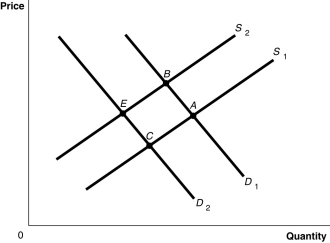 -Which of the following statements is true?
If the price of peaches, a substitute for plums, decreases, the demand for plums will increase.
(True/False)
4.9/5 (77)
(77) Figure 3-1 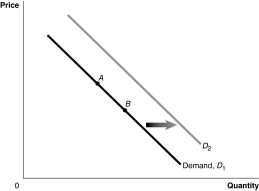 -Buyers rush to purchase stocks in California vineyards following a forecast of a 30 percent decline in this year's grape harvest. What happens in the California wine market as a result of this announcement?
 (Multiple Choice)
4.9/5 (66)
(66) Draw a supply and demand graph showing an equilibrium price of $50 and an equilibrium quantity of 200 units. Explain what would happen if the selling price was $75, and illustrate this on the graph. Explain what would happen if the selling price was $25, and illustrate this on the graph. Be sure to label each axis and curve on the graph.
(Essay)
4.8/5 (78)
(78) Orange juice drinkers want to consume more orange juice at a lower price. Which of the following events would have this effect?
(Multiple Choice)
4.9/5 (77)
(77) Which of the following would shift the supply curve for MP3 players to the right?
(Multiple Choice)
4.8/5 (75)
(75) Peanut butter and jelly are complements. If the price of peanut butter increases, the demand for jelly will increase.
(True/False)
4.8/5 (84)
(84) The popularity of digital cameras has enticed large discount stores like Wal-Mart and Costco to offer digital photo printing services. How does this affect the digital photo printing market?
(Multiple Choice)
4.9/5 (83)
(83) The law of demand implies, holding everything else constant, that
(Multiple Choice)
4.8/5 (69)
(69) 
Filters
- Essay(0)
- Multiple Choice(0)
- Short Answer(0)
- True False(0)
- Matching(0)