



 Chat with AI
Exam 9: Profit Maximization

Exam 1: The Wealth of Nations: Ownership and Economic Freedom87 Questions
Exam 2: Scarcity and Opportunity Costs87 Questions
Exam 3: Markets and the Price System96 Questions
Exam 4: The Aggregate Economy61 Questions
Exam 5: Using Economics to Understand the World Around You68 Questions
Exam 6: Elasticity: Demand and Supply133 Questions
Exam 7: Demand: Consumer Choice142 Questions
Exam 8: Supply: the Costs of Doing Business105 Questions
Exam 9: Profit Maximization121 Questions
Exam 10: Perfect Competition135 Questions
Exam 11: Monopoly118 Questions
Exam 12: Monopolistic Competition and Oligopoly114 Questions
Exam 13: Markets and Government113 Questions
Exam 14: Antitrust and Regulation88 Questions
Exam 15: Resource Markets110 Questions
Exam 16: The Labor Market116 Questions
Exam 17: The Capital Market110 Questions
Exam 18: The Land Market and Natural Resources55 Questions
Exam 19: Current Issues: Income, Income Distribution, Poverty, and Government Policy85 Questions
Exam 20: World Trade Equilibrium112 Questions
Exam 21: International Trade Restrictions109 Questions
Exam 22: Exchange Rates and Financial Links Between Countries130 Questions
Select questions type


Scenario 9.2
Consider a publicly held firm (one whose stock shares are traded on the stock exchange) that earned revenue worth $350 million and incurred land, labor, and debt costs worth $320 million. The stockholders who have invested a total of $100 million in this firm could have earned 10 percent return on other comparable investments.
-Entry barriers exist in a perfectly competitive industry.
(True/False)
4.8/5  (74)
(74) Scenario 9.2
Consider a publicly held firm (one whose stock shares are traded on the stock exchange) that earned revenue worth $350 million and incurred land, labor, and debt costs worth $320 million. The stockholders who have invested a total of $100 million in this firm could have earned 10 percent return on other comparable investments.
-A firm will always maximize profit at the level of output where average total costs are minimized.
(True/False)
4.8/5 (77)
(77) Scenario 9.2
Consider a publicly held firm (one whose stock shares are traded on the stock exchange) that earned revenue worth $350 million and incurred land, labor, and debt costs worth $320 million. The stockholders who have invested a total of $100 million in this firm could have earned 10 percent return on other comparable investments.
-A perfectly competitive firm charges a price which is greater than its marginal cost.
(True/False)
4.8/5 (80)
(80) The table given below shows the total revenue and total cost of producing a commodity.Table 9.1
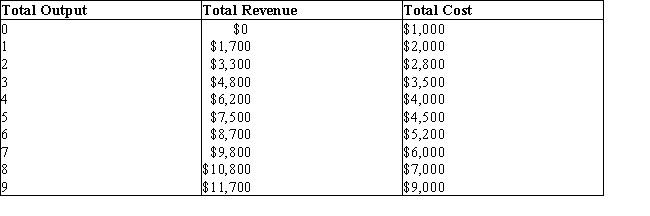 -In Table 9.1, the marginal cost of producing the sixth unit of output is equal to _____.
 (Multiple Choice)
4.8/5 (73)
(73) The figure given below shows the revenue and cost curves of a firm. MC represents the marginal cost curve, AC the average cost curve, MR the marginal revenue curve, and AR the average revenue curve.Figure 9.4
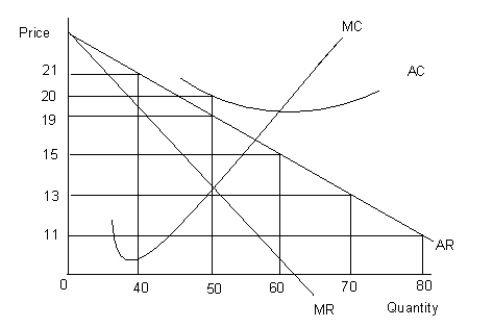 -Steve is about to start up a business in a monopolistically competitive market. Which of the following can he expect?
 (Multiple Choice)
4.8/5 (91)
(91) Scenario 9.2
Consider a publicly held firm (one whose stock shares are traded on the stock exchange) that earned revenue worth $350 million and incurred land, labor, and debt costs worth $320 million. The stockholders who have invested a total of $100 million in this firm could have earned 10 percent return on other comparable investments.
-Irrespective of the market structure, a firm maximizes profit at the level of output where the price of its product equals its marginal cost.
(True/False)
4.9/5 (64)
(64) The figure given below shows the revenue and cost curves of a firm. MC represents the marginal cost curve, AC the average cost curve, MR the marginal revenue curve, and AR the average revenue curve.Figure 9.4
-A(n) ____ is a price taker.
-A(n) ____ is a price taker. (Multiple Choice)
4.8/5 (80)
(80) The figure given below shows the revenue and cost curves of a firm. MC represents the marginal cost curve, AC the average cost curve, MR the marginal revenue curve, and AR the average revenue curve.Figure 9.4
-Monopoly is a market structure in which:
-Monopoly is a market structure in which: (Multiple Choice)
4.8/5 (81)
(81) Scenario 9.2
Consider a publicly held firm (one whose stock shares are traded on the stock exchange) that earned revenue worth $350 million and incurred land, labor, and debt costs worth $320 million. The stockholders who have invested a total of $100 million in this firm could have earned 10 percent return on other comparable investments.
-In monopolistic competition, there are no brands, all the producers produce only identical, generic products.
(True/False)
4.9/5 (78)
(78) Scenario 9.2
Consider a publicly held firm (one whose stock shares are traded on the stock exchange) that earned revenue worth $350 million and incurred land, labor, and debt costs worth $320 million. The stockholders who have invested a total of $100 million in this firm could have earned 10 percent return on other comparable investments.
-The primary goal of any business firm is to maximize social welfare.
(True/False)
4.9/5 (83)
(83) The figure given below shows the revenue and cost curves of a firm. MC represents the marginal cost curve, AC the average cost curve, MR the marginal revenue curve, and AR the average revenue curve.Figure 9.4
-Which of the following is not true of monopolistic competition?
-Which of the following is not true of monopolistic competition? (Multiple Choice)
4.8/5 (85)
(85) Scenario 9.2
Consider a publicly held firm (one whose stock shares are traded on the stock exchange) that earned revenue worth $350 million and incurred land, labor, and debt costs worth $320 million. The stockholders who have invested a total of $100 million in this firm could have earned 10 percent return on other comparable investments.
-The opportunity cost of going to movies is the price of entry into the movies.
(True/False)
4.9/5 (81)
(81) The figure given below shows the cost curves of a firm.Figure 9.3
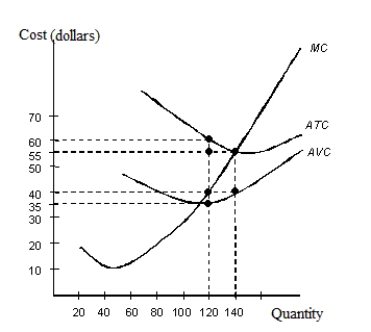 ATC: Average Total Cost
AVC: Average Variable Cost
MC: Marginal Cost
-Refer to Figure 9.3. If the firm maximizes its profit at 120 units of the output, calculate the firm's marginal revenue.
ATC: Average Total Cost
AVC: Average Variable Cost
MC: Marginal Cost
-Refer to Figure 9.3. If the firm maximizes its profit at 120 units of the output, calculate the firm's marginal revenue. (Multiple Choice)
4.9/5 (84)
(84) Scenario 9.2
Consider a publicly held firm (one whose stock shares are traded on the stock exchange) that earned revenue worth $350 million and incurred land, labor, and debt costs worth $320 million. The stockholders who have invested a total of $100 million in this firm could have earned 10 percent return on other comparable investments.
-A positive economic profit signals that the investors of a firm should divert their funds to alternative ventures.
(True/False)
4.7/5 (95)
(95) The figure given below shows the revenue and cost curves of a firm. MC represents the marginal cost curve, AC the average cost curve, MR the marginal revenue curve, and AR the average revenue curve.Figure 9.4
-Why does a monopolist face the market demand curve?
-Why does a monopolist face the market demand curve? (Multiple Choice)
4.8/5 (85)
(85) The table given below shows the total revenue and total cost of producing a commodity.Table 9.1
-In Table 9.1, marginal revenue exceeds marginal cost:
-In Table 9.1, marginal revenue exceeds marginal cost: (Multiple Choice)
4.7/5 (76)
(76) Scenario 9.2
Consider a publicly held firm (one whose stock shares are traded on the stock exchange) that earned revenue worth $350 million and incurred land, labor, and debt costs worth $320 million. The stockholders who have invested a total of $100 million in this firm could have earned 10 percent return on other comparable investments.
-A firm's economic profit is the difference between its total revenue and total costs, including the opportunity costs of the resources used in the business.
(True/False)
4.8/5 (83)
(83) The table given below reports the marginal revenue and marginal cost of Holmes Detective Agency for each client.Table 9.2
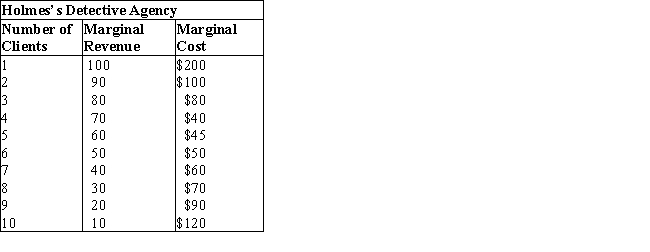 -The profit of a firm is maximized when:
 (Multiple Choice)
4.9/5 (75)
(75) The table given below reports the marginal revenue and marginal cost of Holmes Detective Agency for each client.Table 9.2
-The addition to a business firm's total costs, that comes from producing one more unit of output, is its:
-The addition to a business firm's total costs, that comes from producing one more unit of output, is its: (Multiple Choice)
4.7/5 (71)
(71) Scenario 9.2
Consider a publicly held firm (one whose stock shares are traded on the stock exchange) that earned revenue worth $350 million and incurred land, labor, and debt costs worth $320 million. The stockholders who have invested a total of $100 million in this firm could have earned 10 percent return on other comparable investments.
-According to the information in Scenario 9.2, the cost of equity capital is:
(Multiple Choice)
4.9/5 (74)
(74) 
Filters
- Essay(0)
- Multiple Choice(0)
- Short Answer(0)
- True False(0)
- Matching(0)