



 Chat with AI
Exam 6: Elasticity: Demand and Supply

Exam 1: The Wealth of Nations: Ownership and Economic Freedom87 Questions
Exam 2: Scarcity and Opportunity Costs87 Questions
Exam 3: Markets and the Price System96 Questions
Exam 4: The Aggregate Economy61 Questions
Exam 5: Using Economics to Understand the World Around You68 Questions
Exam 6: Elasticity: Demand and Supply133 Questions
Exam 7: Demand: Consumer Choice142 Questions
Exam 8: Supply: the Costs of Doing Business105 Questions
Exam 9: Profit Maximization121 Questions
Exam 10: Perfect Competition135 Questions
Exam 11: Monopoly118 Questions
Exam 12: Monopolistic Competition and Oligopoly114 Questions
Exam 13: Markets and Government113 Questions
Exam 14: Antitrust and Regulation88 Questions
Exam 15: Resource Markets110 Questions
Exam 16: The Labor Market116 Questions
Exam 17: The Capital Market110 Questions
Exam 18: The Land Market and Natural Resources55 Questions
Exam 19: Current Issues: Income, Income Distribution, Poverty, and Government Policy85 Questions
Exam 20: World Trade Equilibrium112 Questions
Exam 21: International Trade Restrictions109 Questions
Exam 22: Exchange Rates and Financial Links Between Countries130 Questions
Select questions type


The figure given below shows the demand curves for five products: A, B, C, D, and E.Figure 6.1
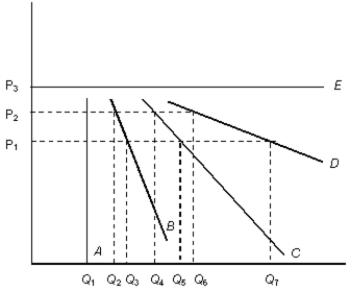 -Which of the following goods is likely to have an income elasticity of demand that is less than zero?
 (Multiple Choice)
4.8/5  (96)
(96) Scenario 5.1
The demand for noodles is given by the following equation: Q = 20 - 4P + 0.2I - 2Px. Assume that P = $8, I = 200, and Px = $10.
-The price elasticity of demand depends on how readily and easily consumers can switch their purchases from one product to another.
(True/False)
4.9/5 (75)
(75) The figure given below shows the demand curves for five products: A, B, C, D, and E.Figure 6.1
-When the price of hot dogs at the supermarket increases, the quantity demanded of hot dog buns declines. This situation describes:
-When the price of hot dogs at the supermarket increases, the quantity demanded of hot dog buns declines. This situation describes: (Multiple Choice)
4.9/5 (80)
(80) Scenario 5.1
The demand for noodles is given by the following equation: Q = 20 - 4P + 0.2I - 2Px. Assume that P = $8, I = 200, and Px = $10.
-There are some special types of goods for which supply cannot change, irrespective of the length of time allowed for change, such as Beethoven symphonies. The price elasticity of supply for these goods is _____.
(Multiple Choice)
4.8/5 (91)
(91) The figure given below shows the demand curves for five products: A, B, C, D, and E.Figure 6.1
-Consider a medical breakthrough that led to the discovery of a simple microchip, which when inserted inside the human ear could prevent certain chronic diseases. The price elasticity of demand for that microchip would most likely be _____.
-Consider a medical breakthrough that led to the discovery of a simple microchip, which when inserted inside the human ear could prevent certain chronic diseases. The price elasticity of demand for that microchip would most likely be _____. (Multiple Choice)
4.9/5 (89)
(89) Scenario 5.1
The demand for noodles is given by the following equation: Q = 20 - 4P + 0.2I - 2Px. Assume that P = $8, I = 200, and Px = $10.
-If the price elasticity of demand is between -1 and -, then demand is inelastic. 
(True/False)
4.9/5 (72)
(72) Scenario 5.1
The demand for noodles is given by the following equation: Q = 20 - 4P + 0.2I - 2Px. Assume that P = $8, I = 200, and Px = $10.
-When economists speak of the short run, they are referring to _____.
(Multiple Choice)
4.8/5 (78)
(78) Scenario 5.1
The demand for noodles is given by the following equation: Q = 20 - 4P + 0.2I - 2Px. Assume that P = $8, I = 200, and Px = $10.
-If a product has an elastic demand, it means that consumers are relatively insensitive to a change in the price of the product.
(True/False)
4.9/5 (82)
(82) Scenario 5.1
The demand for noodles is given by the following equation: Q = 20 - 4P + 0.2I - 2Px. Assume that P = $8, I = 200, and Px = $10.
-Since demand curves are mostly downward sloping, economists tend to ignore the negative sign when calculating the price elasticity of demand.
(True/False)
4.7/5 (82)
(82) Scenario 5.1
The demand for noodles is given by the following equation: Q = 20 - 4P + 0.2I - 2Px. Assume that P = $8, I = 200, and Px = $10.
-A perfectly inelastic demand curve is represented by an upward-sloping straight line.
(True/False)
4.9/5 (83)
(83) Figure 5.3. The figure shows the wage rate and the quantity of labor supplied in an unskilled labor market. 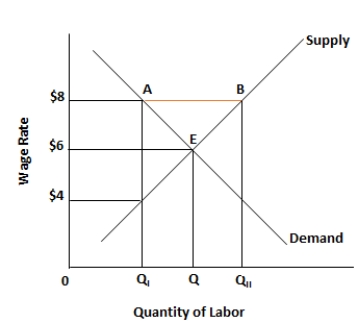 -If the percentage change in the quantity demanded of a good is greater than the percentage change in the price of the good, then the demand for the good is _____.
 (Multiple Choice)
4.9/5 (79)
(79) Scenario 5.1
The demand for noodles is given by the following equation: Q = 20 - 4P + 0.2I - 2Px. Assume that P = $8, I = 200, and Px = $10.
-Given the above equation, the income elasticity of demand for noodles is _____.
(Multiple Choice)
4.8/5 (86)
(86) The figure given below shows the demand curves for five products: A, B, C, D, and E.Figure 6.1
-A 0.5% increase in the price of a particular product causes the quantity demanded of the product to drop to zero. This means that the price elasticity of demand for the product is:
-A 0.5% increase in the price of a particular product causes the quantity demanded of the product to drop to zero. This means that the price elasticity of demand for the product is: (Multiple Choice)
4.8/5 (82)
(82) Scenario 5.1
The demand for noodles is given by the following equation: Q = 20 - 4P + 0.2I - 2Px. Assume that P = $8, I = 200, and Px = $10.
-A perfectly elastic demand curve is represented by a vertical line.
(True/False)
4.8/5 (84)
(84) Scenario 5.1
The demand for noodles is given by the following equation: Q = 20 - 4P + 0.2I - 2Px. Assume that P = $8, I = 200, and Px = $10.
-Supply tends to be more elastic in the long run than in the short run.
(True/False)
4.9/5 (79)
(79) Figure 5.3. The figure shows the wage rate and the quantity of labor supplied in an unskilled labor market.
-Which of the following is true of the price elasticity of demand of a product?
-Which of the following is true of the price elasticity of demand of a product? (Multiple Choice)
4.8/5 (80)
(80) The figure given below shows the demand curves for five products: A, B, C, D, and E.Figure 6.1
-In the opinion of many consumers, there are few, if any, substitutes for the popular search engine Google. If Google were to charge consumers for its services, it would face:
-In the opinion of many consumers, there are few, if any, substitutes for the popular search engine Google. If Google were to charge consumers for its services, it would face: (Multiple Choice)
4.7/5 (76)
(76) The table below shows the quantities of automobiles, margarine, and coffee purchased by Ted at different levels of income.Table 6.2
 -Refer to Table 6.2. What is the income elasticity of demand for automobiles?
 (Multiple Choice)
4.8/5 (82)
(82) The figure given below shows the demand curves for five products: A, B, C, D, and E.Figure 6.1
-Suppose the value of price elasticity of demand for goods manufactured by firms A, B, C, and D are 0, -0.8, -1, and -1.5 respectively. The demand for the good will be elastic for:
-Suppose the value of price elasticity of demand for goods manufactured by firms A, B, C, and D are 0, -0.8, -1, and -1.5 respectively. The demand for the good will be elastic for: (Multiple Choice)
4.8/5 (79)
(79) Scenario 5.1
The demand for noodles is given by the following equation: Q = 20 - 4P + 0.2I - 2Px. Assume that P = $8, I = 200, and Px = $10.
-Price elasticity of demand measures the responsiveness of quantity demanded in a market to a change in price.
(True/False)
4.9/5 (90)
(90) 
Filters
- Essay(0)
- Multiple Choice(0)
- Short Answer(0)
- True False(0)
- Matching(0)