



 Chat with AI
Exam 2: Scarcity and Opportunity Costs

Exam 1: The Wealth of Nations: Ownership and Economic Freedom87 Questions
Exam 2: Scarcity and Opportunity Costs87 Questions
Exam 3: Markets and the Price System96 Questions
Exam 4: The Aggregate Economy61 Questions
Exam 5: Using Economics to Understand the World Around You68 Questions
Exam 6: Elasticity: Demand and Supply133 Questions
Exam 7: Demand: Consumer Choice142 Questions
Exam 8: Supply: the Costs of Doing Business105 Questions
Exam 9: Profit Maximization121 Questions
Exam 10: Perfect Competition135 Questions
Exam 11: Monopoly118 Questions
Exam 12: Monopolistic Competition and Oligopoly114 Questions
Exam 13: Markets and Government113 Questions
Exam 14: Antitrust and Regulation88 Questions
Exam 15: Resource Markets110 Questions
Exam 16: The Labor Market116 Questions
Exam 17: The Capital Market110 Questions
Exam 18: The Land Market and Natural Resources55 Questions
Exam 19: Current Issues: Income, Income Distribution, Poverty, and Government Policy85 Questions
Exam 20: World Trade Equilibrium112 Questions
Exam 21: International Trade Restrictions109 Questions
Exam 22: Exchange Rates and Financial Links Between Countries130 Questions
Select questions type


The figure given below represents an economy producing corn and planes under different economic situations.Figure 2.2
 -Which of the following would not cause any kind of an outward shift of a nation's production possibilities curve [PPC]?
 (Multiple Choice)
4.7/5  (85)
(85) The figure given below represents the production possibilities curves [PPC] of a country producing wine and cars.Figure 2.1
 -If the general education level within a country rises significantly over time, it is likely that:
 (Multiple Choice)
4.9/5 (73)
(73) Figure 1.3
 -Jane wins $100,000 in a lottery and immediately uses her winnings to open up a donuts shop. Her direct cost is $50,000, and she puts the remaining money in a savings account earning 10 percent annual interest. Alternatively, Jane could have placed all her lottery winnings in the 10 percent savings account. Jane's total cost of opening up a donuts shop is:
 (Multiple Choice)
4.8/5 (77)
(77) The figure given below represents the PPC in two nations - Germany and Korea, producing only two goods, cars and food.Figure 2.4
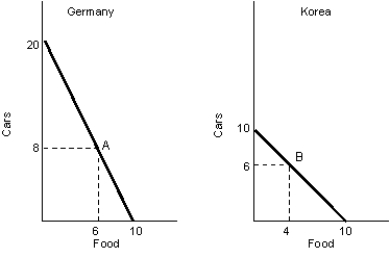 -Economic growth can be illustrated by an outward shift of the PPC.
 (True/False)
4.8/5 (82)
(82) The table given below represents the output per hour of cookies and chilies in Ohio and Iowa.Table 2.4
 -Refer to Table 2.4. Identify the correct statement.
 (Multiple Choice)
5.0/5 (72)
(72) The table given below represents butter and ham production by two countries Norway and Sweden.Table 2.5
 -Assume that the United States uses 20 worker-hours to produce 1 computer and 5 worker-hours to produce 1 unit of food; assume also that Japan uses 10 worker-hours to produce 1 computer and 30 worker-hours to produce 1 unit of food. Which of the following statements is true?
 (Multiple Choice)
4.8/5 (72)
(72) Given below is the production possibilities schedule for a small island nation in South Pacific that produces capital and consumer goods.Table 2.3
 -If a nation specializes in activities in which opportunity costs are the lowest and then trades with other nations, it is most likely to:
 (Multiple Choice)
4.8/5 (82)
(82) 
Filters
- Essay(0)
- Multiple Choice(0)
- Short Answer(0)
- True False(0)
- Matching(0)