



 Chat with AI
Exam 15: Monetary Policy

Exam 1: Economics: Foundations and Models211 Questions
Exam 2: Trade-Offs,comparative Advantage,and the Market System239 Questions
Exam 3: Where Prices Come From: the Interaction of Demand and Supply233 Questions
Exam 4: Economic Efficiency, government Price Setting, and Taxes211 Questions
Exam 5: The Economics of Health Care164 Questions
Exam 6: Firms,the Stock Market,and Corporate Governance276 Questions
Exam 7: Comparative Advantage and the Gains From International Trade190 Questions
Exam 8: GDP: Measuring Total Production and Income266 Questions
Exam 9: Unemployment and Inflation292 Questions
Exam 10: Economic Growth, the Financial System, and Business Cycles257 Questions
Exam 11: Long-Run Economic Growth: Sources and Policies268 Questions
Exam 12: Aggregate Expenditure and Output in the Short Run306 Questions
Exam 13: Aggregate Demand and Aggregate Supply Analysis284 Questions
Exam 14: Money, banks, and the Federal Reserve System280 Questions
Exam 15: Monetary Policy277 Questions
Exam 16: Fiscal Policy303 Questions
Exam 17: Inflation, unemployment, and Federal Reserve Policy257 Questions
Exam 18: Macroeconomics in an Open Economy278 Questions
Exam 19: The International Financial System262 Questions
Select questions type


When housing prices ________ as they did beginning in 2006 following the housing market bubble,most banks and other lenders tightened the requirement for borrowers,making it ________ for potential home buyers to obtain mortgages.
(Multiple Choice)
4.8/5  (89)
(89) Figure 15-3 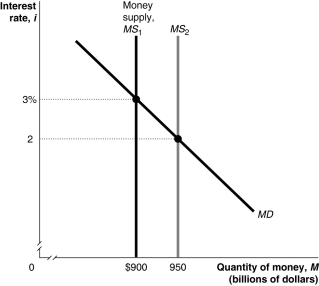 -Refer to Figure 15-3.In the figure above,when the money supply shifts from MS1 to MS2,at the interest rate of 3 percent households and firms will
 (Multiple Choice)
4.9/5 (80)
(80) Figure 15-15 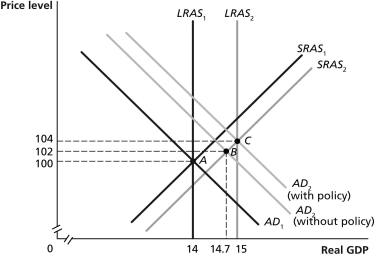 -Refer to Figure 15-15.In the figure above,suppose the economy in Year 1 is at point A and expected in Year 2 to be at point B.Which of the following policies could the Federal Reserve use to move the economy to point C?
 (Multiple Choice)
4.8/5 (80)
(80) The supporters of a monetary growth rule believe that active monetary policy
(Multiple Choice)
4.9/5 (81)
(81) The money market model is concerned with ________ and the loanable funds market model is concerned with ________.
(Multiple Choice)
4.8/5 (77)
(77) When the price of a financial asset ________ its interest rate will ________.
(Multiple Choice)
4.9/5 (84)
(84) Expansionary monetary policy to prevent real GDP from falling below potential real GDP would cause the inflation rate to be ________ and real GDP to be ________.
(Multiple Choice)
4.9/5 (75)
(75) Write out the expression for the Taylor rule.Use the Taylor rule to explain how a decline in real GDP below potential GDP will affect the Federal Reserve's target for the federal funds rate.
(Essay)
4.9/5 (78)
(78) The Fed can use contractionary monetary policy in an attempt to keep inflation from increasing.
(True/False)
4.8/5 (78)
(78) Under the monetary growth rule proposed by the monetarists,the money supply would grow each year at a constant rate equal to the long-run rate of growth of
(Multiple Choice)
4.9/5 (88)
(88) Expansionary monetary policy refers to the Fed's increasing the money supply and increasing interest rates to increase real GDP.
(True/False)
4.8/5 (83)
(83) Your income will increase if the Federal Reserve buys a Treasury bill from you and pays you with a check from the Fed.
(True/False)
4.9/5 (88)
(88) Which of the following would most likely induce the Federal Reserve to conduct expansionary monetary policy? A significant decrease in
(Multiple Choice)
4.9/5 (78)
(78) 
Filters
- Essay(0)
- Multiple Choice(0)
- Short Answer(0)
- True False(0)
- Matching(0)