



 Chat with AI
Exam 15: Monetary Policy

Exam 1: Economics: Foundations and Models211 Questions
Exam 2: Trade-Offs,comparative Advantage,and the Market System239 Questions
Exam 3: Where Prices Come From: the Interaction of Demand and Supply233 Questions
Exam 4: Economic Efficiency, government Price Setting, and Taxes211 Questions
Exam 5: The Economics of Health Care164 Questions
Exam 6: Firms,the Stock Market,and Corporate Governance276 Questions
Exam 7: Comparative Advantage and the Gains From International Trade190 Questions
Exam 8: GDP: Measuring Total Production and Income266 Questions
Exam 9: Unemployment and Inflation292 Questions
Exam 10: Economic Growth, the Financial System, and Business Cycles257 Questions
Exam 11: Long-Run Economic Growth: Sources and Policies268 Questions
Exam 12: Aggregate Expenditure and Output in the Short Run306 Questions
Exam 13: Aggregate Demand and Aggregate Supply Analysis284 Questions
Exam 14: Money, banks, and the Federal Reserve System280 Questions
Exam 15: Monetary Policy277 Questions
Exam 16: Fiscal Policy303 Questions
Exam 17: Inflation, unemployment, and Federal Reserve Policy257 Questions
Exam 18: Macroeconomics in an Open Economy278 Questions
Exam 19: The International Financial System262 Questions
Select questions type


Suppose the equilibrium real federal funds rate is 2 percent,the target rate of inflation is 2 percent,the current inflation rate is 4 percent,and real GDP is 2 percent above potential real GDP.If the weights for the inflation gap and the output gap are both 1/2,then according to the Taylor rule the federal funds target rate equals
(Multiple Choice)
4.9/5  (85)
(85) In reality,the Fed is unable to use monetary policy to keep real GDP exactly at its potential level.
(True/False)
4.8/5 (74)
(74) Figure 15-1 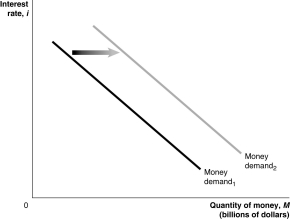 -Refer to Figure 15-1.In the figure above,the money demand curve would move from Money demand1 to Money demand2 if
 (Multiple Choice)
4.9/5 (83)
(83) The situation in which short-term interest rates are pushed to zero,leaving the central bank unable to lower them further is known as
(Multiple Choice)
4.9/5 (84)
(84) Suppose that the economy is producing above potential GDP and the Fed implements the correct change in monetary policy,but not until after the economy has passed the peak of the boom.Then
(Multiple Choice)
4.8/5 (87)
(87) If the amount you owe on your house is less than the price of the house,you have
(Multiple Choice)
4.9/5 (98)
(98) If the Federal Reserve raises or lowers interest rates too late,it could result in a ________ policy that destabilizes the economy.
(Multiple Choice)
4.8/5 (89)
(89) The Fed has adopted an interest rate target for most of the time since World War II.
(True/False)
4.8/5 (82)
(82) Which of the following is not an argument against inflation targeting?
(Multiple Choice)
4.9/5 (87)
(87) Table 15-2
 -Refer to Table 15-2.Consider the hypothetical information in the table above for potential real GDP,real GDP and the price level in 2014 and in 2015 if the Federal Reserve does not use monetary policy.If the Fed wants to keep real GDP at its potential level in 2015,it should
 (Multiple Choice)
4.9/5 (82)
(82) Suppose that the economy is producing below potential GDP and the Fed implements the correct change in monetary policy,but not until after the economy has passed the trough of the recession.Then
(Multiple Choice)
4.8/5 (81)
(81) When the Fed embarked on a policy known as quantitative easing,they
(Multiple Choice)
4.8/5 (76)
(76) Table 15-8
 -Refer to Table 15-8.The hypothetical information in the table shows what the values for real GDP and the price level will be in 2014 if the Federal Reserve does not use monetary policy:
a.If the Fed wants to keep real GDP at its potential level in 2014,should it use an expansionary policy or a contractionary policy? Should the trading desk buy T-bills or sell them?
b.Suppose the Fed's policy is successful in keeping real GDP at its potential level in 2014.State whether each of the following will be higher or lower than if the Fed had taken no action:
(i)Real GDP
(ii)Full-employment real GDP
(iii)The inflation rate
(iv)The unemployment rate
c.Draw an aggregate demand and aggregate supply graph to illustrate your answer.Be sure that your graph contains LRAS curves for 2013 and 2014; SRAS curves 2013 and 2014; AD curve for 2013 and 2014,with and without monetary policy actions; and equilibrium real GDP and the price level in 2014 with and without policy.
-Refer to Table 15-8.The hypothetical information in the table shows what the values for real GDP and the price level will be in 2014 if the Federal Reserve does not use monetary policy:
a.If the Fed wants to keep real GDP at its potential level in 2014,should it use an expansionary policy or a contractionary policy? Should the trading desk buy T-bills or sell them?
b.Suppose the Fed's policy is successful in keeping real GDP at its potential level in 2014.State whether each of the following will be higher or lower than if the Fed had taken no action:
(i)Real GDP
(ii)Full-employment real GDP
(iii)The inflation rate
(iv)The unemployment rate
c.Draw an aggregate demand and aggregate supply graph to illustrate your answer.Be sure that your graph contains LRAS curves for 2013 and 2014; SRAS curves 2013 and 2014; AD curve for 2013 and 2014,with and without monetary policy actions; and equilibrium real GDP and the price level in 2014 with and without policy. (Essay)
4.9/5 (76)
(76) In October 2008,Congress passed the ________,under which the Treasury provided funds to banks in exchange for stock.
(Multiple Choice)
4.7/5 (82)
(82) Use the money demand and money supply model to show graphically and explain the effect on interest rates of the Federal Reserve's open market purchase of Treasury securities.
(Essay)
4.8/5 (84)
(84) An advantage of the personal consumption expenditures price index (PCE)over the Consumer Price Index (CPI)as a measure of inflation is that the PCE
(Multiple Choice)
4.7/5 (89)
(89) The body that is responsible for dating the beginning and ending dates for a recession is
(Multiple Choice)
4.8/5 (75)
(75) In October 2008,Congress passed the Troubled Asset Relief Program (TARP),under which the Treasury provided ________ to banks in exchange for ________.
(Multiple Choice)
4.9/5 (81)
(81) 
Filters
- Essay(0)
- Multiple Choice(0)
- Short Answer(0)
- True False(0)
- Matching(0)