



 Chat with AI
Exam 15: Monetary Policy

Exam 1: Economics: Foundations and Models211 Questions
Exam 2: Trade-Offs,comparative Advantage,and the Market System239 Questions
Exam 3: Where Prices Come From: the Interaction of Demand and Supply233 Questions
Exam 4: Economic Efficiency, government Price Setting, and Taxes211 Questions
Exam 5: The Economics of Health Care164 Questions
Exam 6: Firms,the Stock Market,and Corporate Governance276 Questions
Exam 7: Comparative Advantage and the Gains From International Trade190 Questions
Exam 8: GDP: Measuring Total Production and Income266 Questions
Exam 9: Unemployment and Inflation292 Questions
Exam 10: Economic Growth, the Financial System, and Business Cycles257 Questions
Exam 11: Long-Run Economic Growth: Sources and Policies268 Questions
Exam 12: Aggregate Expenditure and Output in the Short Run306 Questions
Exam 13: Aggregate Demand and Aggregate Supply Analysis284 Questions
Exam 14: Money, banks, and the Federal Reserve System280 Questions
Exam 15: Monetary Policy277 Questions
Exam 16: Fiscal Policy303 Questions
Exam 17: Inflation, unemployment, and Federal Reserve Policy257 Questions
Exam 18: Macroeconomics in an Open Economy278 Questions
Exam 19: The International Financial System262 Questions
Select questions type


An increase in the interest rate should ________ the demand for dollars and the value of the dollar,and net exports should ________.
(Multiple Choice)
4.8/5  (91)
(91) Which of the following would cause the money demand curve to shift to the left?
(Multiple Choice)
4.9/5 (72)
(72) Inflation targeting is a framework for carrying out monetary policy whereby
(Multiple Choice)
4.8/5 (84)
(84) If the probability of losing your job remains ________,a recession would be a good time to purchase a home because the Fed usually ________ interest rates during this time.
(Multiple Choice)
4.8/5 (78)
(78) When the Federal Reserve increases the money supply,at the previous equilibrium interest rate households and firms will now have
(Multiple Choice)
4.8/5 (82)
(82) Which of the following is true about the Federal Reserve and its ability to prevent recessions? The Federal Reserve
(Multiple Choice)
4.9/5 (76)
(76) The Fed can use expansionary monetary policy to lower interest rates to stimulate aggregate demand.
(True/False)
4.8/5 (73)
(73) With the Troubled Asset Relief Program (TARP),the Treasury provided funds to banks in exchange for stock.
(True/False)
4.8/5 (73)
(73) Use a graph to show the effects of an expansionary monetary policy moving an economy out of recession and to potential real GDP.Explain what happens to aggregate demand,real GDP,and the price level.
(Essay)
4.8/5 (74)
(74) Using the Taylor rule,if the current inflation rate equals the target inflation rate and real GDP equals potential GDP,then the federal funds target rate equals the
(Multiple Choice)
5.0/5 (77)
(77) Inflation targeting,typically,has been accompanied by lower inflation.
(True/False)
4.9/5 (90)
(90) Contractionary monetary policy refers to the Fed's decreasing the money supply and decreasing interest rates to decrease real GDP.
(True/False)
4.7/5 (78)
(78) When housing prices fell as they did beginning in 2006 following the housing market bubble,most banks and other lenders ________ the requirement for borrowers,making it ________ for potential home buyers to obtain mortgages.
(Multiple Choice)
4.9/5 (79)
(79) Figure 15-11
 -Refer to Figure 15-11.In the dynamic model of AD-AS in the figure above,if the economy is at point A in year 1 and is expected to go to point B in year 2,and the Federal Reserve pursues no policy,then at point B
 (Multiple Choice)
4.9/5 (78)
(78) Figure 15-16 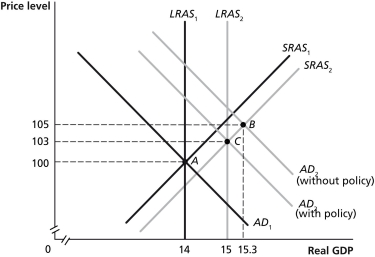 -Refer to Figure 15-16.In the figure above,suppose the economy in Year 1 is at point A and expected in Year 2 to be at point B.Which of the following policies could the Federal Reserve use to move the economy to point C?
 (Multiple Choice)
4.8/5 (85)
(85) In the countries that have adopted inflation targeting,the inflation rate has typically
(Multiple Choice)
4.8/5 (87)
(87) The Federal Reserve can directly affect its monetary policy ________,which then affect its monetary policy ________.
(Multiple Choice)
4.7/5 (76)
(76) Use a graph to show the effects of a contractionary monetary policy to reduce inflation and move an economy back to potential real GDP.Explain what happens to aggregate demand,real GDP,and the price level.
(Essay)
4.8/5 (67)
(67) The dynamic aggregate demand and aggregate supply model accounts for the price level rising every year.
(True/False)
4.9/5 (75)
(75) Table 15-1
 -Refer to Table 15-1.The hypothetical information in the table shows what the values for real GDP and the price level will be in 2015 if the Fed does not use monetary policy.Which of the following policies makes sense if the Fed wants to keep real GDP at its potential level in 2015?
 (Multiple Choice)
4.9/5 (79)
(79) 
Filters
- Essay(0)
- Multiple Choice(0)
- Short Answer(0)
- True False(0)
- Matching(0)