



 Chat with AI
Exam 7: Comparative Advantage and the Gains From International Trade

Exam 1: Economics: Foundations and Models211 Questions
Exam 2: Trade-Offs,comparative Advantage,and the Market System239 Questions
Exam 3: Where Prices Come From: the Interaction of Demand and Supply233 Questions
Exam 4: Economic Efficiency, government Price Setting, and Taxes211 Questions
Exam 5: The Economics of Health Care164 Questions
Exam 6: Firms,the Stock Market,and Corporate Governance276 Questions
Exam 7: Comparative Advantage and the Gains From International Trade190 Questions
Exam 8: GDP: Measuring Total Production and Income266 Questions
Exam 9: Unemployment and Inflation292 Questions
Exam 10: Economic Growth, the Financial System, and Business Cycles257 Questions
Exam 11: Long-Run Economic Growth: Sources and Policies268 Questions
Exam 12: Aggregate Expenditure and Output in the Short Run306 Questions
Exam 13: Aggregate Demand and Aggregate Supply Analysis284 Questions
Exam 14: Money, banks, and the Federal Reserve System280 Questions
Exam 15: Monetary Policy277 Questions
Exam 16: Fiscal Policy303 Questions
Exam 17: Inflation, unemployment, and Federal Reserve Policy257 Questions
Exam 18: Macroeconomics in an Open Economy278 Questions
Exam 19: The International Financial System262 Questions
Select questions type


Which of the following is the best example of a quota?

Free
(Multiple Choice)
4.7/5  (71)
(71) Correct Answer: Verified
B
Figure 7-2 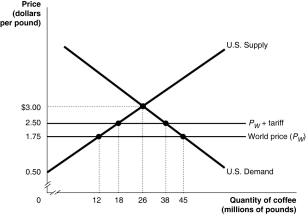 Suppose the U.S.government imposes a $0.75 per pound tariff on coffee imports.Figure 7-2 shows the impact of this tariff.
-Refer to Figure 7-2.The loss in domestic consumer surplus as a result of the tariff is equal to
Suppose the U.S.government imposes a $0.75 per pound tariff on coffee imports.Figure 7-2 shows the impact of this tariff.
-Refer to Figure 7-2.The loss in domestic consumer surplus as a result of the tariff is equal toFree
(Multiple Choice)
4.9/5 (77)
(77) Correct Answer:Verified
VerifiedD
Table 7-6
Production and
Consumption Production
Without Trade With Trade
 Estonia and Morocco can produce both swords and belts.Table 7-6 shows the production and consumption quantities without trade,and the production numbers with trade.
-Refer to Table 7-6.Prior to trade,what was the opportunity cost to produce 1 belt in Morocco?
Estonia and Morocco can produce both swords and belts.Table 7-6 shows the production and consumption quantities without trade,and the production numbers with trade.
-Refer to Table 7-6.Prior to trade,what was the opportunity cost to produce 1 belt in Morocco?Free
(Multiple Choice)
5.0/5 (82)
(82) Correct Answer:Verified
VerifiedC
Examples of comparative advantage show how trade between two countries can make each better off.Compared to their pre-trade positions,trade makes both countries better off because in each country
(Multiple Choice)
4.9/5 (93)
(93) Is the value of U.S.exports is typically larger or smaller than the value of U.S.imports.
(Essay)
4.7/5 (92)
(92) If the ________ cost of production for two goods is different between two countries then mutually beneficial trade is possible.
(Multiple Choice)
4.9/5 (79)
(79) What does it mean for a country to have a comparative advantage in producing a product?
(Essay)
4.9/5 (95)
(95) Figure 7-2 Suppose the U.S.government imposes a $0.75 per pound tariff on coffee imports.Figure 7-2 shows the impact of this tariff.
-Refer to Figure 7-2.The tariff revenue collected by the government equals
Suppose the U.S.government imposes a $0.75 per pound tariff on coffee imports.Figure 7-2 shows the impact of this tariff.
-Refer to Figure 7-2.The tariff revenue collected by the government equals (Multiple Choice)
4.7/5 (80)
(80) Figure 7-1 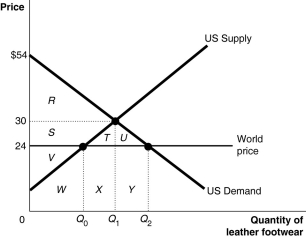 Figure 7-1 shows the U.S.demand and supply for leather footwear.
-Refer to Figure 7-1.Suppose the government allows imports of leather footwear into the United States.What will be the domestic quantity supplied?
Figure 7-1 shows the U.S.demand and supply for leather footwear.
-Refer to Figure 7-1.Suppose the government allows imports of leather footwear into the United States.What will be the domestic quantity supplied? (Multiple Choice)
4.9/5 (70)
(70) Whenever a buyer and a seller agree to trade,both must believe they will be made better off
(Multiple Choice)
4.9/5 (94)
(94) Trade restrictions are often motivated by a desire to save domestic jobs threatened by competition from imports.Which of the following counter-arguments is made by economists who oppose trade restrictions?
(Multiple Choice)
4.9/5 (63)
(63) Table 7-6
Production and
Consumption Production
Without Trade With Trade
Estonia and Morocco can produce both swords and belts.Table 7-6 shows the production and consumption quantities without trade,and the production numbers with trade.
-Refer to Table 7-6.Prior to trade,what was the opportunity cost to produce 1 belt in Estonia?
Estonia and Morocco can produce both swords and belts.Table 7-6 shows the production and consumption quantities without trade,and the production numbers with trade.
-Refer to Table 7-6.Prior to trade,what was the opportunity cost to produce 1 belt in Estonia? (Multiple Choice)
5.0/5 (79)
(79) Table 7-6
Production and
Consumption Production
Without Trade With Trade
Estonia and Morocco can produce both swords and belts.Table 7-6 shows the production and consumption quantities without trade,and the production numbers with trade.
-Refer to Table 7-6.Prior to trade,what was the opportunity cost to produce 1 sword in Morocco?
Estonia and Morocco can produce both swords and belts.Table 7-6 shows the production and consumption quantities without trade,and the production numbers with trade.
-Refer to Table 7-6.Prior to trade,what was the opportunity cost to produce 1 sword in Morocco? (Multiple Choice)
4.8/5 (90)
(90) Autarky is a situation where one country does not trade with other countries.
(True/False)
4.8/5 (72)
(72) Which of the following is an example of a trade restriction?
(Multiple Choice)
4.9/5 (84)
(84) Figure 7-3 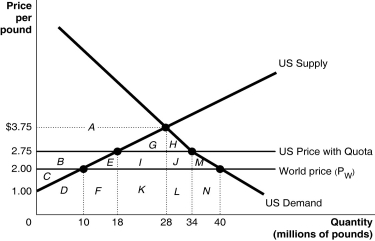 Since 1953 the United States has imposed a quota to limit the imports of peanuts.Figure 7-3 illustrates the impact of the quota.
-Refer to Figure 7-3.Without the quota,the domestic price of peanuts equals the world price which is $2.00 per pound.What is the quantity of peanuts demanded by domestic consumers in the absence of a quota?
Since 1953 the United States has imposed a quota to limit the imports of peanuts.Figure 7-3 illustrates the impact of the quota.
-Refer to Figure 7-3.Without the quota,the domestic price of peanuts equals the world price which is $2.00 per pound.What is the quantity of peanuts demanded by domestic consumers in the absence of a quota? (Multiple Choice)
5.0/5 (89)
(89) a.Define the term "globalization."
b.Describe the benefits of globalization.
c.Who is likely to oppose globalization and why?
(Essay)
4.7/5 (75)
(75) Explain whether it is possible for a country to have a comparative advantage in the production of a product without having an absolute advantage in the production of that product.
(Essay)
4.9/5 (80)
(80) 
Filters
- Essay(0)
- Multiple Choice(0)
- Short Answer(0)
- True False(0)
- Matching(0)