



 Chat with AI
Exam 5: The Economics of Health Care

Exam 1: Economics: Foundations and Models211 Questions
Exam 2: Trade-Offs,comparative Advantage,and the Market System239 Questions
Exam 3: Where Prices Come From: the Interaction of Demand and Supply233 Questions
Exam 4: Economic Efficiency, government Price Setting, and Taxes211 Questions
Exam 5: The Economics of Health Care164 Questions
Exam 6: Firms,the Stock Market,and Corporate Governance276 Questions
Exam 7: Comparative Advantage and the Gains From International Trade190 Questions
Exam 8: GDP: Measuring Total Production and Income266 Questions
Exam 9: Unemployment and Inflation292 Questions
Exam 10: Economic Growth, the Financial System, and Business Cycles257 Questions
Exam 11: Long-Run Economic Growth: Sources and Policies268 Questions
Exam 12: Aggregate Expenditure and Output in the Short Run306 Questions
Exam 13: Aggregate Demand and Aggregate Supply Analysis284 Questions
Exam 14: Money, banks, and the Federal Reserve System280 Questions
Exam 15: Monetary Policy277 Questions
Exam 16: Fiscal Policy303 Questions
Exam 17: Inflation, unemployment, and Federal Reserve Policy257 Questions
Exam 18: Macroeconomics in an Open Economy278 Questions
Exam 19: The International Financial System262 Questions
Select questions type


The provision of the Patient Protection and Affordable Care Act (ACA)which states that every firm with more than 200 full-time employees must offer health insurance to its employees and must automatically enroll them in the plan is the ________ provision.
(Multiple Choice)
4.7/5  (60)
(60) The study of the problems due to asymmetric information was begun when economists analyzed which type of market?
(Multiple Choice)
4.9/5 (96)
(96) In a market with positive externalities,the market equilibrium quantity will be less than the efficient equilibrium quantity.
(True/False)
4.7/5 (77)
(77) Which of the following is not part of the "state health exchanges" provision of the Patient Protection and Affordable Care Act (ACA)?
(Multiple Choice)
4.8/5 (82)
(82) The United Kingdom has a health care system under which the government owns most of the hospitals and employs most of the doctors.
(True/False)
4.9/5 (79)
(79) ________ occurs when actions taken by one party to a transaction are different from what the other party expected at the time of the transaction.
(Multiple Choice)
4.9/5 (77)
(77) Consumers usually pay less than the total cost of medical treatment because
(Multiple Choice)
4.7/5 (72)
(72) Typically,the ________ in a country,the higher the level of spending per person on health care.
(Multiple Choice)
4.9/5 (68)
(68) As a percentage of GDP,health care spending on Medicare and Medicaid is expected to double over the next 40 years unless health care costs begin to grow at a slower rate.
(True/False)
4.9/5 (83)
(83) Figure 5-3  Figure 5-3 represents the market for medical services with and without insurance,and the effect of a third-party payer system on the demand for medical services.
-Refer to Figure 5-3.If consumers paid the full price of medical services,the price they would pay is
Figure 5-3 represents the market for medical services with and without insurance,and the effect of a third-party payer system on the demand for medical services.
-Refer to Figure 5-3.If consumers paid the full price of medical services,the price they would pay is (Multiple Choice)
4.7/5 (76)
(76) If an employee receives health insurance through his or her employer,the employer
(Multiple Choice)
4.9/5 (84)
(84) In the United States from 1981 to 2011,deaths from which of the following increased?
(Multiple Choice)
4.9/5 (87)
(87) Figure 5-2 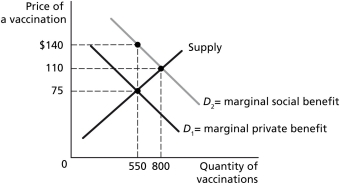 Figure 5-2 shows the effect of a positive externality on the market for vaccinations.
-Refer to Figure 5-2 On the above graph,identify the market equilibrium price and quantity,the efficient equilibrium price and quantity,and the value of the deadweight loss resulting from too few people receiving vaccinations.
Figure 5-2 shows the effect of a positive externality on the market for vaccinations.
-Refer to Figure 5-2 On the above graph,identify the market equilibrium price and quantity,the efficient equilibrium price and quantity,and the value of the deadweight loss resulting from too few people receiving vaccinations. (Essay)
4.9/5 (65)
(65) Briefly describe the types of health care systems in Canada,Japan,and the United Kingdom.
(Essay)
4.7/5 (95)
(95) Compared to the United States,health care spending per person in other high-income countries has been
(Multiple Choice)
4.8/5 (87)
(87) Two consequences of asymmetric information are adverse selection and moral hazard.An important distinction between the two is
(Multiple Choice)
4.8/5 (71)
(71) The situation in which one party to a transaction takes advantage of knowing more than the other party to the transaction is known as adverse selection.
(True/False)
4.9/5 (73)
(73) Some economists have argued that certain characteristics of the delivery of health care justify government intervention.One of these characteristics is
(Multiple Choice)
4.9/5 (87)
(87) "Cost disease" refers to the tendency for high productivity in the service sector to lead to lower costs in those industries.
(True/False)
4.8/5 (90)
(90) The largest government-run health care system in the world,with 1.7 million employees,is the National Health Service (NHS)in the United Kingdom.The NHS receives its funding primarily from
(Multiple Choice)
4.9/5 (75)
(75) 
Filters
- Essay(0)
- Multiple Choice(0)
- Short Answer(0)
- True False(0)
- Matching(0)