



 Chat with AI
Exam 5: The Economics of Health Care

Exam 1: Economics: Foundations and Models211 Questions
Exam 2: Trade-Offs,comparative Advantage,and the Market System239 Questions
Exam 3: Where Prices Come From: the Interaction of Demand and Supply233 Questions
Exam 4: Economic Efficiency, government Price Setting, and Taxes211 Questions
Exam 5: The Economics of Health Care164 Questions
Exam 6: Firms,the Stock Market,and Corporate Governance276 Questions
Exam 7: Comparative Advantage and the Gains From International Trade190 Questions
Exam 8: GDP: Measuring Total Production and Income266 Questions
Exam 9: Unemployment and Inflation292 Questions
Exam 10: Economic Growth, the Financial System, and Business Cycles257 Questions
Exam 11: Long-Run Economic Growth: Sources and Policies268 Questions
Exam 12: Aggregate Expenditure and Output in the Short Run306 Questions
Exam 13: Aggregate Demand and Aggregate Supply Analysis284 Questions
Exam 14: Money, banks, and the Federal Reserve System280 Questions
Exam 15: Monetary Policy277 Questions
Exam 16: Fiscal Policy303 Questions
Exam 17: Inflation, unemployment, and Federal Reserve Policy257 Questions
Exam 18: Macroeconomics in an Open Economy278 Questions
Exam 19: The International Financial System262 Questions
Select questions type


Figure 5-1 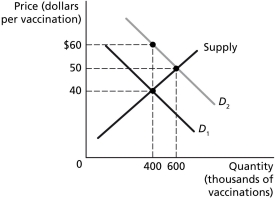 Figure 5-1 represents the market for vaccinations.Vaccinations are considered a benefit to society,and the figure shows both the marginal private benefit and the marginal social benefit from vaccinations.
-Refer to Figure 5-1.The market equilibrium price is
Figure 5-1 represents the market for vaccinations.Vaccinations are considered a benefit to society,and the figure shows both the marginal private benefit and the marginal social benefit from vaccinations.
-Refer to Figure 5-1.The market equilibrium price is (Multiple Choice)
4.9/5  (82)
(82) The Congressional Budget Office estimates that ________ of the increase in federal spending on Medicare and Medicaid over the next 75 years will be due to increases in the cost of providing health care.
(Multiple Choice)
4.9/5 (70)
(70) Pricing insurance policies is made difficult because buyers have more information than sellers.This difficulty is an example of
(Multiple Choice)
4.9/5 (85)
(85) The Congressional Budget Office estimates that ________ account(s)for less than 1 percent of health care costs in the United States.
(Multiple Choice)
4.8/5 (79)
(79) If consumers paid the full price of medical services instead of using health insurance and third-party payers to cover part of the cost,the quantity of medical services provided would decrease.
(True/False)
4.9/5 (93)
(93) The overall mortality rate in the United States has declined for the past 30 years.
(True/False)
4.7/5 (74)
(74) The Congressional Budget Office estimates that the additional taxes and fees enacted under the ACA will not even cover half of the true cost of the ACA.
(True/False)
4.9/5 (69)
(69) in the United States since 1900,life expectancy at birth has ________ and the death rate has ________.
(Multiple Choice)
5.0/5 (83)
(83) Figure 5-3 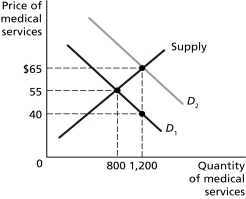 Figure 5-3 represents the market for medical services with and without insurance,and the effect of a third-party payer system on the demand for medical services.
-Refer to Figure 5-3.The efficient price of medical services is
Figure 5-3 represents the market for medical services with and without insurance,and the effect of a third-party payer system on the demand for medical services.
-Refer to Figure 5-3.The efficient price of medical services is (Multiple Choice)
4.9/5 (96)
(96) Which of the following is not part of the "taxes" provision of the Patient Protection and Affordable Care Act (ACA)?
(Multiple Choice)
4.9/5 (91)
(91) ________ account(s)for between 1 and 4 percent of health care costs in the United States.
(Multiple Choice)
4.8/5 (85)
(85) The provision of the Patient Protection and Affordable Care Act (ACA)Insurance companies are required to participate in a high-risk pool that will insure individuals with pre-existing medical conditions who have been unable to buy health insurance for at least six months is the ________ provision.
(Multiple Choice)
4.7/5 (84)
(84) What are two reasons why employees would prefer for their employer pay for their health insurance rather than receiving increased wages and paying for their own health insurance?
(Essay)
4.8/5 (87)
(87) In a market with positive externalities,the market equilibrium price will be greater than the efficient equilibrium price.
(True/False)
4.9/5 (66)
(66) If a hospital knows that an insurance company will pay for most of a patient's bill,the hospital has more of an incentive to require additional medical procedures and tests,even if the patient may not require them.This is an example of
(Multiple Choice)
4.7/5 (87)
(87) Economists refer to the actions people take after they have entered into a transaction that makes the other party to the transaction worse off as
(Multiple Choice)
4.9/5 (78)
(78) Health insurance plans which typically reimburse doctors and hospitals with payment for each service they provide are known as
(Multiple Choice)
4.9/5 (75)
(75) On average,people in low-income countries ________ than people in high-income countries.
(Multiple Choice)
4.7/5 (79)
(79) Why is the study of asymmetric information associated with the market for "lemons"?
(Multiple Choice)
4.9/5 (54)
(54) Changes in the health of the average person are relatively unimportant as an indicator of changes in the standard of living.
(True/False)
4.8/5 (87)
(87) 
Filters
- Essay(0)
- Multiple Choice(0)
- Short Answer(0)
- True False(0)
- Matching(0)