



 Chat with AI
Exam 5: The Economics of Health Care

Exam 1: Economics: Foundations and Models211 Questions
Exam 2: Trade-Offs,comparative Advantage,and the Market System239 Questions
Exam 3: Where Prices Come From: the Interaction of Demand and Supply233 Questions
Exam 4: Economic Efficiency, government Price Setting, and Taxes211 Questions
Exam 5: The Economics of Health Care164 Questions
Exam 6: Firms,the Stock Market,and Corporate Governance276 Questions
Exam 7: Comparative Advantage and the Gains From International Trade190 Questions
Exam 8: GDP: Measuring Total Production and Income266 Questions
Exam 9: Unemployment and Inflation292 Questions
Exam 10: Economic Growth, the Financial System, and Business Cycles257 Questions
Exam 11: Long-Run Economic Growth: Sources and Policies268 Questions
Exam 12: Aggregate Expenditure and Output in the Short Run306 Questions
Exam 13: Aggregate Demand and Aggregate Supply Analysis284 Questions
Exam 14: Money, banks, and the Federal Reserve System280 Questions
Exam 15: Monetary Policy277 Questions
Exam 16: Fiscal Policy303 Questions
Exam 17: Inflation, unemployment, and Federal Reserve Policy257 Questions
Exam 18: Macroeconomics in an Open Economy278 Questions
Exam 19: The International Financial System262 Questions
Select questions type


Insurance companies use deductibles and coinsurance to reduce moral hazard.
(True/False)
5.0/5  (90)
(90) In the United States in 2011,over 50 percent of people without health insurance were below the age of 34.
(True/False)
4.7/5 (73)
(73) In 2014,the average life expectancy at birth in the United Kingdom and other high-income countries was around ________ years.
(Multiple Choice)
5.0/5 (88)
(88) Under current U.S.tax laws individuals do not pay taxes on health insurance benefits they receive from their employers.
(True/False)
4.9/5 (79)
(79) Which of the following did not contributed to the overall decline in death rates in the United States since 1981?
(Multiple Choice)
4.8/5 (70)
(70) The health care system in ________ is referred to as a universal health insurance system,under which every resident is required to enroll in either a private or the government-provided health insurance program.
(Multiple Choice)
4.8/5 (81)
(81) In the United States in 2012,the percentage of firms that employed between 3 and 199 workers and did not offer health insurance as a fringe benefit to the workers was about
(Multiple Choice)
4.8/5 (79)
(79) College education tends to result in a positive externality because the recipient receives the full benefit of the education.
(True/False)
4.9/5 (72)
(72) Replacing employment-based health care with a government-run system could reduce employers payments for their workers insurance,but the amount that they would have to pay in overall compensation
(Multiple Choice)
4.8/5 (77)
(77) Figure 5-1 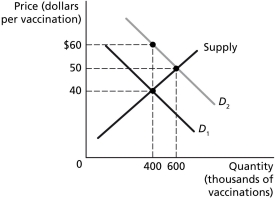 Figure 5-1 represents the market for vaccinations.Vaccinations are considered a benefit to society,and the figure shows both the marginal private benefit and the marginal social benefit from vaccinations.
-Refer to Figure 5-1.Marginal social benefit is represented by which curve?
Figure 5-1 represents the market for vaccinations.Vaccinations are considered a benefit to society,and the figure shows both the marginal private benefit and the marginal social benefit from vaccinations.
-Refer to Figure 5-1.Marginal social benefit is represented by which curve? (Multiple Choice)
4.8/5 (88)
(88) All of the following are ways in which health insurance companies can potentially reduce adverse selection except
(Multiple Choice)
4.9/5 (82)
(82) Under the Patient Protection and Affordable Care Act (ACA),every company with more than 200 employees must offer health insurance to its employees and must automatically enroll them in the plan.
(True/False)
4.7/5 (78)
(78) One consequence of adverse selection in the market for used cars is that most used cars sold will be lemons.
(True/False)
4.9/5 (91)
(91) How might a company that offers to handle all paperwork involved with a health insurance claim for a flat fee face the problem of adverse selection?
(Essay)
4.9/5 (65)
(65) In most circumstances,employees pay taxes on the value of health insurance their employers provide them.
(True/False)
4.8/5 (77)
(77) Adverse selection is a situation in which one party to an economic transaction has less information than the other party.
(True/False)
4.7/5 (81)
(81) Figure 5-1 Figure 5-1 represents the market for vaccinations.Vaccinations are considered a benefit to society,and the figure shows both the marginal private benefit and the marginal social benefit from vaccinations.
-Refer to Figure 5-1.At the market equilibrium,
Figure 5-1 represents the market for vaccinations.Vaccinations are considered a benefit to society,and the figure shows both the marginal private benefit and the marginal social benefit from vaccinations.
-Refer to Figure 5-1.At the market equilibrium, (Multiple Choice)
4.8/5 (65)
(65) Explain why the rates of death due to kidney disease and diabetes has slightly increased in the United States since 1981.
(Essay)
4.7/5 (69)
(69) Figure 5-1 Figure 5-1 represents the market for vaccinations.Vaccinations are considered a benefit to society,and the figure shows both the marginal private benefit and the marginal social benefit from vaccinations.
-Refer to Figure 5-1.Marginal private benefit is represented by which curve?
Figure 5-1 represents the market for vaccinations.Vaccinations are considered a benefit to society,and the figure shows both the marginal private benefit and the marginal social benefit from vaccinations.
-Refer to Figure 5-1.Marginal private benefit is represented by which curve? (Multiple Choice)
4.9/5 (83)
(83) 
Filters
- Essay(0)
- Multiple Choice(0)
- Short Answer(0)
- True False(0)
- Matching(0)