



 Chat with AI
Exam 6: Capital Investment Decisions

Exam 1: Introduction to Management Accounting78 Questions
Exam 2: An Introduction to Cost Terms and Concepts79 Questions
Exam 3: Cost-Volume-Profit Analysis121 Questions
Exam 4: Measuring Relevant Costs and Revenues for Decision-Making82 Questions
Exam 5: Pricing Decisions and Profitability Analysis62 Questions
Exam 6: Capital Investment Decisions110 Questions
Exam 7: Cost Assignment81 Questions
Exam 8: Activity-Based Costing108 Questions
Exam 9: The Budgeting Process120 Questions
Exam 10: Management Control Systems83 Questions
Exam 11: Standard Costing and Variance Analysis95 Questions
Exam 12: Divisional Financial Performance Measurement86 Questions
Exam 13: Transfer Pricing in Divisionalized Companies63 Questions
Exam 14: Cost Management156 Questions
Exam 15: Strategic Performance Management49 Questions
Select questions type


If the annual cash flows are an annuity (equal each period), payback is calculated as
(Multiple Choice)
4.9/5  (86)
(86) Lewis Manufacturing Company is planning to invest in equipment costing £240,000. The estimated cash flows from this equipment are expected to be as follows: Assume that the cash inflows occur evenly over the year. The payback period for this investment is

(Multiple Choice)
4.9/5 (84)
(84) How is working capital needed in the operations of investments treated in discounted cash flow analysis?
(Multiple Choice)
4.9/5 (92)
(92) Projects that, if accepted, preclude the acceptance of competing projects are
(Multiple Choice)
4.8/5 (80)
(80) Figure 2
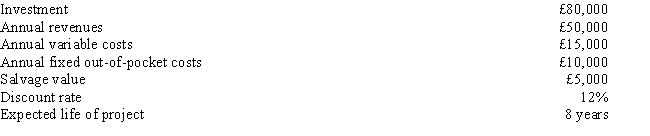 -Refer to Figure 2. The net present value of the project is
 (Multiple Choice)
4.8/5 (81)
(81) Why do the NPV method and the IRR method sometimes produce different rankings of mutually exclusive investment projects?
(Multiple Choice)
4.8/5 (85)
(85) Which of the following capital investment models would be preferred when choosing among mutually exclusive alternatives?
(Multiple Choice)
4.7/5 (96)
(96) Figure 6
JD, Inc., is considering the purchase of production equipment that costs £400,000. The equipment is expected to generate annual cash inflows of £125,000. The equipment is expected to have a useful life of five years with no salvage value. The firm's cost of capital is 12 percent.
-Refer to Figure 6. If depreciation is £90,000 per year, JD's accounting rate of return based on the average investment would be
(Multiple Choice)
4.8/5 (81)
(81) Figure 4
A capital investment project requires an investment of £60,000 and has an expected life of four years. Annual cash flows, which occur evenly throughout the year, are expected to be as follows:
 -Refer to Figure 4. Payback for the project is
 (Multiple Choice)
4.9/5 (72)
(72) Young Company has a tax rate of 40 percent. Information for the company is as follows: What is the weighted cost of capital?

(Multiple Choice)
4.8/5 (94)
(94) Tax savings from tax allowable depreciation (i.e. writing down allowances) is calculated as
(Multiple Choice)
4.9/5 (73)
(73) The present value of £2,000 to be received each year for three years and earning a 10 percent return is
(Multiple Choice)
4.8/5 (75)
(75) Projects that, if accepted or rejected, will not affect the cash flows of another project are
(Multiple Choice)
4.8/5 (78)
(78) 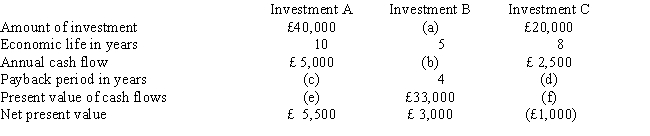
What types of non-quantitative factors can influence the final decision concerning approval of capital expenditures?
(Essay)
4.9/5 (79)
(79) A capital investment project requires an investment of £75,000 and has an expected life of four years. Annual cash flows at the end of each year are expected to be as follows:
Required:
 a.
Compute payback assuming that the cash flows occur evenly throughout the year.
b.
Compute the net present value of the project using a 12 percent discount rate.
a.
Compute payback assuming that the cash flows occur evenly throughout the year.
b.
Compute the net present value of the project using a 12 percent discount rate. (Essay)
4.9/5 (82)
(82) Describe capital investment in the advanced manufacturing environment.
(Essay)
4.9/5 (83)
(83) A _____ is a capital budgeting model that considers the time value of money when evaluating proposed projects.
(Multiple Choice)
4.8/5 (72)
(72) 
Filters
- Essay(0)
- Multiple Choice(0)
- Short Answer(0)
- True False(0)
- Matching(0)