



 Chat with AI
Exam 5: Pricing Decisions and Profitability Analysis

Exam 1: Introduction to Management Accounting78 Questions
Exam 2: An Introduction to Cost Terms and Concepts79 Questions
Exam 3: Cost-Volume-Profit Analysis121 Questions
Exam 4: Measuring Relevant Costs and Revenues for Decision-Making82 Questions
Exam 5: Pricing Decisions and Profitability Analysis62 Questions
Exam 6: Capital Investment Decisions110 Questions
Exam 7: Cost Assignment81 Questions
Exam 8: Activity-Based Costing108 Questions
Exam 9: The Budgeting Process120 Questions
Exam 10: Management Control Systems83 Questions
Exam 11: Standard Costing and Variance Analysis95 Questions
Exam 12: Divisional Financial Performance Measurement86 Questions
Exam 13: Transfer Pricing in Divisionalized Companies63 Questions
Exam 14: Cost Management156 Questions
Exam 15: Strategic Performance Management49 Questions
Select questions type


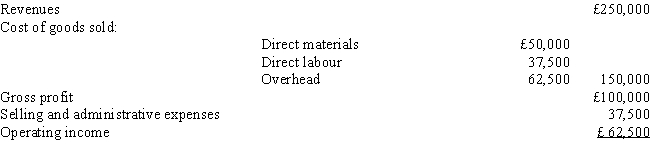
Jamie Ltd. had the following information: What is the markup based on materials?
(Multiple Choice)
4.7/5  (84)
(84) Foley Ltd. has predicted the following costs for this year for 100,000 units:
Required:
 a.
What is the markup on variable costs needed to achieve a target profit of £200,000?
b.
What is the initial unit selling price needed to obtain a target profit of £200,000 using the variable cost markup method?
c.
What is the manufacturing cost markup needed to obtain a target profit of £200,000?

a.
What is the markup on variable costs needed to achieve a target profit of £200,000?
b.
What is the initial unit selling price needed to obtain a target profit of £200,000 using the variable cost markup method?
c.
What is the manufacturing cost markup needed to obtain a target profit of £200,000?
(Essay)
4.8/5 (85)
(85) Which of the following statements concerning target costing is NOT true?
(Multiple Choice)
4.8/5 (94)
(94) Which of the following statements is TRUE about the equilibrium price, P, and equilibrium quantity, Q?
(Multiple Choice)
4.9/5 (84)
(84) Which of the following correctly describes the slope of the demand and supply curves? 
(Multiple Choice)
4.8/5 (84)
(84) Anderson Company manufactures a variety of toys and games. John Boone, president, is disappointed in the sales of a new board game. The game sold only 10,000 units in 2004 when 30,000 were projected. Sales for 2005 look no better. At £100 per game, it is not a hot seller. Direct costs of the board game are £56 variable cost and £100,000 fixed. John is considering several options. Option One: Cut the price to £70 and perhaps sell 15,000 units. Option Two: Cut the price to £60, reduce material costs by £10, and cut advertising by £60,000. Anticipated volume for this option is 10,000 units. Option Three: Cut the price to £80 and include a £10 mail-in rebate offer. It is anticipated that 15,000 units could be sold and only 30 percent of the rebate coupons would be redeemed. What is the profit (loss) from Option One?
(Multiple Choice)
4.9/5 (86)
(86) . Figure 1
Ander Company produces precision equipment for major buyers. Of the six customers, one accounts for 40 percent of the sales, with the remaining five accounting for the rest of the sales. The five smaller customers purchase equipment in roughly equal quantities. Orders placed by the smaller customers are about the same size. Data concerning Ander's customer activity follow:
Order-filling costs for Ander Company total £360,000, and sales-force costs are £375,000.
-Refer to Figure 1 above, what amount of order-filling costs would be allocated to the five smaller customers if these costs are allocated using an activity-based costing approach?
(Multiple Choice)
4.7/5 (84)
(84) Which of the following markets is characterized by the following: many buyers and sellers, a homogeneous product, easy entry into and exit from the industry, and all firms are price takers?
(Multiple Choice)
4.8/5 (89)
(89) Johnson Company produces office equipment for 16 major buyers. Of the 16 customers, one accounts for 50 percent of the sales, with the remaining 15 accounting for the rest of the sales. The 15 smaller customers purchase equipment in roughly equal quantities. Orders placed by the smaller customers are about the same size. Data concerning Johnson's customer activity follow:
Order-filling costs for Johnson Company total £270,000, and sales-force costs are £300,000.
Required:
 a.
Determine the amount of selling costs (order-filling and sales-force costs) allocated to (1) the large customer and (2) the 15 smaller customers if these costs are allocated based on sales volume.
b.
Determine the amount of selling costs (order-filling and sales-force costs) allocated to (1) the large customer and (2) the 15 smaller customers if these costs are assigned using activity-based costing.
c.
Comment on the differences in amounts attributed to the smaller customers in requirements a and b
a.
Determine the amount of selling costs (order-filling and sales-force costs) allocated to (1) the large customer and (2) the 15 smaller customers if these costs are allocated based on sales volume.
b.
Determine the amount of selling costs (order-filling and sales-force costs) allocated to (1) the large customer and (2) the 15 smaller customers if these costs are assigned using activity-based costing.
c.
Comment on the differences in amounts attributed to the smaller customers in requirements a and b (Essay)
4.8/5 (75)
(75) Common segment costs, when contrasted with direct segment costs, are
(Multiple Choice)
4.8/5 (81)
(81) Wurster Company sells a product for £400 per unit. Its market share is 20 percent of the units sold. The marketing manager believes that the market share can be increased to 28 percent of the units sold with a reduction in price to £360. The product is currently earning a profit of £62 per unit. The president of Wurster Company believes that his company needs to maintain the same profit level per unit. The total market for the product has annual sales of 5,000 units.
Required:
a.
How many units does Wurster Company currently sell of the product?
b.
What is the target price per unit?
c.
What is the target cost per unit?
(Essay)
4.9/5 (81)
(81) . Multiple Products Co.
Multiple Products Co. has predicted the following costs for this year for 100,000 units:
-Refer to Multiple Products Co. What is the manufacturing cost markup needed to obtain a target profit of £100,000?
(Multiple Choice)
4.7/5 (80)
(80) Bay Company produces boats for 11 major buyers. Of the 11 customers, one accounts for 45 percent of the sales, with the remaining ten accounting for the rest of the sales. The ten smaller customers purchase boats in roughly equal quantities. Orders placed by the smaller customers are about the same size. Data concerning Bay's customer activity follow:
Order-filling costs for Bay Company total £401,500, and sales-force costs are £260,000.
Required:
 a.
Determine the amount of selling costs (order-filling and sales-force costs) allocated to (1) the large customer and (2) the ten smaller customers if these costs are allocated based on sales volume.
b.
Determine the amount of selling costs (order-filling and sales-force costs) allocated to (1) the large customer and (2) the ten smaller customers if these costs are assigned using activity-based costing.
c.
Comment on the differences in amounts attributed to the smaller customers in requirements a and b
a.
Determine the amount of selling costs (order-filling and sales-force costs) allocated to (1) the large customer and (2) the ten smaller customers if these costs are allocated based on sales volume.
b.
Determine the amount of selling costs (order-filling and sales-force costs) allocated to (1) the large customer and (2) the ten smaller customers if these costs are assigned using activity-based costing.
c.
Comment on the differences in amounts attributed to the smaller customers in requirements a and b (Essay)
4.9/5 (77)
(77) _____ is the pricing of a new product at a low initial price to build market share quickly.
(Multiple Choice)
4.9/5 (86)
(86) Nordholm Construction Company builds houses. Each job requires a bid. Nordholm's bidding policy is to estimate the costs of materials, direct labour, and subcontractor's costs. These are totaled and a markup is applied to cover overhead and profit. In the coming year, Nordholm believes it will be the successful bidder on ten jobs with the following total revenues and costs:
The residual will cover overhead and profits.
Required:
 a.
What is the markup percentage on total direct costs?
b.
Suppose Nordholm is asked to bid on a job with estimated direct costs of £55,000. What is the bid? If the customer complains that the profit seems pretty high, how might Nordholm counter that?
a.
What is the markup percentage on total direct costs?
b.
Suppose Nordholm is asked to bid on a job with estimated direct costs of £55,000. What is the bid? If the customer complains that the profit seems pretty high, how might Nordholm counter that? (Essay)
4.8/5 (78)
(78) The following information pertains to three different products being sold by Leone Company:
Required:
 a.
Determine the price elasticity of demand for each of the products.
b.
Which products have an elastic demand? Inelastic demand?
a.
Determine the price elasticity of demand for each of the products.
b.
Which products have an elastic demand? Inelastic demand? (Essay)
4.9/5 (91)
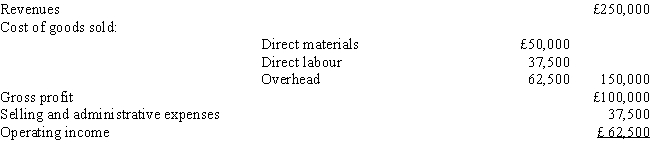
(91) Jamie Ltd. had the following information: What would be the price for something that has a cost of £500, assuming that the markup is based on cost of goods sold?
(Multiple Choice)
4.7/5 (66)
(66) World-class organizations operating in competitive markets are more likely to take which one of the following approaches toward pricing?
(Multiple Choice)
4.8/5 (81)
(81) 
Filters
- Essay(0)
- Multiple Choice(0)
- Short Answer(0)
- True False(0)
- Matching(0)