



 Chat with AI
Exam 4: Measuring Relevant Costs and Revenues for Decision-Making

Exam 1: Introduction to Management Accounting78 Questions
Exam 2: An Introduction to Cost Terms and Concepts79 Questions
Exam 3: Cost-Volume-Profit Analysis121 Questions
Exam 4: Measuring Relevant Costs and Revenues for Decision-Making82 Questions
Exam 5: Pricing Decisions and Profitability Analysis62 Questions
Exam 6: Capital Investment Decisions110 Questions
Exam 7: Cost Assignment81 Questions
Exam 8: Activity-Based Costing108 Questions
Exam 9: The Budgeting Process120 Questions
Exam 10: Management Control Systems83 Questions
Exam 11: Standard Costing and Variance Analysis95 Questions
Exam 12: Divisional Financial Performance Measurement86 Questions
Exam 13: Transfer Pricing in Divisionalized Companies63 Questions
Exam 14: Cost Management156 Questions
Exam 15: Strategic Performance Management49 Questions
Select questions type


The following information pertains to Ewing Company's three products: Assume that product F is discontinued and the space used to produce product F is rented for £600 per month. Monthly profits will

(Multiple Choice)
4.9/5  (86)
(86) Vest Industries manufactures 40,000 components per year. The manufacturing cost of the components was determined as follows: An outside supplier has offered to sell the component for £12.75.
What is the effect on income if Vest Industries purchases the component from the outside supplier?

(Multiple Choice)
4.8/5 (89)
(89) For a cost or revenue to be relevant to a particular decision, the cost or revenue must
(Multiple Choice)
4.7/5 (73)
(73) Meco Company produces a product that has a regular selling price of £360 per unit. At a typical monthly production volume of 2,000 units, the product's average unit cost of goods sold amounts to £270. Included in this average is £120,000 of fixed manufacturing costs. All selling and administrative costs are fixed and amount to £30,000 per month. Meco Company has just received a special order for 1,000 units at £240 per unit. The buyer will pay transportation, and the regular selling price will not be affected if Meco accepts the order.
Assuming Meco Company is operating at capacity and accepting the order would require an offsetting reduction in regular sales, the effect on profits of accepting the order would be a
(Multiple Choice)
4.9/5 (76)
(76) Terrazo Ltd. produces three kinds of ceramic tile that are used in home and office construction. Details of each type of tile are as follows:
Terrazo has 30,000 machine hours available for production.
Required:
Assume that Terrazo can sell all of each type of tile that it produces.
 a. Determine the amount of each type of tile that Terrazo should produce.
b. Determine Terrazo's contribution margin using your decision in requirement a.
c. Assume that the demand for each type of tile is limited to 20,000 units each. Determine the amount of each type of tile that Terrazo should produce.
d. Determine Terrazo's contribution margin using your decision in requirement b.
a. Determine the amount of each type of tile that Terrazo should produce.
b. Determine Terrazo's contribution margin using your decision in requirement a.
c. Assume that the demand for each type of tile is limited to 20,000 units each. Determine the amount of each type of tile that Terrazo should produce.
d. Determine Terrazo's contribution margin using your decision in requirement b. (Essay)
4.9/5 (83)
(83) The Dot Company manufactures two products: X and Y. The contribution margin per unit is determined as follows: Total demand for Product X is 16,000 units and for Product Y is 8,000 units. Machine hours is a scarce resource. During the year, 42,000 machine hours are available. Product X requires 6 machine hours per unit, while Product Y requires 3 machine hours per unit.
How many units of Products X and Y should Dot Company produce?


(Multiple Choice)
4.8/5 (81)
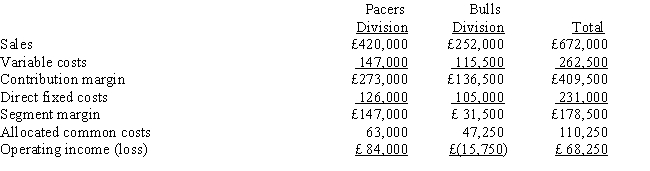
(81) The operations of Knickers Ltd. are divided into the Pacers Division and the Bulls Division. Projections for the next year are as follows: Operating income for Knickers Ltd. as a whole if the Bulls Division were dropped would be
(Multiple Choice)
4.8/5 (71)
(71) KnitWorks Ltd. produces three kinds of yarn. Details of each type of yarn are as follows:
KnitWorks has 15,000 machine hours available for production.
Required:
Assume that KnitWorks can sell all of each type of yarn that it produces.
 a.
Determine the amount of each type of yarn that KnitWorks should produce.
b.
Assume that the demand for each type of yarn is limited to 10,000 units each. Determine the amount of each type of yarn that KnitWorks should produce.
c.
Assume that the demand for each type of yarn is limited to 10,000 units each. Determine KnitWorks' contribution margin.
a.
Determine the amount of each type of yarn that KnitWorks should produce.
b.
Assume that the demand for each type of yarn is limited to 10,000 units each. Determine the amount of each type of yarn that KnitWorks should produce.
c.
Assume that the demand for each type of yarn is limited to 10,000 units each. Determine KnitWorks' contribution margin. (Essay)
4.8/5 (82)
(82) If a firm is at full capacity, the minimum special order price must cover
(Multiple Choice)
4.8/5 (84)
(84) Reggie Ltd. manufactures a single product with the following unit costs for 1,000 units: Recently, a company approached Reggie Ltd. about buying 100 units for £5,100 each. Currently, the models are sold to dealers for £7,800. Reggie Ltd.'s capacity is sufficient to produce the extra 100 units. No additional selling expenses would be incurred on the special order.
How much will income change if the special order is accepted?

(Multiple Choice)
4.9/5 (89)
(89) Which of the following is a qualitative factor that should be considered when evaluating a make-or-buy decision?
(Multiple Choice)
4.9/5 (74)
(74) The following information relates to a product produced by Creamer Company: Fixed selling costs are £500,000 per year, and variable selling costs are £12 per unit sold. Although production capacity is 600,000 units per year, the company expects to produce only 400,000 units next year. The product normally sells for £120 each. A customer has offered to buy 60,000 units for £90 each.
If the firm produces the special order, the effect on income would be a

(Multiple Choice)
4.8/5 (81)
(81) A decision to make or eliminate an unprofitable product is a
(Multiple Choice)
4.7/5 (82)
(82) Which of the following costs is NOT relevant for special decisions?
(Multiple Choice)
4.7/5 (76)
(76) Houston Ltd. manufacturers a part for its production cycle. The costs per unit for 5,000 units of this part are as follows: Johnson Company has offered to sell Houston Ltd. 5,000 units of the part for £112 per unit. If Houston Ltd. accepts Johnson Company's offer, total fixed costs will be reduced to £60,000. What alternative is more desirable and by what amount is it more desirable?


(Multiple Choice)
4.8/5 (86)
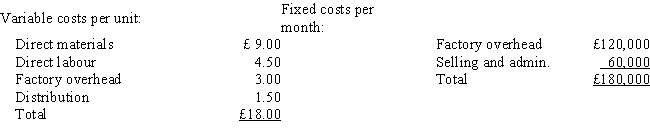
(86) Miller Company produces speakers for home stereo units. The speakers are sold to retail stores for £30. Manufacturing and other costs are as follows: The variable distribution costs are for transportation to the retail stores. The current production and sales volume is 20,000 per year. Capacity is 25,000 units per year.
A San Diego wholesaler has proposed to place a special one-time order of 10,000 units at a reduced price of £24 per unit. The wholesaler would pay all distribution costs, but there would be additional fixed selling and administrative costs of £3,000. All other information remains the same as the original data. What is the effect on profits if the special order is accepted?
(Multiple Choice)
4.9/5 (77)
(77) Meco Company produces a product that has a regular selling price of £360 per unit. At a typical monthly production volume of 2,000 units, the product's average unit cost of goods sold amounts to £270. Included in this average is £120,000 of fixed manufacturing costs. All selling and administrative costs are fixed and amount to £30,000 per month. Meco Company has just received a special order for 1,000 units at £240 per unit. The buyer will pay transportation, and the regular selling price will not be affected if Meco accepts the order.
Assuming Meco Company has excess capacity, the effect on profits of
Accepting the order would be
(Multiple Choice)
4.9/5 (80)
(80) Majestic Company manufactures a product that has the following unit costs: direct materials, £5; direct labour, £7; variable overhead, £3; and fixed overhead, £5. Fixed selling costs are £200,000 per year. Variable selling costs of £1 per unit cover the transportation cost. Although production capacity is 80,000 units per year, the company expects to produce only 65,000 units next year. The product normally sells for £30 each. A customer has offered to buy 10,000 units for £18 each. The customer will pay the transportation charge on the units purchased.
Required:
a.
What is the incremental cost per unit to Majestic Company for the special order?
b.
What is the effect on Majestic's income if the special order is accepted?
(Essay)
5.0/5 (85)
(85) Reggie Ltd. manufactures a single product with the following unit costs for 1,000 units: Recently, a company approached Reggie Ltd. about buying 100 units for £5,100 each. Currently, the models are sold to dealers for £7,800.
Assume there is additional capacity for 60 more units and the firm has to reduce regular customer sales by 40 units in order to contract the special order. There are selling expenses on only the sales to the regular customers. What is the net income if the special order of 100 units is accepted?

(Multiple Choice)
4.8/5 (75)
(75) 
Filters
- Essay(0)
- Multiple Choice(0)
- Short Answer(0)
- True False(0)
- Matching(0)