



 Chat with AI
Exam 3: Cost-Volume-Profit Analysis

Exam 1: Introduction to Management Accounting78 Questions
Exam 2: An Introduction to Cost Terms and Concepts79 Questions
Exam 3: Cost-Volume-Profit Analysis121 Questions
Exam 4: Measuring Relevant Costs and Revenues for Decision-Making82 Questions
Exam 5: Pricing Decisions and Profitability Analysis62 Questions
Exam 6: Capital Investment Decisions110 Questions
Exam 7: Cost Assignment81 Questions
Exam 8: Activity-Based Costing108 Questions
Exam 9: The Budgeting Process120 Questions
Exam 10: Management Control Systems83 Questions
Exam 11: Standard Costing and Variance Analysis95 Questions
Exam 12: Divisional Financial Performance Measurement86 Questions
Exam 13: Transfer Pricing in Divisionalized Companies63 Questions
Exam 14: Cost Management156 Questions
Exam 15: Strategic Performance Management49 Questions
Select questions type


In the formula, Total cost = Fixed cost + (Variable rate x Output), variable cost refers to the
(Multiple Choice)
4.8/5  (66)
(66) Product 1 has a contribution margin of £6.00 per unit, and Product 2 has a contribution margin of £7.50 per unit. Total fixed costs are £300,000. Sales mix and total volume varies from one period to another. Which of the following is TRUE?
(Multiple Choice)
4.8/5 (82)
(82) In a cost-volume-profit graph, the slope of the total cost line represents
(Multiple Choice)
4.8/5 (86)
(86) Boss Company currently leases a delivery van from Check Enterprises for a fee of £250 per month plus £0.40 per mile. Management is evaluating the desirability of switching to a modern, fuel-efficient van, which can be leased from David, SA., for a fee of £600 per month plus £0.05 per mile. All operating costs and fuel are included in the rental fees. In general,
(Multiple Choice)
4.8/5 (73)
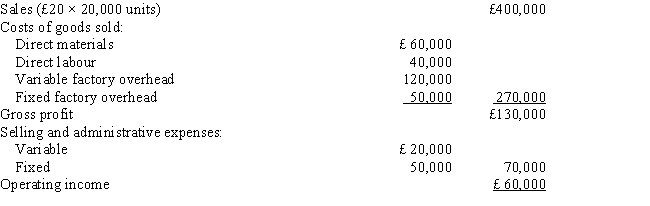
(73) The Waldo Company had the following functional income statement for the month of July 2004:
There were no beginning and ending inventories.
Required:
 a.
Calculate the contribution margin per unit.
b.
Calculate the contribution margin ratio.
c.
What is the break-even point in units?
d.
What is the monetary amount of sales in needed to obtain a before-tax profit of £40,000?
a.
Calculate the contribution margin per unit.
b.
Calculate the contribution margin ratio.
c.
What is the break-even point in units?
d.
What is the monetary amount of sales in needed to obtain a before-tax profit of £40,000? (Essay)
5.0/5 (65)
(65) Which of the following assumptions is NOT necessary for cost-volume-profit analysis?
(Multiple Choice)
4.9/5 (80)
(80) Assuming all other things are the same, contribution margin per unit must have _____ if there was an increase in the break-even point.
(Multiple Choice)
4.9/5 (95)
(95) Dirth Company sells only one product at a regular price of £7.50 per unit. Variable expenses are 60 percent of sales and fixed expenses are £30,000. Management has decided to decrease the selling price to £6.00 in hopes of increasing its volume of sales. What is the new break-even point in units for Dirth Company when the selling price is £6.00?
(Multiple Choice)
5.0/5 (79)
(79) Zachary Plumbing Company has the following information for 2004:
Required:
Prepare a profit-volume graph identifying the following items:
 a.
Profit line
b.
Intersection of profit line and vertical axis
c.
Break-even point
d.
Profit area
e.
Loss area
a.
Profit line
b.
Intersection of profit line and vertical axis
c.
Break-even point
d.
Profit area
e.
Loss area (Essay)
4.8/5 (55)
(55) Using cost-volume-profit analysis, we can conclude that a 20 percent reduction in variable costs will
(Multiple Choice)
4.8/5 (82)
(82) Arnold Ltd.has the following information for 2001:
Required:
Prepare a cost-volume-profit graph identifying the following items:
 a. Total costs line
b. Total fixed costs line
c. Total variable costs line
d. Total revenues line
e. Break-even point in monetary sales
f. Break-even point in units
g. Profit area
h. Loss area
a. Total costs line
b. Total fixed costs line
c. Total variable costs line
d. Total revenues line
e. Break-even point in monetary sales
f. Break-even point in units
g. Profit area
h. Loss area (Essay)
4.8/5 (72)
(72) Urban Company had the following information: What is the break-even point in units using ABC?

(Multiple Choice)
4.9/5 (90)
(90) Lewis Production Company had the following projected information for 2004: What is the profit when one unit more than the break-even point is sold?

(Multiple Choice)
4.8/5 (73)
(73) In a cost-volume-profit graph, the slope of the total revenue line represents
(Multiple Choice)
4.9/5 (80)
(80) When the volume of activity increases within the relevant range, the fixed cost per unit
(Multiple Choice)
4.8/5 (70)
(70) Assume the following cost behaviour data for Portrait Company: What volume of monetary sales is required to earn a before-tax income of £27,000?

(Multiple Choice)
4.8/5 (85)
(85) Which of the following assumptions does NOT pertain to cost-volume-profit analysis?
(Multiple Choice)
4.9/5 (89)
(89) 
Filters
- Essay(0)
- Multiple Choice(0)
- Short Answer(0)
- True False(0)
- Matching(0)