



 Chat with AI
Exam 15: Cost Allocation: Joint Products and Byproducts

Exam 1: The Accountants Vital Role in Decision Making141 Questions
Exam 2: An Introduction to Cost Terms and Purposes171 Questions
Exam 3: Cost-Volume-Profit Analysis156 Questions
Exam 4: Job Costing145 Questions
Exam 5: Activity-Based Costing and Management144 Questions
Exam 6: Master Budget and Responsibility Accounting170 Questions
Exam 7: Flexible Budgets,variances,and Management Control: I172 Questions
Exam 8: Flexible Budgets,variances,and Management Control: II148 Questions
Exam 9: Income Effects of Denominator Level on Inventory Valuation171 Questions
Exam 10: Analysis of Cost Behaviour212 Questions
Exam 11: Decision Making and Relevant Information174 Questions
Exam 12: Pricing Decisions, product Profitability Decisions, and Cost Management150 Questions
Exam 13: Strategy,balanced Scorecard,and Profitability Analysis161 Questions
Exam 14: Period Cost Allocation163 Questions
Exam 15: Cost Allocation: Joint Products and Byproducts167 Questions
Exam 16: Revenue and Customer Profitability Analysis152 Questions
Exam 17: Process Costing147 Questions
Exam 18: Spoilage, rework, and Scrap137 Questions
Exam 19: Inventory Cost Management Strategies152 Questions
Exam 20: Capital Budgeting: Methods of Investment Analysis187 Questions
Exam 21: Transfer Pricing and Multinational Management Control Systems157 Questions
Exam 22: Multinational Performance Measurement and Compensation156 Questions
Select questions type


Use the information below to answer the following question(s):
Orange Paper Company processes wood pulp into two products.During February the joint costs of processing were $156,000.Production and sales value information for the month were as follows:
 Paper sells for $2.85 a kilogram and cardboard sells for $3.90 a kilogram.
There were no beginning inventories for April but ending inventories totalled 15,000 kilograms for paper and 18,000 kilograms for cardboard.
-How much of the Orange Paper Company joint costs should be allocated to the cardboard using the net realizable value method based on total production?
Paper sells for $2.85 a kilogram and cardboard sells for $3.90 a kilogram.
There were no beginning inventories for April but ending inventories totalled 15,000 kilograms for paper and 18,000 kilograms for cardboard.
-How much of the Orange Paper Company joint costs should be allocated to the cardboard using the net realizable value method based on total production? (Multiple Choice)
4.8/5  (74)
(74) Use the information below to answer the following question(s).
Chem Manufacturing Company processes direct materials up to the splitoff point,where two products (X and Y)are obtained and sold.The following information was collected for the month of November.
Direct materials processed:
10,000 litres (10,000 litres yield 9,500 litres of good product and 500 litres of shrinkage)
 The cost of purchasing 10,000 litres of direct materials and processing it up to the splitoff point to yield a total of 9,500 litres of good products was $975,000.
The beginning inventories totalled 50 litres for X and 25 litres for Y.Ending inventory amounts reflected 300 litres of product X and 525 litres of product Y.October costs were per unit were the same as November.
-What is product Y's approximate joint production cost if the sales value at splitoff point method is used?
The cost of purchasing 10,000 litres of direct materials and processing it up to the splitoff point to yield a total of 9,500 litres of good products was $975,000.
The beginning inventories totalled 50 litres for X and 25 litres for Y.Ending inventory amounts reflected 300 litres of product X and 525 litres of product Y.October costs were per unit were the same as November.
-What is product Y's approximate joint production cost if the sales value at splitoff point method is used? (Multiple Choice)
4.8/5 (64)
(64) Trundle Ltd.produces two main products,J and K;and,a byproduct,L.There were no beginning inventories.During April,it incurred $275,000 of joint costs,which are allocated to main products using the physical output method.Additional information follows:
 Required:
Assuming Trundle recognizes byproduct revenue at the time of sale,what is the total value of ending inventory?
Required:
Assuming Trundle recognizes byproduct revenue at the time of sale,what is the total value of ending inventory? (Essay)
4.9/5 (70)
(70) Use the information below to answer the following question(s).
Raynor Manufacturing purchases trees from Tree Nursery and processes them up to the splitoff point,where two products (paper and pencil casings)are obtained.The products are then sold to an independent company that markets and distributes them to retail outlets.The following information was collected for the month of October.
Trees processed:
50 trees (yield is 30,000 sheets of paper and 30,000 pencil casings and no scrap)
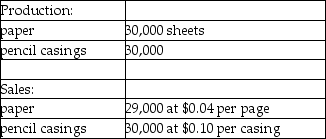 Cost of purchasing 50 trees and processing them up to the splitoff point to yield 30,000 sheets of paper and 30,000 pencil casings is $1,500.
Raynor Manufacturing's accounting department reported no beginning inventories;however,ending inventory amounts reflected 1,000 sheets of paper in stock.
-What are the pencil casings' sales value at the split-off point?
Cost of purchasing 50 trees and processing them up to the splitoff point to yield 30,000 sheets of paper and 30,000 pencil casings is $1,500.
Raynor Manufacturing's accounting department reported no beginning inventories;however,ending inventory amounts reflected 1,000 sheets of paper in stock.
-What are the pencil casings' sales value at the split-off point? (Multiple Choice)
4.9/5 (66)
(66) What are the four methods of allocating joint costs to individual products? Which of these methods is preferred,and what are two advantages of this method?
(Essay)
4.9/5 (72)
(72) Use the information below to answer the following question(s).
Raynor Manufacturing purchases trees from Tree Nursery and processes them up to the splitoff point,where two products (paper and pencil casings)are obtained.The products are then sold to an independent company that markets and distributes them to retail outlets.The following information was collected for the month of October.
Trees processed:
50 trees (yield is 30,000 sheets of paper and 30,000 pencil casings and no scrap)
Cost of purchasing 50 trees and processing them up to the splitoff point to yield 30,000 sheets of paper and 30,000 pencil casings is $1,500.
Raynor Manufacturing's accounting department reported no beginning inventories;however,ending inventory amounts reflected 1,000 sheets of paper in stock.
-What is the paper's sales value at the splitoff point?
Cost of purchasing 50 trees and processing them up to the splitoff point to yield 30,000 sheets of paper and 30,000 pencil casings is $1,500.
Raynor Manufacturing's accounting department reported no beginning inventories;however,ending inventory amounts reflected 1,000 sheets of paper in stock.
-What is the paper's sales value at the splitoff point? (Multiple Choice)
4.8/5 (81)
(81) 
Filters
- Essay(0)
- Multiple Choice(0)
- Short Answer(0)
- True False(0)
- Matching(0)